Archos has unveiled a new smartphone the Oxygen line, Archos 50d Oxygen. It will be presented during the Mobile World Congress 2016 which, remember, will be held February 22 to 25. The new French will be as usual a solution from the value targeted, with mid-range hardware, Android 5.1 Lollipop preinstalled with full access to Google Play Store and dual-SIM module device. The price? 179.99 USD.

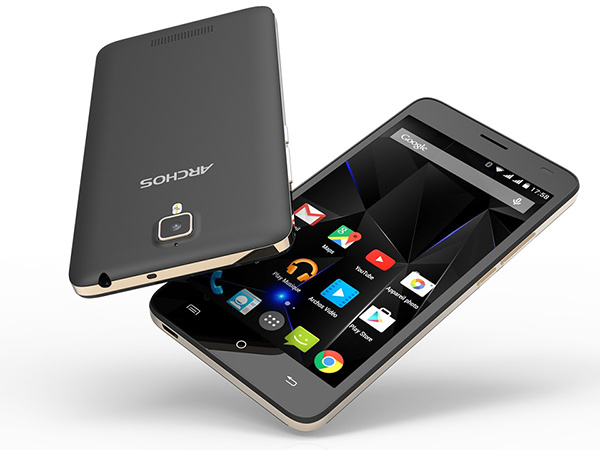
Archos 50d Oxygen is a low-budget smartphone features a 5-inch IPS LCD display with Full HD resolution. The company promises "deep blacks" by implementing a manufacturing technology called "Full Lamination". As for the design we find a gold metal frame and a rear polycarbonate shell, but it will be verified in the field in Barcelona the feeling that the solution will be able to express in normal use.
Hardware side we find a platform centered on a SoC MediaTek MT-6753, containing eight cores to 1.3 GHz Cortex-A53. The processor is supported by 2GB of DDR3 RAM and 16GB of ROM expandable up to 32GB via a microSD card. The new model is compatible with 4G LTE networks Cat. 4, then 150Mbps theoretical maximum download bandwidth, and can hold two SIM Dual Standby mode.
Photo on the front there are two distinct forms, as usual: the rear uses a 13-megapixel sensor with auto-focus and LED flash, and is capable of recording video at 1080p resolution. For selfies and video calls you will instead rely on a 5 megapixel module. Under the shell, thick 8.2mm, there is a removable battery 2.100mAh that considering the specifications of the device, it should offer a duration sufficient only on single charge.
Archos 50d Oxygen technical specifications
OS Android 5.1 Lollipop
LCD IPS display 5 "
Resolution 1920x1080 (440PPI)
MediaTek processor MT-6753 octa-core 1.3 GHz @
RAM 2 GB
Storage 16 GB expandable to 32 GB
Cameras 13 MP - 5 MP
802.11n Wi-Fi connectivity, Bluetooth 4.0, USB OTG
Battery 2100 mAh
Dimensions 141.4 x 70.8 x 8.2
Weight 140 g
Archos 50d Oxygen is a low-budget smartphone features a 5-inch IPS LCD display with Full HD resolution. The company promises "deep blacks" by implementing a manufacturing technology called "Full Lamination". As for the design we find a gold metal frame and a rear polycarbonate shell, but it will be verified in the field in Barcelona the feeling that the solution will be able to express in normal use.
Hardware side we find a platform centered on a SoC MediaTek MT-6753, containing eight cores to 1.3 GHz Cortex-A53. The processor is supported by 2GB of DDR3 RAM and 16GB of ROM expandable up to 32GB via a microSD card. The new model is compatible with 4G LTE networks Cat. 4, then 150Mbps theoretical maximum download bandwidth, and can hold two SIM Dual Standby mode.
Photo on the front there are two distinct forms, as usual: the rear uses a 13-megapixel sensor with auto-focus and LED flash, and is capable of recording video at 1080p resolution. For selfies and video calls you will instead rely on a 5 megapixel module. Under the shell, thick 8.2mm, there is a removable battery 2.100mAh that considering the specifications of the device, it should offer a duration sufficient only on single charge.
Archos 50d Oxygen technical specifications
OS Android 5.1 Lollipop
LCD IPS display 5 "
Resolution 1920x1080 (440PPI)
MediaTek processor MT-6753 octa-core 1.3 GHz @
RAM 2 GB
Storage 16 GB expandable to 32 GB
Cameras 13 MP - 5 MP
802.11n Wi-Fi connectivity, Bluetooth 4.0, USB OTG
Battery 2100 mAh
Dimensions 141.4 x 70.8 x 8.2
Weight 140 g
Comments
Post a Comment