Usually when someone in tech says the word “quantum,” I put my hands on my ears and sing until they go away. But while IBM’s “quantum computing safe tape drive” nearly drove me to song, when I thought about it, it actually made a lot of sense.
First of all, it’s a bit of a misleading lede. The tape is not resistant to quantum computing at all. The problem isn’t that qubits are going to escape their cryogenic prisons and go interfere with tape drives in the basement of some datacenter or HQ. The problem is what these quantum computers may be able to accomplish when they’re finally put to use.
Without going too deep down the quantum rabbit hole, it’s generally acknowledged that quantum computers and classical computers (like the one you’re using) are good at different things — to the point where in some cases, a problem that might take incalculable time on a traditional supercomputer could be done in a flash on quantum. Don’t ask me how — I said we’re not going down the hole!
One of the things quantum is potentially very good at is certain types of cryptography: It’s theorized that quantum computers could absolutely smash through many currently used encryption techniques. In the worst case scenario, that means that if someone got hold of a large cache of encrypted data that today would be useless without the key, a future adversary may be able to force the lock. Considering how many breaches there have been where the only reason your entire life wasn’t stolen was because it was encrypted, this is a serious threat.
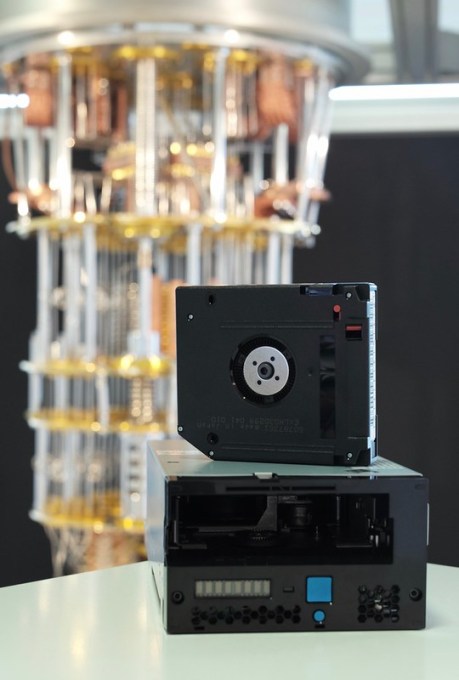 IBM and others are thinking ahead. Quantum computing isn’t a threat right now, right? It isn’t being seriously used by anyone, let alone hackers. But what if you buy a tape drive for long-term data storage today, and then a decade from now a hack hits and everything is exposed because it was using “industry standard” encryption?
To prevent that from happening, IBM is migrating its tape storage over to encryption algorithms that are resistant to state of the art quantum decryption techniques — specifically lattice cryptography (another rabbit hole — go ahead). Because these devices are meant to be used for decades if possible, during which time the entire computing landscape can change. It will be hard to predict exactly what quantum methods will emerge in the future, but at the very least you can try not to be among the low-hanging fruit favored by hackers.
The tape itself is just regular tape. In fact, the whole system is pretty much the same as you’d have bought a week ago. All the changes are in the firmware, meaning earlier drives can be retrofitted with this quantum-resistant tech.
Quantum computing may not be relevant to many applications today, but next year who knows? And in ten years, it might be commonplace. So it behooves companies like IBM, which plan to be part of the enterprise world for decades to come, to plan for it today.


from TechCrunch https://ift.tt/2NzEsus
via IFTTT
Comments
Post a Comment