
Google falls to third place in worldwide smart speaker market

The global smart speaker market grew 55.4% in the second quarter to reach 26.1 million shipments, according to a new report from Canalys. Amazon continued to lead the race, accounting for 6.6 million units shipped in the quarter. Google, however, fell to the third spot as China’s Baidu surged ahead. Baidu in Q2 grew a sizable 3,700% to reach 4.5 million units, overtaking Google’s 4.3 million units shipped.

China’s market overall doubled its quarterly shipments to 12.6 million units, or more than twice the U.S.’s 6.1 million total. The latter represents a slight (2.4%) decline since the prior quarter.

Baidu’s growth in the quarter was attributed to aggressive marketing and go-to-market campaigns. It was particularly successful in terms of smart displays, which accounted for 45% of the products it shipped.

“Local network operator’s interests on the [smart display] device category soared recently. This bodes well for Baidu as it faces little competition in the smart display category, allowing the company to dominate in the operator channel,” noted Canalys Research Analyst Cynthia Chen.

Meanwhile, Google was challenged by the Nest rebranding in Q2, the analyst firm said.

The report also suggested that Google should to introduce a revamped smart speaker portfolio to rekindle consumer interest. The Google Home device hasn’t been updated since launch — still sporting the air freshener-style looks it had back in 2016. And the Google Home mini hasn’t received much more than a color change.

Instead, Google’s attention as of late has been on making it easier for device manufacturers to integrate with Google Assistant technology, in addition to its increased focus on smart displays.

Amazon, by comparison, has updated its Echo line of speakers several times while expanding Alexa to devices with screens like the Echo Spot and Show, and to those without like the Echo Plus, Echo Dot, Echo Auto, and others — even clocks and microwaves, as sort of public experiments in voice computing.

That said, both Amazon and Google turned their attention to non-U.S. markets in Q2, the report found. 50% of Amazon’s smart speaker shipments were outside the U.S. in Q2, up from 32% in Q2 last year. And 55% of Google’s shipments were outside the U.S., up from 42% in Q2 2018.
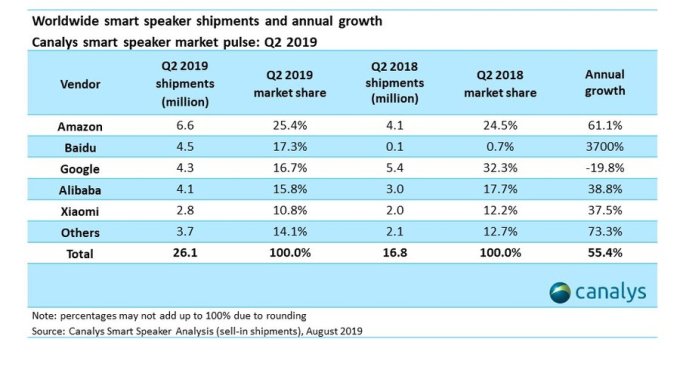
table ifnal final

Beyond the top 3 — Amazon, Baidu and now No. 3 Google — the remaining top 5 included Alibaba and Xiaomi, with 4.1 million and 2.8 million units shipped in Q2, respectively.

The rest of the market, which would also include Apple’s HomePod, totaled 3.7 million units.


from TechCrunch https://ift.tt/2HFJpyn
via IFTTT

Comments

Popular posts from this blog

The Silent Revolution of On-Device AI: Why the Cloud Is No Longer King

Introduction For years, artificial intelligence has meant one thing: the cloud. Whether you’re asking ChatGPT a question, editing a photo with AI tools, or getting recommendations on Netflix — those decisions happen on distant servers, not your device. But that’s changing. Thanks to major advances in silicon, model compression, and memory architecture, AI is quietly migrating from giant data centres to the palm of your hand. Your phone, your laptop, your smartwatch — all are becoming AI engines in their own right. It’s a shift that redefines not just how AI works, but who controls it, how private it is, and what it can do for you. This article explores the rise of on-device AI — how it works, why it matters, and why the cloud’s days as the centre of the AI universe might be numbered. What Is On-Device AI? On-device AI refers to machine learning models that run locally on your smartphone, tablet, laptop, or edge device — without needing constant access to the cloud. In practi...

Apple’s AI Push: Everything We Know About Apple Intelligence So Far

Apple’s WWDC 2025 confirmed what many suspected: Apple is finally making a serious leap into artificial intelligence. Dubbed “Apple Intelligence,” the suite of AI-powered tools, enhancements, and integrations marks the company’s biggest software evolution in a decade. But unlike competitors racing to plug AI into everything, Apple is taking a slower, more deliberate approach — one rooted in privacy, on-device processing, and ecosystem synergy. If you’re wondering what Apple Intelligence actually is, how it works, and what it means for your iPhone, iPad, or Mac, you’re in the right place. This article breaks it all down.   What Is Apple Intelligence? Let’s get the terminology clear first. Apple Intelligence isn’t a product — it’s a platform. It’s not just a chatbot. It’s a system-wide integration of generative AI, machine learning, and personal context awareness, embedded across Apple’s OS platforms. Think of it as a foundational AI layer stitched into iOS 18, iPadOS 18, and m...

Max Q: Anomalous

Hello and welcome back to Max Q! Last week wasn’t the most successful for spaceflight missions. We’ll get into that a bit more below. In this issue: First up, a botched launch from Virgin Orbit… …followed by one from ABL Space Systems News from Rocket Lab, World View and more Virgin Orbit’s botched launch highlights shaky financial future After Virgin Orbit’s launch failure last Monday, during which the mission experienced an  “anomaly” that prevented the rocket from reaching orbit, I went back over the company’s financials — and things aren’t looking good. For Virgin Orbit, this year has likely been completely turned on its head. The company was aiming for three launches this year, but everything will remain grounded until the cause of the anomaly has been identified and resolved. It’s unclear how long that will take, but likely at least three months. Add this delay to Virgin’s dwindling cash reserves and you have a foundation that’s suddenly much shakier than before. ...