
Maverick, a social network for young women, launches with $2.7M in funding

While Bumble BFF and Hey! Vina help adult women find new friends, there isn’t a social network dedicated to young women.

But Brooke Chaffin and Catherine Connors are looking to change that with the introduction of Maverick, a social network that connects young girls with female mentors to express their creativity in a safe space.

Here’s how it works:

When a new user signs up, they can browse through various challenges set forth by Catalysts, inspiring role models selected specifically by the founders to inspire the younger demographic on the network. These challenges include things like making their own super hero, creating their own dance number or choosing a mantra.

Users, usually between the ages of 10 and 20, can post their response to a challenge via photo or a 30-second video and browse the responses of others. Interestingly, Maverick has done away with ‘likes’ and instead offers points for various types of engagement, like posting a response to a challenge, posting a comment, or giving someone a badge.

For now, there are four badges on the platform (unique, creative, unstoppable, and daring) and the company has plans to add more badges as it grows.
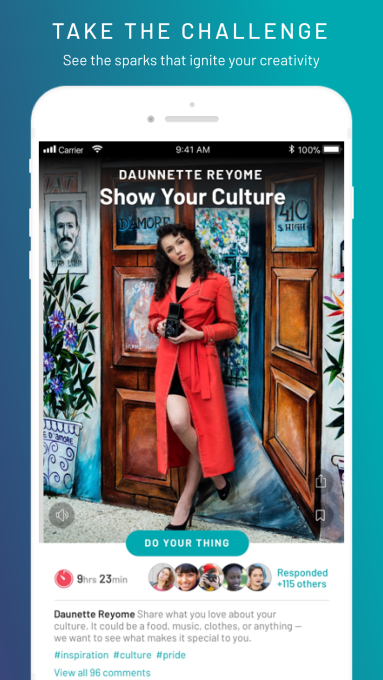
But Maverick isn’t just an app. The company also plans on holding a series of one-day live events across the country, highlighting young women emerging on the platform in categories like STEAM, entrepreneurship, comedy and music.

In fact, the first live event goes down tomorrow in Los Angeles, featuring “Founding Mavericks” or role models such as Chloe & Halle Baily, Brooklyn and Bailey McKnight, Daunnette Reyome, Laurie Hernandez and Ruby Karp.

For now, Maverick is a free app focused on growing its user base. But the founders see an opportunity to turn Maverick into a utility, not unlike LinkedIn, offering a subscription for premium features. And it makes sense that LinkedIn would serve as inspiration for Chaffin and Connors, as LinkedIn CEO Jeff Weiner is one of Maverick’s investors.

The company has raised $2.7 million in seed funding led by Matt Robinson of Heroic Ventures, with participatino from Susan Lyne and Nisha Dua of BBG Ventures as well as Jeff Weiner.

Here’s what co-founder and Chief Content Officer Catherine Connors had to say:

The research on girls’ social development has shown us the same thing for decades. During early adolescence, the majority of girls stop raising their hands, participating in sports and extra-curricular activities, taking risks, and stepping into leadership roles. In short, they stop believing in themselves. And it’s not because we don’t tell them that they should believe in themselves — it’s that they don’t get enough real opportunity to prove to themselves that they can.

Founders Chaffin and Connors met during their tenure at the Walt Disney Company and kept coming back to the idea of empowering girls through a new social network, and so Maverick was born.

The network is designed with a progression loop not unlike that of a game, where Mavericks can progress toward becoming a Catalyst and inspiring other young women.

The app launches out of beta today.


from TechCrunch https://ift.tt/2r4OdEi
via IFTTT

Comments

Popular posts from this blog

The Silent Revolution of On-Device AI: Why the Cloud Is No Longer King

Introduction For years, artificial intelligence has meant one thing: the cloud. Whether you’re asking ChatGPT a question, editing a photo with AI tools, or getting recommendations on Netflix — those decisions happen on distant servers, not your device. But that’s changing. Thanks to major advances in silicon, model compression, and memory architecture, AI is quietly migrating from giant data centres to the palm of your hand. Your phone, your laptop, your smartwatch — all are becoming AI engines in their own right. It’s a shift that redefines not just how AI works, but who controls it, how private it is, and what it can do for you. This article explores the rise of on-device AI — how it works, why it matters, and why the cloud’s days as the centre of the AI universe might be numbered. What Is On-Device AI? On-device AI refers to machine learning models that run locally on your smartphone, tablet, laptop, or edge device — without needing constant access to the cloud. In practi...

Apple’s AI Push: Everything We Know About Apple Intelligence So Far

Apple’s WWDC 2025 confirmed what many suspected: Apple is finally making a serious leap into artificial intelligence. Dubbed “Apple Intelligence,” the suite of AI-powered tools, enhancements, and integrations marks the company’s biggest software evolution in a decade. But unlike competitors racing to plug AI into everything, Apple is taking a slower, more deliberate approach — one rooted in privacy, on-device processing, and ecosystem synergy. If you’re wondering what Apple Intelligence actually is, how it works, and what it means for your iPhone, iPad, or Mac, you’re in the right place. This article breaks it all down.   What Is Apple Intelligence? Let’s get the terminology clear first. Apple Intelligence isn’t a product — it’s a platform. It’s not just a chatbot. It’s a system-wide integration of generative AI, machine learning, and personal context awareness, embedded across Apple’s OS platforms. Think of it as a foundational AI layer stitched into iOS 18, iPadOS 18, and m...

Billionaire clothing dynasty heiress launches Everybody & Everyone to make fashion sustainable

Veronica Chou’s family has made its fortune at the forefront of the fast fashion business through investments in companies like Michael Kors and Tommy Hilfiger . But now, the heiress to an estimated $2.1 billion fortune is launching her own company, Everybody & Everyone , to prove that the fashion industry can be both environmentally sustainable and profitable. There’s no argument about the negative impacts of the fashion industry on the environment. The textiles industry primarily uses non-renewable resources — on the order of 98 million tons per year. That includes the oil to make synthetic fibers, fertilizers to grow cotton, and toxic chemicals to dye, treat, and produce the textiles used to make clothes. The greenhouse gas footprint from textiles production was roughly 1.2 billion tons of CO2 equivalent in 2015 — more than all international flights and maritime shipments combined (and a lot of those maritime shipments and international flights were hauling clothes). The lit...