
Seinfeld: How Old Elaine Is At The Beginning & The End

The events of Seinfeld encompassed nine years of shenanigans for Jerry and his friends, including Elaine Benes (Julia Louis-Dreyfus), but how old was Elaine at the start and end of the hit series? As it was with the other three main characters, Elaine’s Seinfeld story explored a long list of failed romantic relationships, mishaps at work, and day-to-day, trivial conversations with her friends in Jerry’s apartment.


Seinfeld rarely noted the ages of these four characters, but based on their activities, pop culture references, and interactions in New York City, it was widely assumed that this was a group of thirty-somethings. Occasionally, there were lines in the show that seemingly confirmed their exact ages. For example, Jerry claimed to be 37 years old in a season 3 episode. The issue, though, is that the series was sometimes inconsistent, thus creating a deal of uncertainty over their actual ages.


This problem extends to Elaine, who didn’t have a defined age in the series. Early on, she said that she was in her “early twenties”, but this doesn’t seem to be factual. Instead, it makes more sense that Elaine was closer to 28 years old in season 1. She was known to be the youngest of the group, but not too much younger than Jerry. Jerry, like the actor himself, is thought to have been 35 years old when the show started. It seems highly unlikely that he was more than a decade older than her. Plus, there are signs that the Seinfeld characters have occasionally lied about their ages. It was revealed at one point that Jerry and George Costanza (Jason Alexander) graduated high school together, which would mean that their stated ages should have lined up, but they never did.
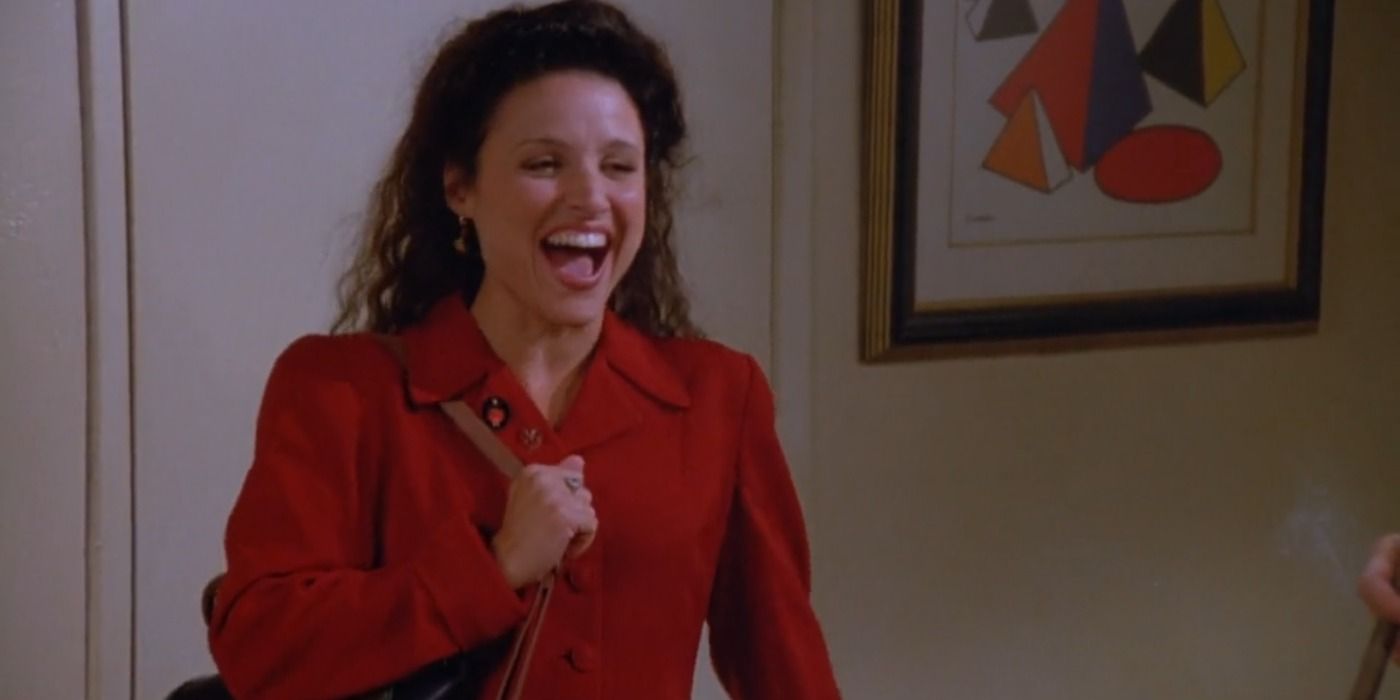
In short, Elaine wouldn’t be the only character on the show to be disingenuous about this when she said she was in her “early twenties”. Julia Louis-Dreyfus was 28 years old at the start of the series, so many have come to the conclusion that this was also the character’s age. After all, character and actor ages usually did match up rather closely in Seinfeld, which was the case with Jerry and Kramer (the oldest of the bunch). In any case, Elaine was presumably close to 30. Since the series lasted for nine seasons, that would put her around 37 years old when the show ended, whereas Julia Louis-Dreyfus was 38 years old at the time.

While the rest of the main cast ended their Seinfeld journeys well into their 40s, Elaine’s wrapped up while she was still in her late 30s. As for why there’s such confusion over this aspect of characters like Elaine, many attribute the mystery – and rightly so – to Jerry, Elaine, and George’s well-earned reputation for lying, among many other morally questionable decisions that they made over the course of Seinfeld’s nine-season run.


from TechCrunch https://ift.tt/3apHAn1
via IFTTT

Comments

Popular posts from this blog

The Silent Revolution of On-Device AI: Why the Cloud Is No Longer King

Introduction For years, artificial intelligence has meant one thing: the cloud. Whether you’re asking ChatGPT a question, editing a photo with AI tools, or getting recommendations on Netflix — those decisions happen on distant servers, not your device. But that’s changing. Thanks to major advances in silicon, model compression, and memory architecture, AI is quietly migrating from giant data centres to the palm of your hand. Your phone, your laptop, your smartwatch — all are becoming AI engines in their own right. It’s a shift that redefines not just how AI works, but who controls it, how private it is, and what it can do for you. This article explores the rise of on-device AI — how it works, why it matters, and why the cloud’s days as the centre of the AI universe might be numbered. What Is On-Device AI? On-device AI refers to machine learning models that run locally on your smartphone, tablet, laptop, or edge device — without needing constant access to the cloud. In practi...

Apple’s AI Push: Everything We Know About Apple Intelligence So Far

Apple’s WWDC 2025 confirmed what many suspected: Apple is finally making a serious leap into artificial intelligence. Dubbed “Apple Intelligence,” the suite of AI-powered tools, enhancements, and integrations marks the company’s biggest software evolution in a decade. But unlike competitors racing to plug AI into everything, Apple is taking a slower, more deliberate approach — one rooted in privacy, on-device processing, and ecosystem synergy. If you’re wondering what Apple Intelligence actually is, how it works, and what it means for your iPhone, iPad, or Mac, you’re in the right place. This article breaks it all down.   What Is Apple Intelligence? Let’s get the terminology clear first. Apple Intelligence isn’t a product — it’s a platform. It’s not just a chatbot. It’s a system-wide integration of generative AI, machine learning, and personal context awareness, embedded across Apple’s OS platforms. Think of it as a foundational AI layer stitched into iOS 18, iPadOS 18, and m...

Max Q: Anomalous

Hello and welcome back to Max Q! Last week wasn’t the most successful for spaceflight missions. We’ll get into that a bit more below. In this issue: First up, a botched launch from Virgin Orbit… …followed by one from ABL Space Systems News from Rocket Lab, World View and more Virgin Orbit’s botched launch highlights shaky financial future After Virgin Orbit’s launch failure last Monday, during which the mission experienced an  “anomaly” that prevented the rocket from reaching orbit, I went back over the company’s financials — and things aren’t looking good. For Virgin Orbit, this year has likely been completely turned on its head. The company was aiming for three launches this year, but everything will remain grounded until the cause of the anomaly has been identified and resolved. It’s unclear how long that will take, but likely at least three months. Add this delay to Virgin’s dwindling cash reserves and you have a foundation that’s suddenly much shakier than before. ...