
Iron Man's Secret Armor Doubles as a Corporate Lawyer

Marvel's Iron Man is one of the smartest characters in the Marvel Universe - and he's also one of the shrewdest businessmen on Earth, so it's no surprise that the genius, billionaire, playboy-philanthropist would quite literally invent a lawyer for himself. As the CEO of Stark Industries, Tony is often beset by legal troubles; lawyers accompanying him everywhere he goes would not be seen as out of the ordinary. In the short story collection Iron Man: Titanium, the tale Railguns, Power Ties and Titanium Men, written by Adam Warren with art by Salva Espin and colors by Rachelle Rosenberg, introduces readers to Tony Stark's very own "Lawyer Armor."

At the start of the story, Tony Stark accompanies Pepper Potts (along with bodyguards and lawyers) to a public meeting in a new skyscraper; the young Chief Technological Officer of the company Designed Intelligence, Huang Qiaolian appears ready to announce the company's IPO before dozens of potential investors. Instead, she kidnaps all the attendees and holds them hostage through the use of the Titanium Man: a robot that can also deploy smaller versions of itself. To add insult to injury, Huang Qiaolian isn't from Designed Intelligence at all, but Advanced Idea Mechanics, or A.I.M.


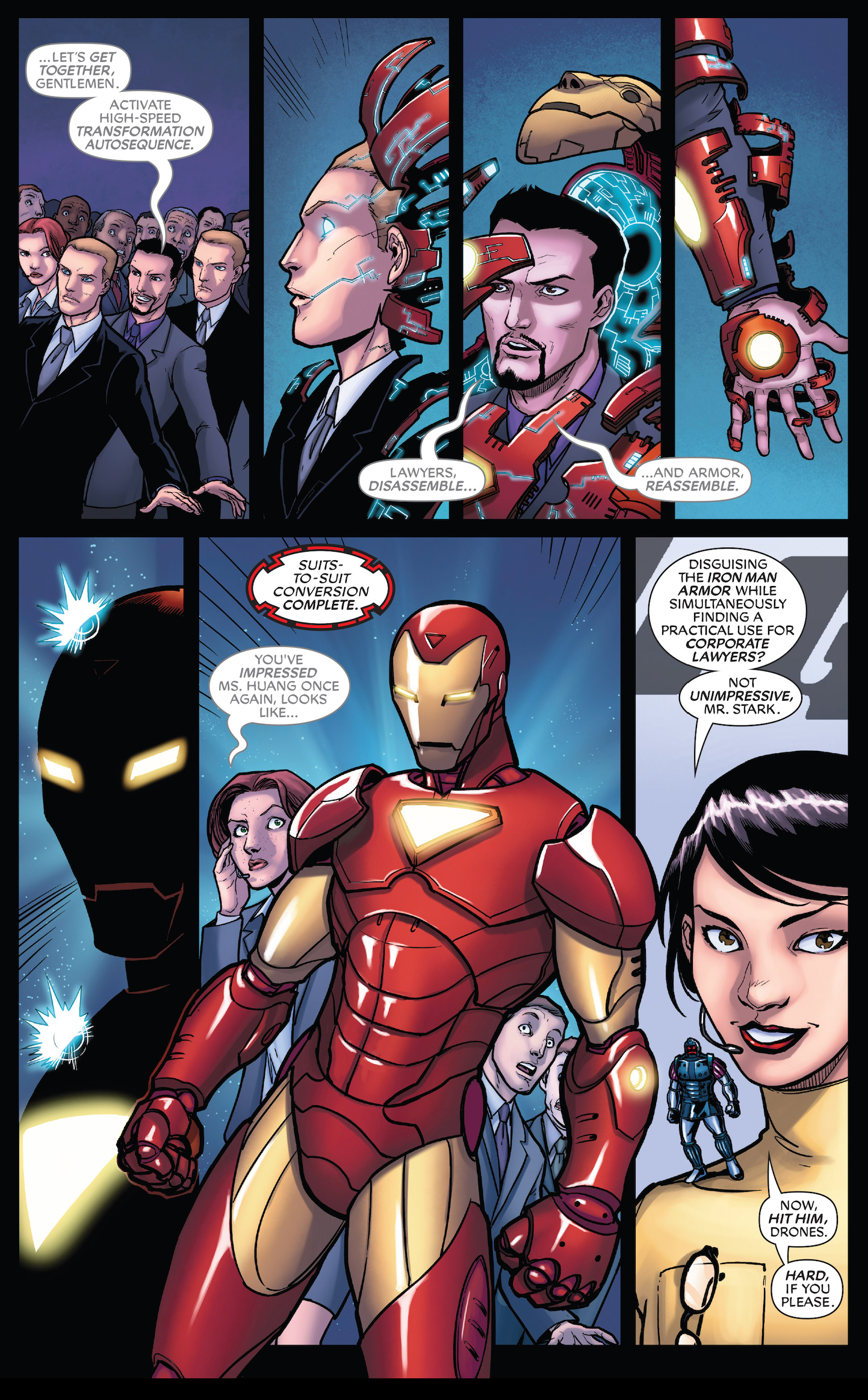
Huang Qiaolin's plan is revealed as she ushers the hostages toward high-speed electromagnetic elevators. They're not elevators; they're mass drivers, designed to launch the cabins into orbit where they'll reenter the atmosphere and land near an A.I.M. ship. But Tony Stark has a plan; he stands in the middle of his two lawyers and  initiates a high-speed transformation sequence. The two lawyers disassemble and form around Tony, creating a new armor. "Suits-to suit conversation complete," he says - while Huang stands amazed that Stark was able to find a practical use for corporate lawyers.
Tony Stark is no stranger to hiding his suits in plain sight. The most famous of Tony's concealed armors is the "suitcase armor" popularized in Iron Man 2, but was seen much earlier in the comics. Unlike the film, the suit wasn't disguised as the briefcase; it simply hid Tony's collapsible armor within. The Extremis armor was the logical next step; Tony stored the undersheath of the armor inside his bones, and moved it outside his skin with a mental command.

Thanks to the Lawyer Armor, Tony was able to rescue Pepper Potts and the passengers inside the elevators, destroy the Titanium Man and defeat Huang Qiaolin (who was later revealed to be a Life Model Decoy). Stark's legal troubles worked to his advantage in this instance. Iron Man's reputation for palling around with an entourage allowed one more suit of armor up his sleeve.


from TechCrunch https://ift.tt/3AHyQDt
via IFTTT

Comments

Popular posts from this blog

The Silent Revolution of On-Device AI: Why the Cloud Is No Longer King

Introduction For years, artificial intelligence has meant one thing: the cloud. Whether you’re asking ChatGPT a question, editing a photo with AI tools, or getting recommendations on Netflix — those decisions happen on distant servers, not your device. But that’s changing. Thanks to major advances in silicon, model compression, and memory architecture, AI is quietly migrating from giant data centres to the palm of your hand. Your phone, your laptop, your smartwatch — all are becoming AI engines in their own right. It’s a shift that redefines not just how AI works, but who controls it, how private it is, and what it can do for you. This article explores the rise of on-device AI — how it works, why it matters, and why the cloud’s days as the centre of the AI universe might be numbered. What Is On-Device AI? On-device AI refers to machine learning models that run locally on your smartphone, tablet, laptop, or edge device — without needing constant access to the cloud. In practi...

Apple’s AI Push: Everything We Know About Apple Intelligence So Far

Apple’s WWDC 2025 confirmed what many suspected: Apple is finally making a serious leap into artificial intelligence. Dubbed “Apple Intelligence,” the suite of AI-powered tools, enhancements, and integrations marks the company’s biggest software evolution in a decade. But unlike competitors racing to plug AI into everything, Apple is taking a slower, more deliberate approach — one rooted in privacy, on-device processing, and ecosystem synergy. If you’re wondering what Apple Intelligence actually is, how it works, and what it means for your iPhone, iPad, or Mac, you’re in the right place. This article breaks it all down.   What Is Apple Intelligence? Let’s get the terminology clear first. Apple Intelligence isn’t a product — it’s a platform. It’s not just a chatbot. It’s a system-wide integration of generative AI, machine learning, and personal context awareness, embedded across Apple’s OS platforms. Think of it as a foundational AI layer stitched into iOS 18, iPadOS 18, and m...

Billionaire clothing dynasty heiress launches Everybody & Everyone to make fashion sustainable

Veronica Chou’s family has made its fortune at the forefront of the fast fashion business through investments in companies like Michael Kors and Tommy Hilfiger . But now, the heiress to an estimated $2.1 billion fortune is launching her own company, Everybody & Everyone , to prove that the fashion industry can be both environmentally sustainable and profitable. There’s no argument about the negative impacts of the fashion industry on the environment. The textiles industry primarily uses non-renewable resources — on the order of 98 million tons per year. That includes the oil to make synthetic fibers, fertilizers to grow cotton, and toxic chemicals to dye, treat, and produce the textiles used to make clothes. The greenhouse gas footprint from textiles production was roughly 1.2 billion tons of CO2 equivalent in 2015 — more than all international flights and maritime shipments combined (and a lot of those maritime shipments and international flights were hauling clothes). The lit...