
Walmart’s Flipkart makes local languages push to win small Indian cities and towns

Flipkart on Wednesday added support for three more local languages as the Indian e-commerce giant looks to widen its foothold in smaller cities and towns across the country where fewer people speak English and Hindi.

The Walmart-owned firm said its online marketplace now has interfaces in Tamil, Telugu, and Kannada, three languages that are spoken by roughly 200 million people in India.

Today’s announcement follows Flipkart adapting its interface in Hindi language on its website and app last year. Flipkart’s rival, Amazon, added support for Hindi in 2018. It does not support any additional Indian languages.

A Flipkart spokeswoman told TechCrunch that support for Hindi language has been well received by customers. “About 95% of consumers who opted for the Hindi interface continued using the interface as a testament of its efficacy,” the spokeswoman said.

Flipkart said the new localization effort, for which it conducted on-ground surveys in many cities, includes a “judicious” mix of translation and transliteration of words from the aforementioned three languages. Overall, it has incorporated more than 5.4 million translated words into its product pages, banners, and payments pages in the three local languages.
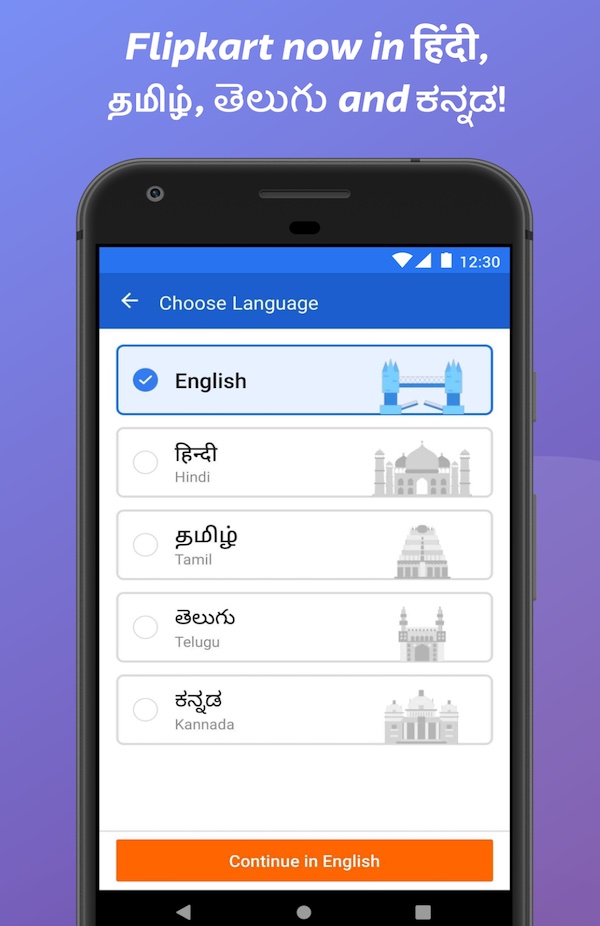
“We truly believe that language, if solved well, can be an opportunity rather than a barrier to reach millions of consumers who have been underserved. As a homegrown e-commerce marketplace, we understand India and its diversity in a more nuanced way and are building products that have the potential to bring a long-term change,” said Kalyan Krishnamurthy, chief executive officer of Flipkart Group, in a statement.

The push to local languages comes as both Flipkart and Amazon India are exploring ways to expand their reach beyond urban cities in India. Online shopping accounts for about 3% of total retail sales in India, according to industry estimates.

In recent quarters, Flipkart has added support for voice assistant, short-form videos, and bundled a free on-demand video streaming service to please new customers. The company has previously stated that most of its new users are coming from smaller cities and towns in India.

India, the world’s second largest internet market, has emerged as a global battleground for American and Chinese technology groups. Both Amazon, which completed seven years in the country this month, and 13-year-old Flipkart claim the top spot in the e-commerce market.

Amazon India’s apps had about 140 million monthly active users last month, ahead of Flipkart marquee app’s 108 million, according to one of the top mobile insight firms, data of which an industry executive shared with TechCrunch. (Though it should be noted that monthly active users, that alone of mobile apps, is not the best metric to gauge a shopping platform’s performance.) Flipkart claims it has amassed over 150 million registered users.


from TechCrunch https://ift.tt/3hUGNgr
via IFTTT

Comments

Popular posts from this blog

The Silent Revolution of On-Device AI: Why the Cloud Is No Longer King

Introduction For years, artificial intelligence has meant one thing: the cloud. Whether you’re asking ChatGPT a question, editing a photo with AI tools, or getting recommendations on Netflix — those decisions happen on distant servers, not your device. But that’s changing. Thanks to major advances in silicon, model compression, and memory architecture, AI is quietly migrating from giant data centres to the palm of your hand. Your phone, your laptop, your smartwatch — all are becoming AI engines in their own right. It’s a shift that redefines not just how AI works, but who controls it, how private it is, and what it can do for you. This article explores the rise of on-device AI — how it works, why it matters, and why the cloud’s days as the centre of the AI universe might be numbered. What Is On-Device AI? On-device AI refers to machine learning models that run locally on your smartphone, tablet, laptop, or edge device — without needing constant access to the cloud. In practi...

Apple’s AI Push: Everything We Know About Apple Intelligence So Far

Apple’s WWDC 2025 confirmed what many suspected: Apple is finally making a serious leap into artificial intelligence. Dubbed “Apple Intelligence,” the suite of AI-powered tools, enhancements, and integrations marks the company’s biggest software evolution in a decade. But unlike competitors racing to plug AI into everything, Apple is taking a slower, more deliberate approach — one rooted in privacy, on-device processing, and ecosystem synergy. If you’re wondering what Apple Intelligence actually is, how it works, and what it means for your iPhone, iPad, or Mac, you’re in the right place. This article breaks it all down.   What Is Apple Intelligence? Let’s get the terminology clear first. Apple Intelligence isn’t a product — it’s a platform. It’s not just a chatbot. It’s a system-wide integration of generative AI, machine learning, and personal context awareness, embedded across Apple’s OS platforms. Think of it as a foundational AI layer stitched into iOS 18, iPadOS 18, and m...

Max Q: Galactic

Hello and welcome back to Max Q! Happy Memorial Day everyone. In this issue: Astranis’ novel approach to GEO satellites Virgin Galactic’s return to the skies News from SpaceX, and more Astranis’ novel approach to internet satellites is starting to pay off Astranis , a satellite internet startup based in San Francisco, said Wednesday that its first spacecraft completed a milestone test and will start bringing broadband access to rural Alaskans as soon as mid-June. It’s a major step for the company, which was founded in 2015 by John Gedmark and Ryan McLinko. By taking a first principles approach to satellite development, the pair bet that they could make a smaller, cheaper spacecraft for geosynchronous orbit — the orbit farthest from Earth and arguably the most inhospitable — and use them to bring internet to millions, or even billions, of people around the globe. Their bet is paying off: The company’s first satellite, Arcturus, launched on a Falcon Heavy at the end of April. W...