
Google’s 46-camera ‘light field videos’ let you change perspective and peek around corners

Google is showing off one of the most impressive efforts yet turning traditional photography and video into something more immersive: 3D video that lets the viewer change their perspective and even look around objects in frame. Unfortunately, unless you have 46 spare cameras to sync together, you probably won’t be making these “light field videos” any time soon.

The new technique, due to be presented at SIGGRAPH, uses footage from dozens of cameras shooting simultaneously, forming a sort of giant compound eye. These many perspectives are merged into a single one in which the viewer can move their viewpoint and the scene will react correspondingly in real time.
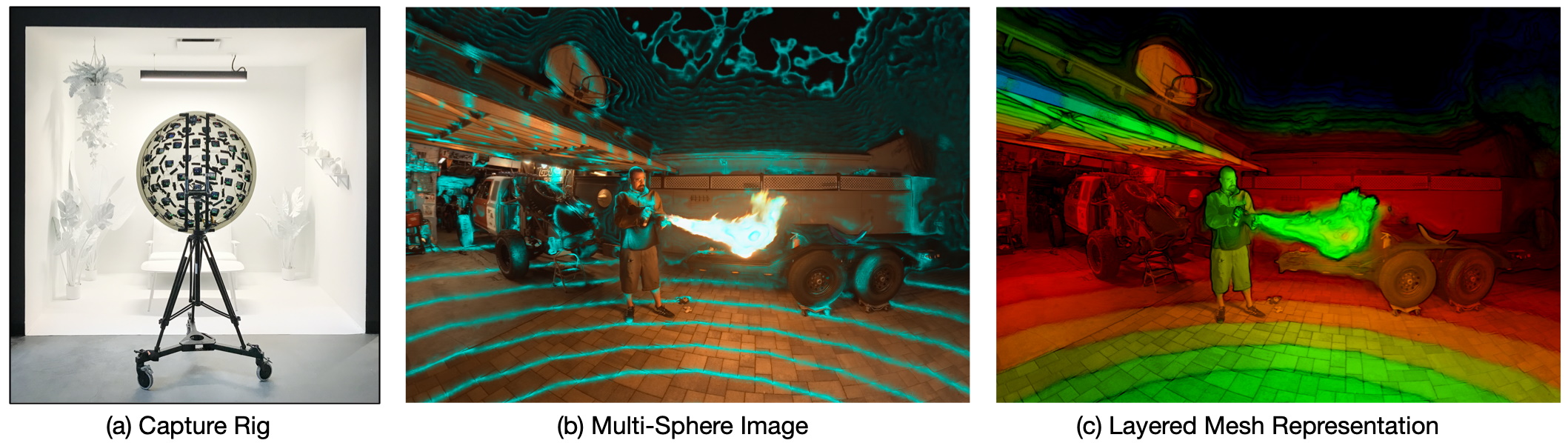
This image from the researchers’ paper shows how the cameras capture and segment the view.

The effect of high-definition video and freedom of movement gives these light field videos a real sense of reality. Existing VR-enhanced video generally uses fairly ordinary stereoscopic 3D, which doesn’t really allow for a change in viewpoint. And while Facebook’s method of understanding depth in photos and adding perspective to them is clever, it’s far more limited, creating only a small shift in perspective.

In Google’s videos, you can move your head a foot to the side to peek around a corner or see the other side of a given object — the image is photorealistic and full motion but in fact rendered in 3D, so even slight changes to the viewpoint are accurately reflected.

Image Credits: Google

And because the rig is so wide, parts of the scene that are hidden from one perspective are visible from others. When you swing from the far right side to the far left and zoom in, you may find entirely new features — eerily reminiscent of the infamous “enhance” scene from Blade Runner.

It’s probably best experienced in VR, but you can test out a static version of the system at the project’s website, or look at a number of demo light field videos as long as you have Chrome and have experimental web platform features enabled (there are instructions at the site).

The experiment is close cousin to the LED egg used for volumetric capture of human motion we saw late last year. Clearly Google’s AI division is interested in enriching media, though how they’ll do it in a Pixel smartphone rather than a car-sized camera array is anyone’s guess.


from TechCrunch https://ift.tt/2YtGPEh
via IFTTT

Comments

Popular posts from this blog

The Silent Revolution of On-Device AI: Why the Cloud Is No Longer King

Introduction For years, artificial intelligence has meant one thing: the cloud. Whether you’re asking ChatGPT a question, editing a photo with AI tools, or getting recommendations on Netflix — those decisions happen on distant servers, not your device. But that’s changing. Thanks to major advances in silicon, model compression, and memory architecture, AI is quietly migrating from giant data centres to the palm of your hand. Your phone, your laptop, your smartwatch — all are becoming AI engines in their own right. It’s a shift that redefines not just how AI works, but who controls it, how private it is, and what it can do for you. This article explores the rise of on-device AI — how it works, why it matters, and why the cloud’s days as the centre of the AI universe might be numbered. What Is On-Device AI? On-device AI refers to machine learning models that run locally on your smartphone, tablet, laptop, or edge device — without needing constant access to the cloud. In practi...

Apple’s AI Push: Everything We Know About Apple Intelligence So Far

Apple’s WWDC 2025 confirmed what many suspected: Apple is finally making a serious leap into artificial intelligence. Dubbed “Apple Intelligence,” the suite of AI-powered tools, enhancements, and integrations marks the company’s biggest software evolution in a decade. But unlike competitors racing to plug AI into everything, Apple is taking a slower, more deliberate approach — one rooted in privacy, on-device processing, and ecosystem synergy. If you’re wondering what Apple Intelligence actually is, how it works, and what it means for your iPhone, iPad, or Mac, you’re in the right place. This article breaks it all down.   What Is Apple Intelligence? Let’s get the terminology clear first. Apple Intelligence isn’t a product — it’s a platform. It’s not just a chatbot. It’s a system-wide integration of generative AI, machine learning, and personal context awareness, embedded across Apple’s OS platforms. Think of it as a foundational AI layer stitched into iOS 18, iPadOS 18, and m...

Max Q: Galactic

Hello and welcome back to Max Q! Happy Memorial Day everyone. In this issue: Astranis’ novel approach to GEO satellites Virgin Galactic’s return to the skies News from SpaceX, and more Astranis’ novel approach to internet satellites is starting to pay off Astranis , a satellite internet startup based in San Francisco, said Wednesday that its first spacecraft completed a milestone test and will start bringing broadband access to rural Alaskans as soon as mid-June. It’s a major step for the company, which was founded in 2015 by John Gedmark and Ryan McLinko. By taking a first principles approach to satellite development, the pair bet that they could make a smaller, cheaper spacecraft for geosynchronous orbit — the orbit farthest from Earth and arguably the most inhospitable — and use them to bring internet to millions, or even billions, of people around the globe. Their bet is paying off: The company’s first satellite, Arcturus, launched on a Falcon Heavy at the end of April. W...