
Meet Bespoke Financial, a lender for cannabis companies backed by Snoop Dogg’s Casa Verde Capital

Bespoke Financial wants to provide cannabis businesses with the same kind of financial services that other businesses get, but that dispensaries and growers can’t yet access.

The regulations around cannabis operations are so stringent at the local level — and so nebulous at the federal level — that national banks won’t give businesses in the cannabis industry the same basic services (like short-term loans).

That’s why one former Goldman Sachs banker has partnered with two entrepreneurs from the traditional agriculture industry to create Bespoke Financial. And it’s why the company has raised $7 million in financing led by Casa Verde Capital — the investment firm launched by legendary cannabis aficionado, Calvin Broadus (AKA Snoop Dogg).

In some ways, George Mancheril is the new face of the cannabis business. The former banker hails from Goldman Sachs and Guggenheim Partners and worked on the desks that dealt with alternative lending.

A transplant to Los Angeles roughly six years ago, Mancheril says he saw the migration of legally sanctioned cannabis begin for recreational use and knew that there would be opportunities for new lending businesses.

“Cannabis will become a broad, mature industry just like any other, and if that is going to happen there needs to be a debt structure that can support that,” Mancheril says.

The biggest impediment to the industry’s growth is the one that Bespoke Financial wants to tackle first — and that’s access to debt.

To build the company’s first product Mancheril looked to his co-founder’s Pablo Borquez-Schwarzbeck and Benjamin Dusastre. Borquez-Schwarzbeck and Dusastre previously launched ProducePay, a fintech platform focused on produce farmers that has already financed roughly $2 billion in perishable commodities throughout 13 countries. It’s backed by around $200 million in venture capital and debt financing.  

What Mancheril and his co-founders have done is take ProducePay’s underwriting model and apply it to the cannabis industry. The financial instrument that they’re starting with is known “in the business” as factoring.

It’s basically advancing money to businesses for a contract that’s signed in exchange for a cut of the money once a company gets paid for the goods or services they’ve rendered.
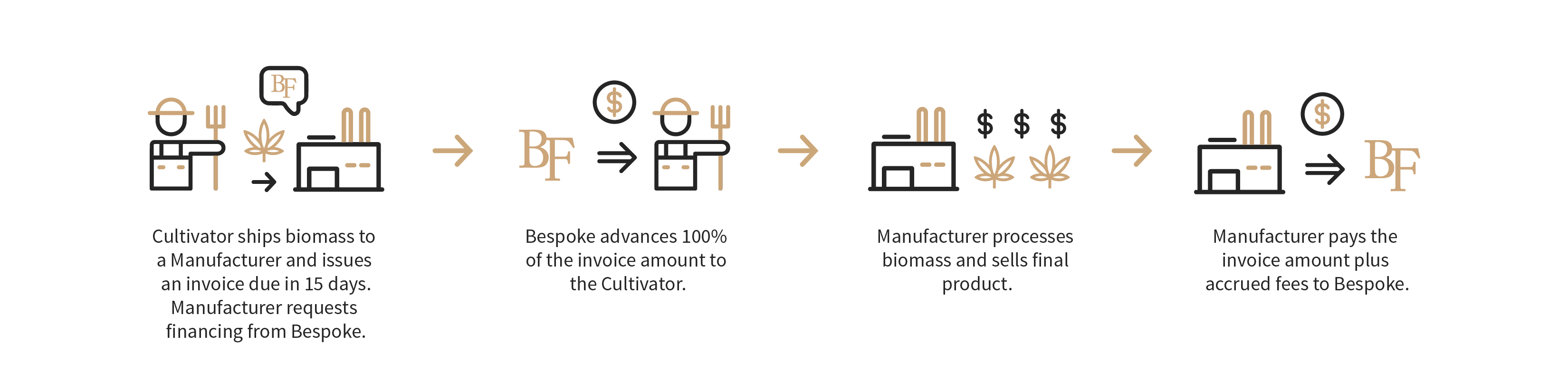
BF Website Diagrams Final 02

“While the US legal cannabis market is forecasted to grow over 20% annually, reaching $23B by 2022, the industry’s true growth potential is limited by long cash flow cycles throughout the supply chain and a lack of scalable and efficient capital sources,” says Bespoke Financial co-founder and chief executive, George Mancheril, in a statement. “Our approach will dramatically improve cash flow cycles across the supply chain and provide scalable working capital to fuel our clients’ growth.”

The $7 million infusion from investors including Casa Verde, Greenhouse Capital Partners and Outbound Ventures, will be used to build out the company’s business and establish its first credit lines with customers. Mancheril says it already has around $3 million worth of loans revolving through its business. Right now, the company is focused on California, but says it could expand to other regions that are embracing legalization. 

“In general in the cannabis industry overall it’s difficult to access any part of the financial system,” says Karan Wadhera, a managing director at Casa Verde. “Now that we’re moving into a place where equity financing is getting expensive a company like bespoke plays an important and valuable role in the ecosystem to help young brands and mature brands get access to working capital when they need it the most.”


from TechCrunch https://ift.tt/31IdLY9
via IFTTT

Comments

Popular posts from this blog

The Silent Revolution of On-Device AI: Why the Cloud Is No Longer King

Introduction For years, artificial intelligence has meant one thing: the cloud. Whether you’re asking ChatGPT a question, editing a photo with AI tools, or getting recommendations on Netflix — those decisions happen on distant servers, not your device. But that’s changing. Thanks to major advances in silicon, model compression, and memory architecture, AI is quietly migrating from giant data centres to the palm of your hand. Your phone, your laptop, your smartwatch — all are becoming AI engines in their own right. It’s a shift that redefines not just how AI works, but who controls it, how private it is, and what it can do for you. This article explores the rise of on-device AI — how it works, why it matters, and why the cloud’s days as the centre of the AI universe might be numbered. What Is On-Device AI? On-device AI refers to machine learning models that run locally on your smartphone, tablet, laptop, or edge device — without needing constant access to the cloud. In practi...

Apple’s AI Push: Everything We Know About Apple Intelligence So Far

Apple’s WWDC 2025 confirmed what many suspected: Apple is finally making a serious leap into artificial intelligence. Dubbed “Apple Intelligence,” the suite of AI-powered tools, enhancements, and integrations marks the company’s biggest software evolution in a decade. But unlike competitors racing to plug AI into everything, Apple is taking a slower, more deliberate approach — one rooted in privacy, on-device processing, and ecosystem synergy. If you’re wondering what Apple Intelligence actually is, how it works, and what it means for your iPhone, iPad, or Mac, you’re in the right place. This article breaks it all down.   What Is Apple Intelligence? Let’s get the terminology clear first. Apple Intelligence isn’t a product — it’s a platform. It’s not just a chatbot. It’s a system-wide integration of generative AI, machine learning, and personal context awareness, embedded across Apple’s OS platforms. Think of it as a foundational AI layer stitched into iOS 18, iPadOS 18, and m...

Billionaire clothing dynasty heiress launches Everybody & Everyone to make fashion sustainable

Veronica Chou’s family has made its fortune at the forefront of the fast fashion business through investments in companies like Michael Kors and Tommy Hilfiger . But now, the heiress to an estimated $2.1 billion fortune is launching her own company, Everybody & Everyone , to prove that the fashion industry can be both environmentally sustainable and profitable. There’s no argument about the negative impacts of the fashion industry on the environment. The textiles industry primarily uses non-renewable resources — on the order of 98 million tons per year. That includes the oil to make synthetic fibers, fertilizers to grow cotton, and toxic chemicals to dye, treat, and produce the textiles used to make clothes. The greenhouse gas footprint from textiles production was roughly 1.2 billion tons of CO2 equivalent in 2015 — more than all international flights and maritime shipments combined (and a lot of those maritime shipments and international flights were hauling clothes). The lit...