
Hyundai is launching Botride, a robotaxi service in California with Pony.ai and Via

A fleet of electric, autonomous Hyundai Kona crossovers — equipped with a self-driving system from Chinese autonomous startup Pony.ai and Via’s ride-hailing platform, will start shuttling customers on public roads next week.

The robotaxi service called BotRide will operate on public roads in Irvine, California, beginning November 4. This isn’t a driverless service; there will be a human safety driver behind the wheel at all times. But it is one of the few ride-hailing pilots on California roads. Only four companies, AutoX, Pony.ai, Waymo and Zoox have permission to operate a ride-hailing service using autonomous vehicles in the state of the California.

Customers will be able to order rides through a smartphone app, which will direct passengers to nearby stops for pick up and drop off. Via’s expertise is on shared rides, and this platform aims for the same multiple rider goal. Via’s platform handles the on-demand ride-hailing features such as booking, passenger and vehicle assignment and vehicle identification (QR code). Via has two sides to its business. The company operates consumer-facing shuttles in Chicago, Washington, D.C. and New York. It also partners with cities and transportation authorities — and now automakers launching robotaxi services — giving clients access to their platform to deploy their own shuttles.

Hyundai said BotRide is “validating its user experience in preparation for a fully driverless future.” Hyundai didn’t explain when this driverless future might arrive. Whatever this driverless future ends up looking like, Hyundai sees this pilot as a critical marker along the way.
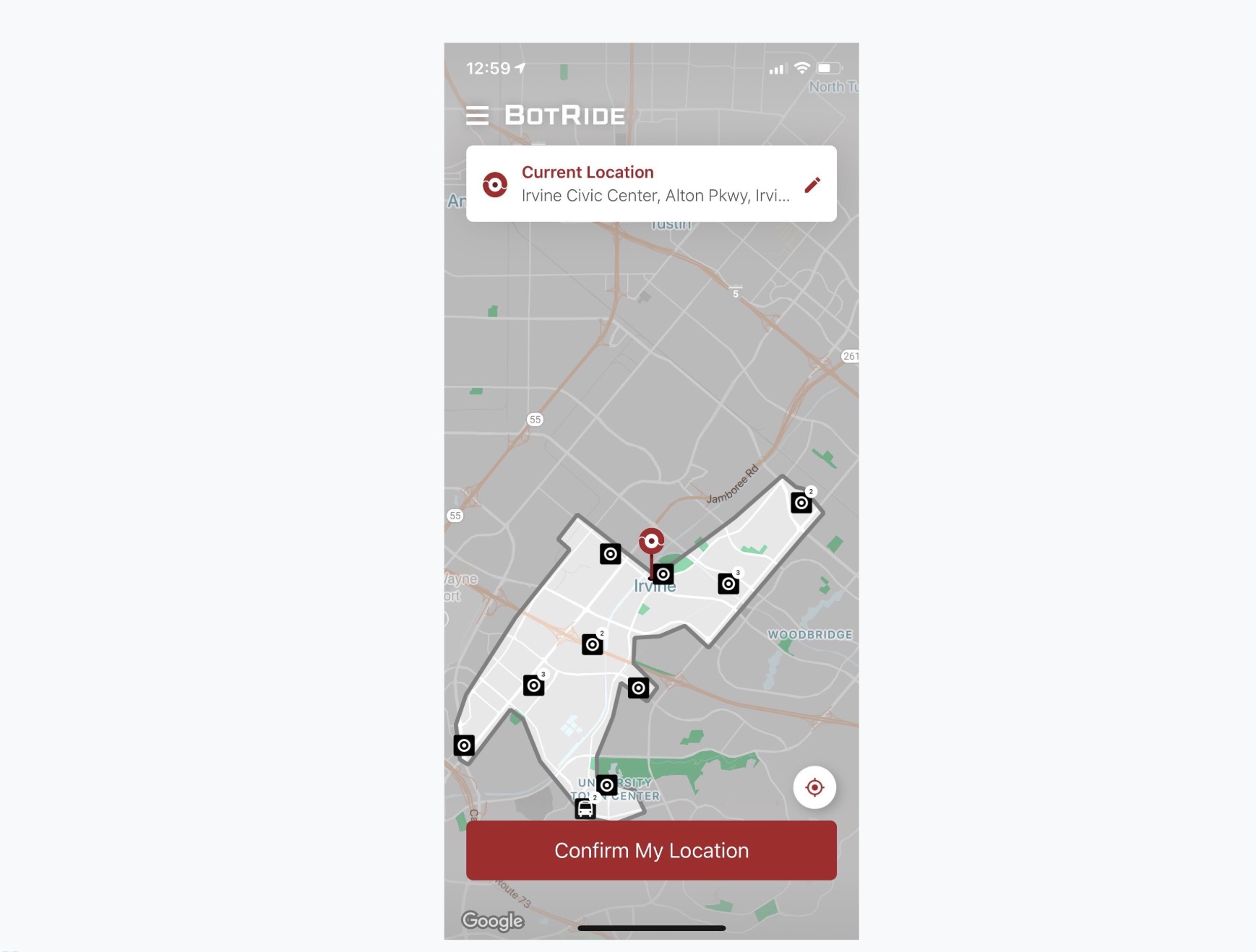
Coverage area of Hyundai robotaxi pilot

Hyundai said it is using BotRide to study consumer behavior in an autonomous ride-sharing environment, according to Christopher Chang, head of business development, strategy and technology division, Hyundai Motor Company.

“The BotRide pilot represents an important step in the deployment and eventual commercialization of a growing new mobility business,” said Daniel Han, manager, Advanced Product Strategy, Hyundai Motor America.

Hyundai might be the household name behind BotRide, but Pony.ai and Via are doing much of the heavy lifting. Pony.ai is a relative newcomer to the AV world, but it has already raised $300 million on a $1.7 billion valuation and locked in partnerships with Toyota and Hyundai.

The company, which has operations in China and California and about 500 employees globally, was founded in late 2016 with backing from Sequoia Capital China, IDG Capital and Legend Capital.

It’s also one of the few autonomous vehicle companies to have both a permit with the California Department of Motor Vehicles to test AVs on public roads and permission from the California Public Utilities Commission to use these vehicles in a ride-hailing service. Under rules established by the CPUC, Pony.ai cannot charge for rides.


from TechCrunch https://ift.tt/31PuKaO
via IFTTT

Comments

Popular posts from this blog

The Silent Revolution of On-Device AI: Why the Cloud Is No Longer King

Introduction For years, artificial intelligence has meant one thing: the cloud. Whether you’re asking ChatGPT a question, editing a photo with AI tools, or getting recommendations on Netflix — those decisions happen on distant servers, not your device. But that’s changing. Thanks to major advances in silicon, model compression, and memory architecture, AI is quietly migrating from giant data centres to the palm of your hand. Your phone, your laptop, your smartwatch — all are becoming AI engines in their own right. It’s a shift that redefines not just how AI works, but who controls it, how private it is, and what it can do for you. This article explores the rise of on-device AI — how it works, why it matters, and why the cloud’s days as the centre of the AI universe might be numbered. What Is On-Device AI? On-device AI refers to machine learning models that run locally on your smartphone, tablet, laptop, or edge device — without needing constant access to the cloud. In practi...

Apple’s AI Push: Everything We Know About Apple Intelligence So Far

Apple’s WWDC 2025 confirmed what many suspected: Apple is finally making a serious leap into artificial intelligence. Dubbed “Apple Intelligence,” the suite of AI-powered tools, enhancements, and integrations marks the company’s biggest software evolution in a decade. But unlike competitors racing to plug AI into everything, Apple is taking a slower, more deliberate approach — one rooted in privacy, on-device processing, and ecosystem synergy. If you’re wondering what Apple Intelligence actually is, how it works, and what it means for your iPhone, iPad, or Mac, you’re in the right place. This article breaks it all down.   What Is Apple Intelligence? Let’s get the terminology clear first. Apple Intelligence isn’t a product — it’s a platform. It’s not just a chatbot. It’s a system-wide integration of generative AI, machine learning, and personal context awareness, embedded across Apple’s OS platforms. Think of it as a foundational AI layer stitched into iOS 18, iPadOS 18, and m...

Max Q: Galactic

Hello and welcome back to Max Q! Happy Memorial Day everyone. In this issue: Astranis’ novel approach to GEO satellites Virgin Galactic’s return to the skies News from SpaceX, and more Astranis’ novel approach to internet satellites is starting to pay off Astranis , a satellite internet startup based in San Francisco, said Wednesday that its first spacecraft completed a milestone test and will start bringing broadband access to rural Alaskans as soon as mid-June. It’s a major step for the company, which was founded in 2015 by John Gedmark and Ryan McLinko. By taking a first principles approach to satellite development, the pair bet that they could make a smaller, cheaper spacecraft for geosynchronous orbit — the orbit farthest from Earth and arguably the most inhospitable — and use them to bring internet to millions, or even billions, of people around the globe. Their bet is paying off: The company’s first satellite, Arcturus, launched on a Falcon Heavy at the end of April. W...