
Captiv8 report highlights data for spotting fake followers

Captiv8, a company offering tools for brands to manage influencer marketing campaigns, has released its 2018 Fraud Influencer Marketing Benchmark Report. The goal is to give marketers the data they need to spot fake followers — and thus, to separate the influencers with a real following from those who only offer the illusion of engagement.

The report argues that that this a problem with a real financial impact (it’s something that Instagram is working to crack down on), with $2.1 billion spent on influencer marketing on Instagram in 2017 and 11 percent of the engagement coming from fraudulent accounts.

“For influencer marketing to truly deliver on its transformative potential, marketers need a more concrete and reliable way to identify fake followers and engagement, compare their performance to industry benchmarks, and determine the real reach and impact of social media spend,” Captiv8 says.

So the company looked at a range of marketing categories (pets, parenting, beauty, fashion, entertainment, travel, gaming, fitness, food and traditional celebrity) and randomly selected 5,000 Instagram influencer accounts in each one, pulling engagement from August to November of this year.

The idea is to establish a baseline for standard activity, so that marketers can spot potential red flags. Of course, everyone with a significant social media audience is going to have some fake followers, but Captiv8 suggests that some categories have a higher rate of fraud than others — fashion was the worst, with an average of 14 percent of fake activity per account, compared to traditional celebrity, where the average was just 4 percent.
Captiv8 report

So what should you look out for? For starters, the report says the average daily change in follower counts for an influencer is 1.2 percent, so be on the lookout for shifts that are significantly larger.

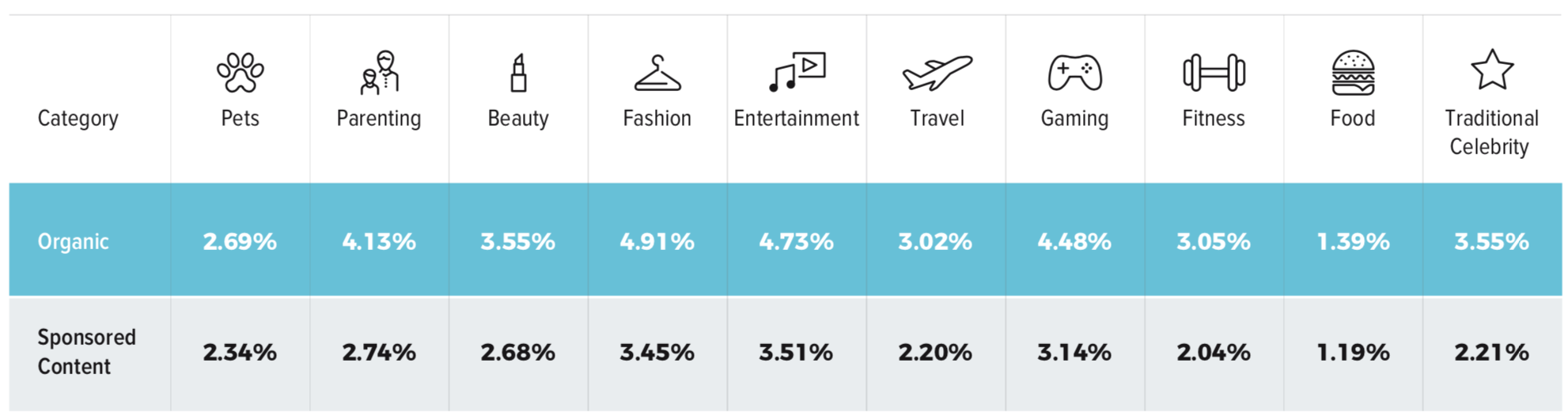
The report also breaks down the average engagement rate for organic and sponsored content by category (ranging from 1.19 percent for sponsored content in food to 3.51 percent in entertainment), and suggests that a lower engagement rate “shows a high probability that their follower count is inflated through bots or fake followers.”

Conversely, it says it could also be a warning sign if a creator’s audience reach or impressions per user is higher than the industry benchmarks (for example, image posts in fashion have an average audience reach of 23.69 percent, with 1.32 impressions per unique user).

You can download the full report on the Captiv8 website.


from TechCrunch https://tcrn.ch/2LwijtY
via IFTTT

Comments

Popular posts from this blog

The Silent Revolution of On-Device AI: Why the Cloud Is No Longer King

Introduction For years, artificial intelligence has meant one thing: the cloud. Whether you’re asking ChatGPT a question, editing a photo with AI tools, or getting recommendations on Netflix — those decisions happen on distant servers, not your device. But that’s changing. Thanks to major advances in silicon, model compression, and memory architecture, AI is quietly migrating from giant data centres to the palm of your hand. Your phone, your laptop, your smartwatch — all are becoming AI engines in their own right. It’s a shift that redefines not just how AI works, but who controls it, how private it is, and what it can do for you. This article explores the rise of on-device AI — how it works, why it matters, and why the cloud’s days as the centre of the AI universe might be numbered. What Is On-Device AI? On-device AI refers to machine learning models that run locally on your smartphone, tablet, laptop, or edge device — without needing constant access to the cloud. In practi...

Apple’s AI Push: Everything We Know About Apple Intelligence So Far

Apple’s WWDC 2025 confirmed what many suspected: Apple is finally making a serious leap into artificial intelligence. Dubbed “Apple Intelligence,” the suite of AI-powered tools, enhancements, and integrations marks the company’s biggest software evolution in a decade. But unlike competitors racing to plug AI into everything, Apple is taking a slower, more deliberate approach — one rooted in privacy, on-device processing, and ecosystem synergy. If you’re wondering what Apple Intelligence actually is, how it works, and what it means for your iPhone, iPad, or Mac, you’re in the right place. This article breaks it all down.   What Is Apple Intelligence? Let’s get the terminology clear first. Apple Intelligence isn’t a product — it’s a platform. It’s not just a chatbot. It’s a system-wide integration of generative AI, machine learning, and personal context awareness, embedded across Apple’s OS platforms. Think of it as a foundational AI layer stitched into iOS 18, iPadOS 18, and m...

Max Q: Galactic

Hello and welcome back to Max Q! Happy Memorial Day everyone. In this issue: Astranis’ novel approach to GEO satellites Virgin Galactic’s return to the skies News from SpaceX, and more Astranis’ novel approach to internet satellites is starting to pay off Astranis , a satellite internet startup based in San Francisco, said Wednesday that its first spacecraft completed a milestone test and will start bringing broadband access to rural Alaskans as soon as mid-June. It’s a major step for the company, which was founded in 2015 by John Gedmark and Ryan McLinko. By taking a first principles approach to satellite development, the pair bet that they could make a smaller, cheaper spacecraft for geosynchronous orbit — the orbit farthest from Earth and arguably the most inhospitable — and use them to bring internet to millions, or even billions, of people around the globe. Their bet is paying off: The company’s first satellite, Arcturus, launched on a Falcon Heavy at the end of April. W...