
Instagram announces verification requests, transparency tools and stronger 2FA

Instagram has introduced a wide-ranging set of new tools today with security and transparency in mind. In a blog post titled “New Tools to Keep Instagram Safe,” the company is announcing three significant updates: an “about this account” section to provide users more context about accounts with large followings, a form through which accounts can request a coveted blue verified badge and support for third-party authenticator apps.

Instagram’s new “About this Account” section is designed to give users more information that they can use when evaluating the legitimacy of an account. The feature will be available by tapping the menu button from an account with substantial reach and will provide information like when an account was created, the country in which it is based, accounts that share followers, a lineage of that account’s username changes over the last year.
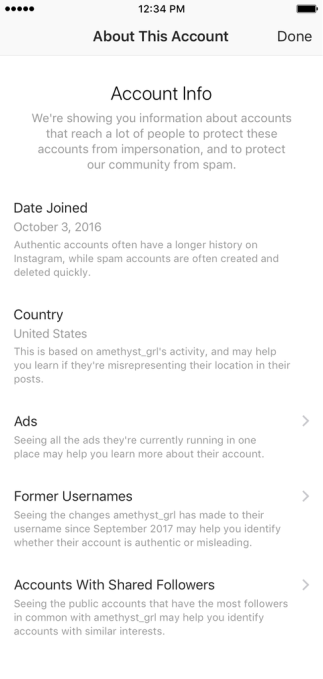
The feature will also link accounts with large audiences to the Instagram ads they are running, a nod to recent conversations around ad transparency in light of Russian government-sponsored political ads and disinformation seeping into social platforms.

According to Instagram, “In September, people who have accounts that reach large audiences can review the information about their accounts that will soon be publicly available.” When that period is over, the About This Account tool will launch to users around the globe.

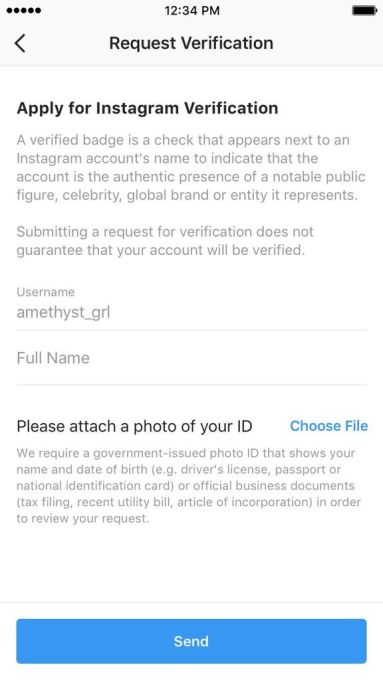
The second major Instagram change will offer accounts a path toward verification on the platform, standardizing a process that’s generally been opaque. A blue verified badge can be requested through a user’s own profile by tapping the menu icon, choosing Settings, and “Request Verification.” Instagram will then review the request, asking users to “provide your account username, your full name and a copy of your legal or business identification,” information that will not be made available to the public.
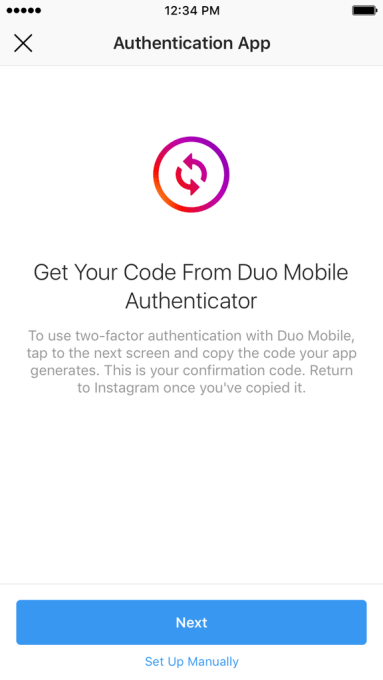
Last but certainly not least, Instagram is adding support for third-party authenticator apps like Google Authenticator and DUO Mobile that provide more robust methods of two-factor authentication (2FA). The move is a long anticipated effort to make Instagram more robust against threats to user accounts that target text-based 2FA, which is notoriously vulnerable to sim hijacking attacks.
“We’ve been focused on the safety of our platform since the very beginning, and today’s updates build upon our existing tools, such as our spam and abusive content filters and the ability to report or block accounts,” Instagram Co-Founder & CTO Mike Krieger said in a statement about the updates.

“We know we have more work to do to keep bad actors off Instagram, and we are committed to continuing to build more tools to do just that.”


from TechCrunch https://ift.tt/2NxEJuY
via IFTTT

Comments

Popular posts from this blog

The Silent Revolution of On-Device AI: Why the Cloud Is No Longer King

Introduction For years, artificial intelligence has meant one thing: the cloud. Whether you’re asking ChatGPT a question, editing a photo with AI tools, or getting recommendations on Netflix — those decisions happen on distant servers, not your device. But that’s changing. Thanks to major advances in silicon, model compression, and memory architecture, AI is quietly migrating from giant data centres to the palm of your hand. Your phone, your laptop, your smartwatch — all are becoming AI engines in their own right. It’s a shift that redefines not just how AI works, but who controls it, how private it is, and what it can do for you. This article explores the rise of on-device AI — how it works, why it matters, and why the cloud’s days as the centre of the AI universe might be numbered. What Is On-Device AI? On-device AI refers to machine learning models that run locally on your smartphone, tablet, laptop, or edge device — without needing constant access to the cloud. In practi...

Apple’s AI Push: Everything We Know About Apple Intelligence So Far

Apple’s WWDC 2025 confirmed what many suspected: Apple is finally making a serious leap into artificial intelligence. Dubbed “Apple Intelligence,” the suite of AI-powered tools, enhancements, and integrations marks the company’s biggest software evolution in a decade. But unlike competitors racing to plug AI into everything, Apple is taking a slower, more deliberate approach — one rooted in privacy, on-device processing, and ecosystem synergy. If you’re wondering what Apple Intelligence actually is, how it works, and what it means for your iPhone, iPad, or Mac, you’re in the right place. This article breaks it all down.   What Is Apple Intelligence? Let’s get the terminology clear first. Apple Intelligence isn’t a product — it’s a platform. It’s not just a chatbot. It’s a system-wide integration of generative AI, machine learning, and personal context awareness, embedded across Apple’s OS platforms. Think of it as a foundational AI layer stitched into iOS 18, iPadOS 18, and m...

Max Q: Anomalous

Hello and welcome back to Max Q! Last week wasn’t the most successful for spaceflight missions. We’ll get into that a bit more below. In this issue: First up, a botched launch from Virgin Orbit… …followed by one from ABL Space Systems News from Rocket Lab, World View and more Virgin Orbit’s botched launch highlights shaky financial future After Virgin Orbit’s launch failure last Monday, during which the mission experienced an  “anomaly” that prevented the rocket from reaching orbit, I went back over the company’s financials — and things aren’t looking good. For Virgin Orbit, this year has likely been completely turned on its head. The company was aiming for three launches this year, but everything will remain grounded until the cause of the anomaly has been identified and resolved. It’s unclear how long that will take, but likely at least three months. Add this delay to Virgin’s dwindling cash reserves and you have a foundation that’s suddenly much shakier than before. ...