Tesla just unveiled its first pickup truck, and the Cybertruck gets a lot of things right. The look is polarizing, but from a truck perspective, it’s capable, practical, and relatively affordable compared to other pickups. Of course, all those qualifiers come with an asterisk. Tesla didn’t say when it will hit the market and past Tesla vehicles have been hit with delays and missing features.
Now that the dust has settled, some questions stick out. Is the design final or how will Tesla have to change it to meet regulations? Tesla says the Cybertruck has a maximum range of 500 miles, but how will that change once a trailer is behind it? And what’s the size? It looks significantly longer than a full-size Ford F-150. Why does it have super glass and who does Tesla expect to buy it?
How does the design need to change to meet safety regulations?
There are many safety regulations throughout the world. Each market has slightly different variations. Does the current design meet these regulations? What changes are expected to meet these regulations?
The tires look to stick out from the wheel-wells, and that’s not allowed. The vehicle seems to lack a pedestrian-friendly front bumper. Where are the windshield wipers and turn signals and side mirrors?
How does load affect the range?
Weight kills range — in electric and gas vehicles. In my F-150 Ecoboost, when towing a large camper, my mpg drops from 19 mpg to 10 mpg. Where I can generally get around 700 miles on a tank, when towing a camper, I get about 400 miles.
Tesla seems to be addressing this in a few ways. One, adding another motor should increase the efficiency and help increase range, and the Cybertruck will be offered with two and three motors. Two, an air suspension is better suited to handle the added weight on the rear axle, allowing the vehicle to distribute the weight better.
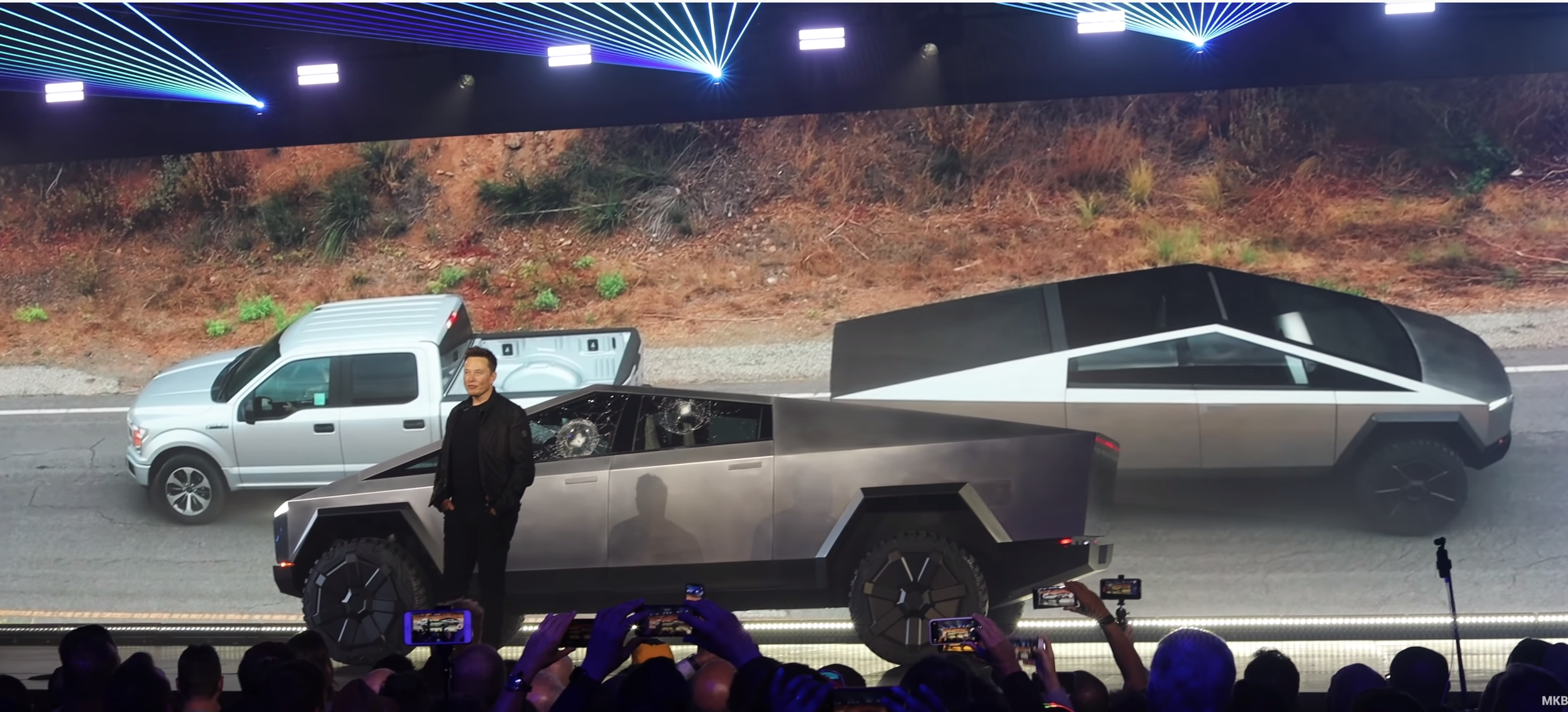
What are the vehicle dimensions?
The Cybertruck looks massive. During the presentation, it’s showed next to several other vehicles, including a Ford F-150 SuperCrew with a 5-1/2-foot bed. The Cybertruck looks significantly longer and wider.
I drive a Ford F-150 SuperCrew with a 6-1/2-foot bed. It’s longer than a standard parking spot. It’s very long and hard to park, even in suburban parking spots. I worry the Cybertruck will be even harder to park — though the tough exterior will help door dings.
If the Cybertruck is longer and wider than a standard pickup truck, it will need additional lights to drive on US roads. Any vehicle wider than 80-inches, the US Government mandates the vehicle has five orange safety lights to illustrate the width. The Cybertruck showed during the presentation lacked these lights.
Why super glass?
The Cybertruck is a unibody design, something Elon talked up extensively throughout the introduction. A unibody vehicle distributes stress throughout the body instead of a decoupled frame. But unibody trucks are not new, and there are several on the market, including the Honda Ridgeline. None have bulletproof glass.
With more stress hitting the body, durable glass is wanted to help handle the pressure.
But why extra strong glass? Adding extra durable glass seems like a waste of weight, and Tesla didn’t explain the justification outside of saying it’s cool.
What’s the target market?
Who does Tesla expect to buy the Cybertruck?
For construction companies, the massive (and necessary) sail pillar is polarizing and impractical as it limits the utility of the bed. Plus, Tesla doesn’t like owners wrenching on their vehicles, which could hamper on-the-spot repairs construction companies generally employ.
For those hauling trailers, the Cybertruck’s range is dramatically less than what’s possible with gasoline and diesel engines and will be even less once under load.
For the weekend DIY, the Cybertruck appears to be extremely long, limiting its appeal as a daily driver when it needs to navigate parking lots and city streets.
Eventually, Tesla will answer the questions above as the Cybertruck nears release.
from TechCrunch https://ift.tt/2OA9txl
via IFTTT
Comments
Post a Comment