Elon Musk revealed Thursday evening the Tesla Cybertruck, a futuristic vehicle that seemed stripped straight out of a post-apocalyptic era movie.
The Tesla Cybertruck, which Musk unveiled in dramatic fashion and to the hoots and hollers of invited guests at the Tesla Design Center in Hawthorne, California, is made of cold-rolled steel, armored glass that did crack in one demonstration, and adaptive air suspension.
And yet despite its cubist look and performance specs, its price is rather modest.
Tesla will offer three variants of the cybertruck. The cheapest version, a single motor and rear wheel drive model, will cost $39,900, have a towing capacity of 7,500 pounds and more than 250 miles of range. The middle version will be a dual-motor all-wheel drive, have a towing capacity of more than 10,000 pounds and be able to travel more than 300 miles on a single charge. The dual motor AWD model is priced at $49,900.
The third version will have three electric motors and all-wheel, a towing capacity of 14,000 pounds and battery range of more than 500 miles. This version, known as “tri motor” is priced at $69,900.
Musk touted the acceleration of the Cybertruck as well, showing a video at one point of the truck beat a Porsche 911 off the line. Musk said the “tri motor” version can travel from 0 to 60 miles per hour in under 2.9 seconds. The single motor rear wheel is the slowest off the line with a 0 to 60 mph acceleration of less than 6.5 seconds.
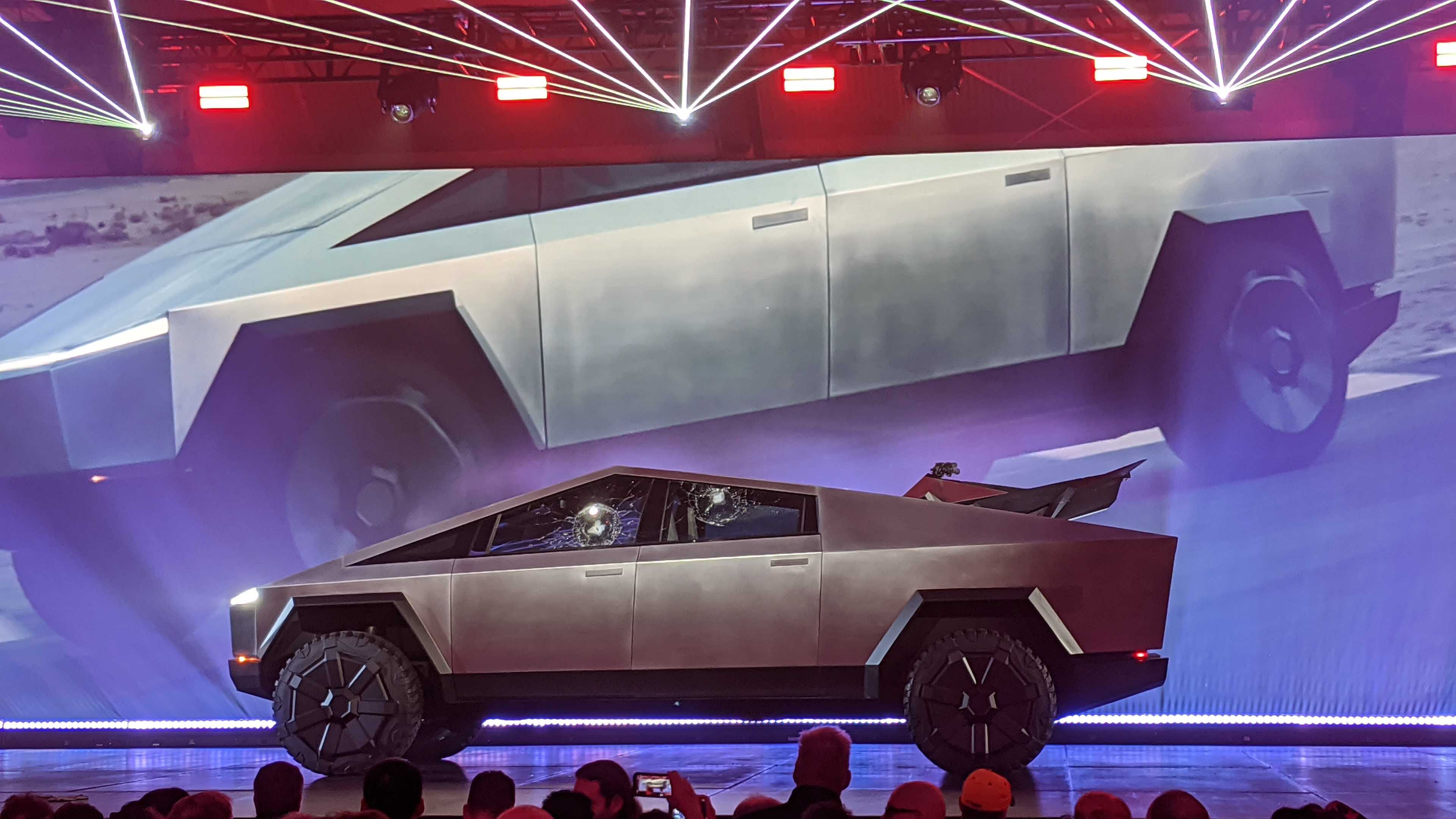
Tesla CEO Elon Musk revealed Thursday, November 21, 2019, the Tesla Cybertruck.
Tesla said customers can put down a $100 deposit. They’ll be able to complete their configuration as production nears in late 2021. Tri Motor AWD production is expected to begin in late 2022.
Musk has talked about producing an all-electric pickup truck for years now. In December, Musk resurrected the idea, saying that Tesla might have a prototype to unveil in 2019.
Musk mentioned on Twitter the desire to produce a pickup truck in April 2017, before the first Model 3 sedans had been handed over to customers and the CEO had entered production hell. At the time, Musk tweeted that a pickup truck would be unveiled in 18 to 24 months.
If Tesla were to hit that mark it would be bringing its electric truck to market after GM and Rivian have started delivering their products.
Rivian is expected to begin vehicle production of its electric R1T pickup truck in the second half of 2020. GM CEO Mary Barra said Thursday during an investor conference that the automaker plans to bring an electric pickup truck to market in 2021. Ford also is planning an electric F-150 truck.
It’s unclear how much demand there will be for electric pickup trucks. However, the demand for gas- and diesel-powered trucks is growing. Large trucks account for 14.4% of new vehicle sales through October, compared to 12.6% in 2015, according to Edmunds.
Midsize trucks accounted for 3.7% of new vehicle sales through October, compared to 1.5% in 2014.
Automakers are keen to tap into that growth since trucks and SUVs, which tend to have higher profit margins than sedans. And those margins could continue to increase if automakers can keep costs down.
The average transaction price of a full-size truck (gas and diesel) crossed $50,000 for the first time in September, and continues to climb, according Jessica Caldwell, the executive director of insights at Edmunds. The average transaction price of a full-size truck was $50,496 in October, and a midsize truck was $36,251.
from TechCrunch https://ift.tt/2OEjPw2
via IFTTT
Comments
Post a Comment