The Indian conglomerate Reliance is poised to outpace Amazon and Walmart-backed Flipkart in the race for the country’s $150 billion e-commerce market, analysts at Bernstein projected in a scathing report to clients this week, challenging the prevailing industry views that favor the incumbent global powerhouses.
Bernstein’s projection hinges on a quartet of compelling advantages that they argue will propel Reliance to the top: a robust retail network, a sweeping mobile network, a holistic digital ecosystem, and a “home field advantage” in a notoriously challenging regulatory landscape. These factors should help Reliance seize the majority of the massive e-commerce market in the longer run, the wealth management firm said.
Reliance Retail, a Reliance Industries subsidiary, is already a dominant force, operating the country’s largest retail chain, with over 18,000 stores. Bernstein sees the conglomerate’s expansive physical presence, bolstered by numerous recent acquisitions of retail companies with a focus on e-commerce, and a partnership with Meta to develop a small business communication platform through WhatsApp Business as constituting a formidable “competitive moat” for the Indian powerhouse. E-commerce still accounts for less than 10% of India’s overall retail.
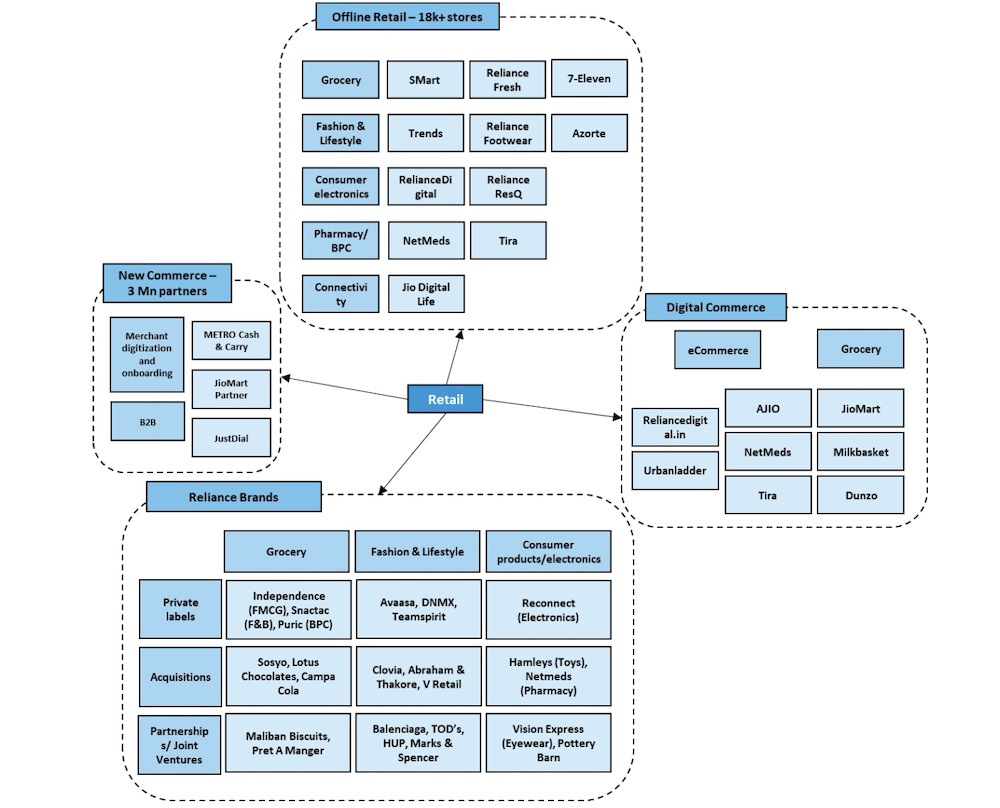
Reliance Retail ecosystem. (Image and analysis: Bernstein)
In contrast, Flipkart, which is heavily reliant on the wireless and mobile category – accounting for half of e-commerce sales in India – is facing concerns as the country’s smartphone shipments slow. Moreover, the lower-margin nature of the smartphone category necessitates both Flipkart and Amazon to grow their high-margin categories.
For Amazon, the recent pledged $12.7 billion investment in Amazon Web Services in India suggests a shift in focus towards cloud services in the South Asian market. Bernstein’s report reveals that while Amazon’s cloud business operates with losses of merely $500,000 to $1 million, the e-commerce division has lost up to $500 million in India.
Furthermore, Amazon is losing ground in high-profit categories such as fashion. While Flipkart claims a commanding 60% market share in this sector, Amazon only captures 20%. Reliance’s AJio is hot on their heels, already securing over 15% of the fashion market, according to Bernstein.
Bernstein values Reliance Retail’s e-commerce business at $36.4 billion, surpassing Flipkart’s adjusted $33 billion valuation after the spin-off of PhonePe. The wealth management firm values Reliance Retail at $110.9 billion.
Arguably the most daunting obstacle facing Amazon and Flipkart is India’s complex regulatory environment. Local legislation prevents these marketplace-model firms from owning, selling, and pricing goods directly. In contrast, Reliance’s inventory-led model allows it to navigate these challenges with inventory control, pricing autonomy, and an enhanced customer experience.
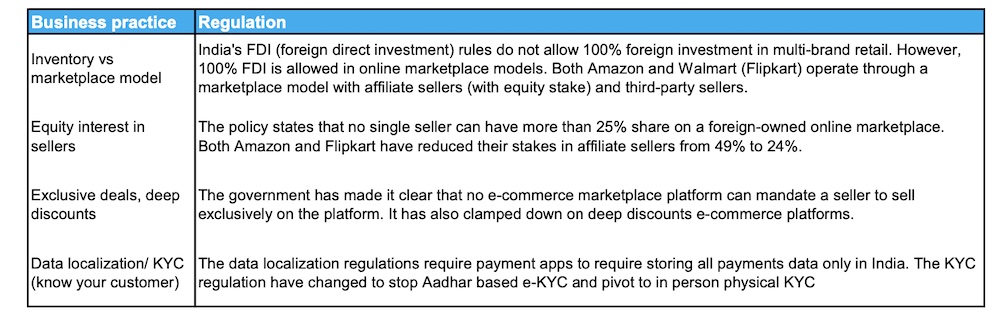
E-commerce business practices and regulations in India (Image and analysis: Bernstein)
Bernstein also contends that India’s relatively undeveloped seller ecosystem hampers the execution of a pure marketplace model, a model that is responsible for over 80% of e-commerce gross merchandise value in China. Despite this, they note, the third-party model proves victorious in terms of SKU depth and is more straightforward in China due to the typical responsibility of merchants for fulfillment via express delivery companies.
Bernstein pegs Reliance as India’s eventual e-commerce kingpin by Manish Singh originally published on TechCrunch
source https://techcrunch.com/2023/05/25/bernstein-pegs-reliance-as-india-eventual-e-commerce-kingpin/
Comments
Post a Comment