
Walmart’s AI is getting smarter about grocery delivery

It’s no surprise that the coronavirus pandemic has changed the way we shop, especially when it comes to groceries. Grocery delivery apps experienced a record number of downloads in March 2020, and by the following month, Walmart Grocery (which is now integrated into the Walmart app) surpassed Amazon as the No. 1 shopping app on both Google Play and the App Store. But even as pandemic restrictions have eased, consumers are still using ordering groceries for delivery or pickup more frequently than they were pre-pandemic.

As Walmart’s grocery delivery services have continued to boom, posing competition to companies like Amazon and Instacart, the tech that Walmart uses has expanded too. Today, Walmart shared information about how it’s training its AI to make smarter substitutions in online grocery orders.

Bringing this technology to grocery delivery isn’t novel by any means. Last May, Walmart reported how it used to AI to determine eligibility for its Express delivery service, which was brand new at the time. A year into the United States’ coronavirus outbreak, Instacart engineers reported that they crunched “petabytes daily to predict what will be on grocery shelves and even how long it will take to find parking.”

So what makes Walmart’s AI for grocery substitutions unique? According to Srini Venkatesan, an Executive Vice President at Walmart Global Tech, it’s the sheer quantity of data that Walmart can use to teach its AI. Over 200 million people shop at Walmart in-store and online each week for more than 150,000 different grocery products. The AI uses that data to predict consumer behavior, preferences, and needs.

“The tech we built uses deep learning AI to consider hundreds of variables — size, type, brand, price, aggregate shopper data, individual customer preference, current inventory and more — in real time to determine the best next available item,” explained Venkatesan. “It then preemptively asks the customer to approve the substituted item or let us know they don’t want it, an important signal that’s fed back into our learning algorithms to improve the accuracy of future recommendations.”
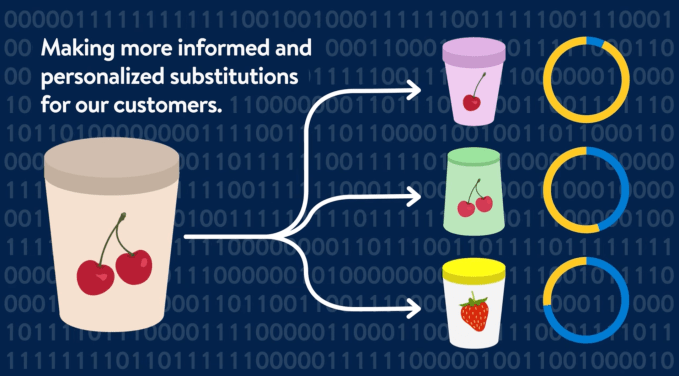
Image Credits: Walmart

Rather than asking a Personal Shopper to make a quick decision about how to substitute for cherry yogurt (do you get a different flavor from the same brand, the same flavor from a more expensive brand, and so on), the AI makes that choice for them. Walmart started developing this algorithm last year, and in the time since, customer acceptance of substitutions has improved.

“We were at about 90% before this algorithm rolled out,” said Venkatesan. “We are now around 97% to 98%.”

In the last year, Walmart doubled its number of Personal Shoppers to over 170,000 workers. About 3,750 stores are enabled for order pickup, and 3,000 stores are enabled for delivery, which covers 68% of the population. Earlier this year, Walmart dropped the $35 order minimum on its Express delivery service, a competitor to Amazon’s Prime Now.


from TechCrunch https://ift.tt/3dagfXI
via IFTTT

Comments

Popular posts from this blog

The Silent Revolution of On-Device AI: Why the Cloud Is No Longer King

Introduction For years, artificial intelligence has meant one thing: the cloud. Whether you’re asking ChatGPT a question, editing a photo with AI tools, or getting recommendations on Netflix — those decisions happen on distant servers, not your device. But that’s changing. Thanks to major advances in silicon, model compression, and memory architecture, AI is quietly migrating from giant data centres to the palm of your hand. Your phone, your laptop, your smartwatch — all are becoming AI engines in their own right. It’s a shift that redefines not just how AI works, but who controls it, how private it is, and what it can do for you. This article explores the rise of on-device AI — how it works, why it matters, and why the cloud’s days as the centre of the AI universe might be numbered. What Is On-Device AI? On-device AI refers to machine learning models that run locally on your smartphone, tablet, laptop, or edge device — without needing constant access to the cloud. In practi...

Apple’s AI Push: Everything We Know About Apple Intelligence So Far

Apple’s WWDC 2025 confirmed what many suspected: Apple is finally making a serious leap into artificial intelligence. Dubbed “Apple Intelligence,” the suite of AI-powered tools, enhancements, and integrations marks the company’s biggest software evolution in a decade. But unlike competitors racing to plug AI into everything, Apple is taking a slower, more deliberate approach — one rooted in privacy, on-device processing, and ecosystem synergy. If you’re wondering what Apple Intelligence actually is, how it works, and what it means for your iPhone, iPad, or Mac, you’re in the right place. This article breaks it all down.   What Is Apple Intelligence? Let’s get the terminology clear first. Apple Intelligence isn’t a product — it’s a platform. It’s not just a chatbot. It’s a system-wide integration of generative AI, machine learning, and personal context awareness, embedded across Apple’s OS platforms. Think of it as a foundational AI layer stitched into iOS 18, iPadOS 18, and m...

Max Q: Anomalous

Hello and welcome back to Max Q! Last week wasn’t the most successful for spaceflight missions. We’ll get into that a bit more below. In this issue: First up, a botched launch from Virgin Orbit… …followed by one from ABL Space Systems News from Rocket Lab, World View and more Virgin Orbit’s botched launch highlights shaky financial future After Virgin Orbit’s launch failure last Monday, during which the mission experienced an  “anomaly” that prevented the rocket from reaching orbit, I went back over the company’s financials — and things aren’t looking good. For Virgin Orbit, this year has likely been completely turned on its head. The company was aiming for three launches this year, but everything will remain grounded until the cause of the anomaly has been identified and resolved. It’s unclear how long that will take, but likely at least three months. Add this delay to Virgin’s dwindling cash reserves and you have a foundation that’s suddenly much shakier than before. ...