Regularly testing waterways and reservoirs is a never-ending responsibility for utility companies and municipal safety authorities, and generally — as you might expect — involves either a boat or at least a pair of waders. Nixie does the job with a drone instead, making the process faster, cheaper, and a lot less wet.
The most common methods of testing water quality haven’t changed in a long time, partly because they’re effective and straightforward, and partly because really, what else are you going to do? No software or web platform out there is going to reach into the middle of the river and pull out a liter of water.
But with the advent of drones powerful and reliable enough to deploy in professional and industrial circumstances, the situation has changed. Nixie is a solution by the drone specialists at Reign Maker, involving either a custom-built sample collection arm or an in-situ sensor arm.
The sample collector is basically a long vertical arm with a locking cage for a sample container. You put the empty container in there, fly the drone out to the location, then submerge the arm. When it flies back, the filled container can be taken out while the drone hovers and a fresh one put in its place to bring to the next spot. (This switch can be done safely in winds up to 18 MPH and sampling in currents up to 5 knots, the company said.)
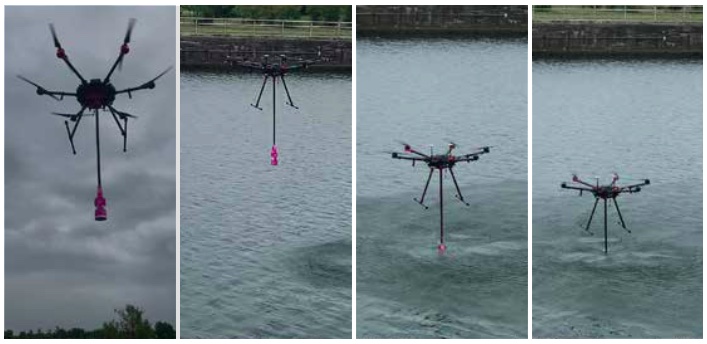
Image Credits: Reign Maker
This allows for quick sampling at multiple locations — the drone’s battery will last about 20 minutes, enough for two to four samples depending on the weather and distance. Swap the battery out and drive to the next location and do it all again.
For comparison, Reign Maker pointed to New York’s water authority, which collects 30 samples per day from boats and other methods, at an approximate cost (including labor, boat fuel, etc) of $100 per sample. Workers using Nixie were able to collect an average of 120 samples per day, for around $10 each. Sure, New York is probably among the higher cost locales for this (like everything else) but the deltas are pretty huge. (The dipper attachment itself costs $850, but doesn’t come with a drone.)
It should be mentioned that the drone is not operating autonomously; it has a pilot who will be flying with line of sight (which simplifies regulations and requirements). But even so, that means a team of two, with a handful of spare batteries, can cover the same space that would normally take a boat crew and more than a little fuel. Currently the system works with the M600 and M300 RTK drones from DJI.
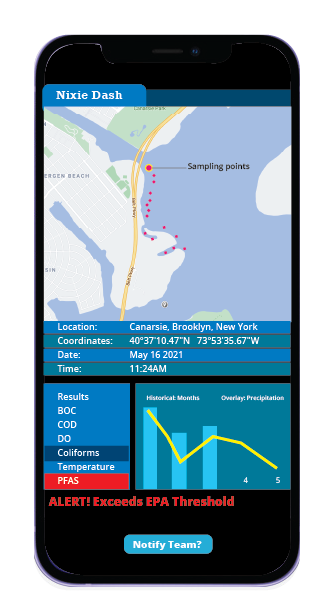
Image Credits: Reign Maker
The drone method has the added benefits of having precise GPS locations for each sample and of not disturbing the water when it dips in. No matter how carefully you step or pilot a boat, you’re going to be pushing the water all over the place, potentially affecting the contents of the sample, but that’s not the case if you’re hovering overhead.
In development is a smarter version of the sampler that includes a set of sensors that can do on-site testing for all the most common factors: temperature, pH, troubling organisms, various chemicals. Skipping the step of bringing the water back to a lab for testing streamlines the process immensely, as you might expect.
Right now Reign Maker is working with New York’s Department of Environmental Protection and in talks with other agencies. While the system would take some initial investment, training, and getting used to, it’s probably hard not to be tempted by the possibility of faster and cheaper testing.
Ultimately the company hopes to offer (in keeping with the zeitgeist) a more traditional SaaS offering involving water quality maps updating in real time with new testing. That too is still in the drawing-board phase, but once a few customers sign up it starts looking a lot more attractive.


from TechCrunch https://ift.tt/2U4gE7d
via IFTTT
Comments
Post a Comment