E-commerce startup Little Birdie lands $30M AUD pre-launch funding from Australia’s largest bank

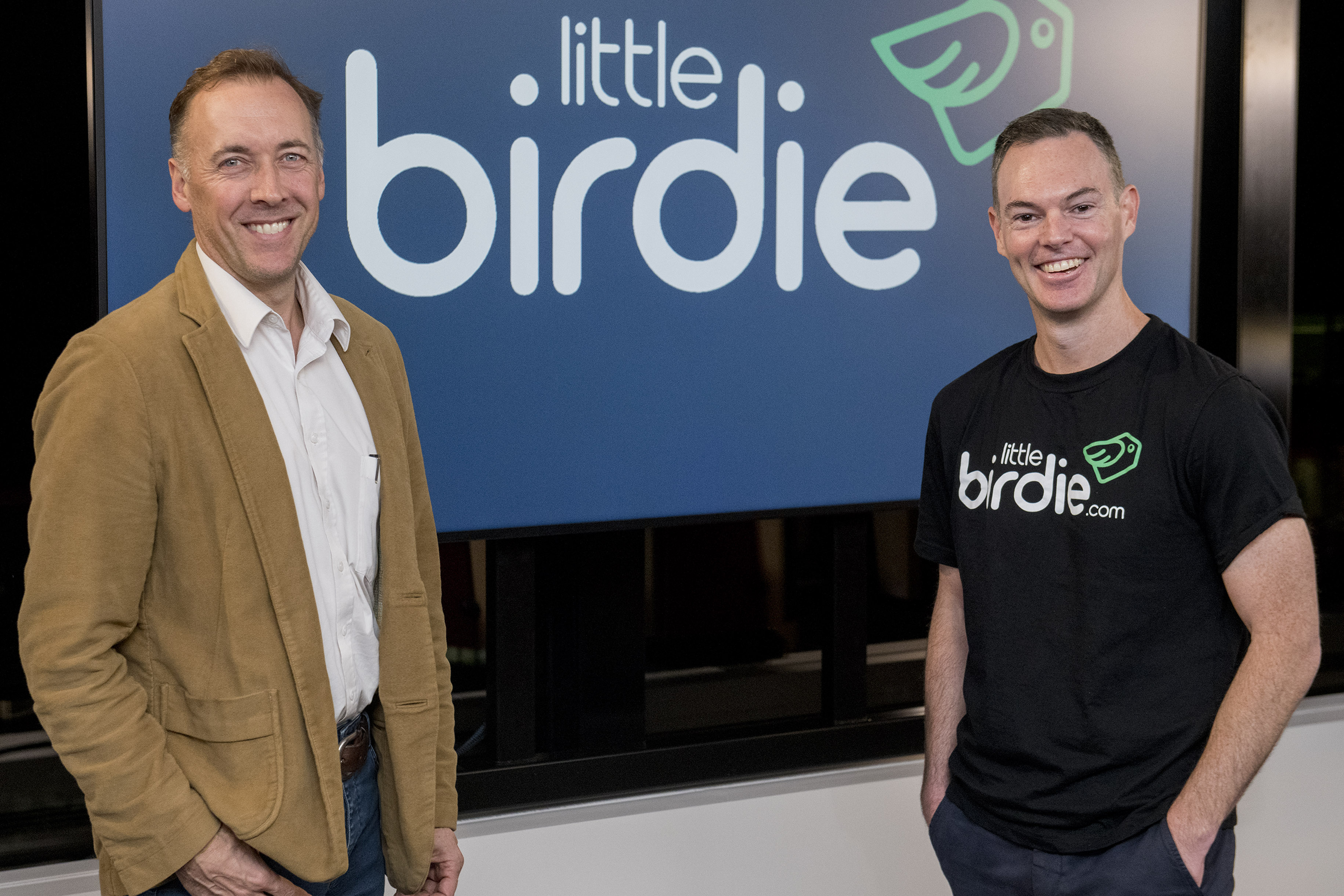
A photo of (left) Commonwealth Bank group executive Angus Sullivan and (right) Jon Beros, co-founder and CEO of Little Birdie, standing in front of Little Birdie’s logo

Commonwealth Bank group executive Angus Sullivan and Jon Beros, co-founder and CEO of Little Birdie

Melbourne-based Little Birdie, an e-commerce startup that wants to become the “new homepage of online shopping,” won’t launch until next month, but it’s already scored a major investor. Commonwealth Bank of Australia (CBA), the largest of Australia’s “Big Four” banks, has poured $30 million AUD (about $23.2 million USD) in pre-launch funding into Little Birdie, and will also integrate its shopping content, including exclusive offers, into its consumer banking app, which reaches 11 million retail customers in Australia.

Little Birdie says this brings its valuation to $130 million AUD (about $100 million USD). Compared to the United States, where Amazon is the largest e-commerce retailer by far, Australian shoppers spend more time choosing between several platforms, including large marketplaces like eBay, Gumtree, Amazon, Woolworths and a host of smaller players.

Set to launch in mid-June, Little Birdie will aggregate over 70 million products from different online brands and stores, with the goal of being the first place shoppers look when they want to buy something. Users can use Little Birdie to track and compare products, and look for price drops, sales and offers. The SKUs come from a combination of brand partnerships and scraping e-commerce sites, with the majority from retailers’ product feeds.

Co-founder and chief executive officer Jon Beros told TechCrunch that “Australia’s e-commerce market is very competitive and quite fragmented with a lot of retailers fighting for market share. The pandemic accelerated online adoption and saw many retailers switch on an online presence, or shift their focus online. With so many players fighting for the attention of shoppers and driving up the cost of acquisition, Little Birdie can genuinely help retailers by providing a new marketing channel that delivers qualified customers leads.”

Commonwealth Bank will be able to access Little Birdie’s catalog of shopping content to create targeted offers for customers, including features that link savings goals to specific items through its money management tools. Beros said that Little Birdie will also seek two different types of brand partnerships: “Firstly with retailers who come on board to promote their exclusive offers and products on Little Birdie and secondly with major brands and media companies that look to integrate our shopping content into their apps or websites. These integration partners ultimately deepen the value Little Birdie offers its retail partners by helping to amplify the reach of their offers to a wider audience.”

The company is looking at expansion into Southeast Asia and the United States, but Beros said there is not a firm timeline for its international growth yet, since it depends on the COVID-19 pandemic situation and when borders start to reopen.

In a press statement, Commonwealth Bank group executive Angus Sullivan said, “We believe customers should have access to the world’s best digital experience and our partnership with Little Birdie will give customers access to exclusive industry leading deals via the CommBank app.”


from TechCrunch https://ift.tt/2Soa4I9
via IFTTT

Comments

Popular posts from this blog

The Silent Revolution of On-Device AI: Why the Cloud Is No Longer King

Introduction For years, artificial intelligence has meant one thing: the cloud. Whether you’re asking ChatGPT a question, editing a photo with AI tools, or getting recommendations on Netflix — those decisions happen on distant servers, not your device. But that’s changing. Thanks to major advances in silicon, model compression, and memory architecture, AI is quietly migrating from giant data centres to the palm of your hand. Your phone, your laptop, your smartwatch — all are becoming AI engines in their own right. It’s a shift that redefines not just how AI works, but who controls it, how private it is, and what it can do for you. This article explores the rise of on-device AI — how it works, why it matters, and why the cloud’s days as the centre of the AI universe might be numbered. What Is On-Device AI? On-device AI refers to machine learning models that run locally on your smartphone, tablet, laptop, or edge device — without needing constant access to the cloud. In practi...

Apple’s AI Push: Everything We Know About Apple Intelligence So Far

Apple’s WWDC 2025 confirmed what many suspected: Apple is finally making a serious leap into artificial intelligence. Dubbed “Apple Intelligence,” the suite of AI-powered tools, enhancements, and integrations marks the company’s biggest software evolution in a decade. But unlike competitors racing to plug AI into everything, Apple is taking a slower, more deliberate approach — one rooted in privacy, on-device processing, and ecosystem synergy. If you’re wondering what Apple Intelligence actually is, how it works, and what it means for your iPhone, iPad, or Mac, you’re in the right place. This article breaks it all down.   What Is Apple Intelligence? Let’s get the terminology clear first. Apple Intelligence isn’t a product — it’s a platform. It’s not just a chatbot. It’s a system-wide integration of generative AI, machine learning, and personal context awareness, embedded across Apple’s OS platforms. Think of it as a foundational AI layer stitched into iOS 18, iPadOS 18, and m...

Billionaire clothing dynasty heiress launches Everybody & Everyone to make fashion sustainable

Veronica Chou’s family has made its fortune at the forefront of the fast fashion business through investments in companies like Michael Kors and Tommy Hilfiger . But now, the heiress to an estimated $2.1 billion fortune is launching her own company, Everybody & Everyone , to prove that the fashion industry can be both environmentally sustainable and profitable. There’s no argument about the negative impacts of the fashion industry on the environment. The textiles industry primarily uses non-renewable resources — on the order of 98 million tons per year. That includes the oil to make synthetic fibers, fertilizers to grow cotton, and toxic chemicals to dye, treat, and produce the textiles used to make clothes. The greenhouse gas footprint from textiles production was roughly 1.2 billion tons of CO2 equivalent in 2015 — more than all international flights and maritime shipments combined (and a lot of those maritime shipments and international flights were hauling clothes). The lit...