
Microsoft offers a closer look at the next Xbox

It’s been a few months since Microsoft announced the impending arrival of the Xbox Series X. The somewhat redundantly named console made cameo during the Game Awards, getting a late 2020 date in the process.

We got at glimpse at the big, boxy design and peek into a handful of features, including the new wireless controllers and backward game compatibility. It didn’t, however, really get into the nitty gritty of what’s going to set the next-gen console apart. Thankfully, MS’s head of Xbox Phil Spencer is back with some honest to goodness specs.

“Xbox Series X is our fastest, most powerful console ever, designed for a console generation that has you at its center,” Spencer writes. “This means a high-fidelity gaming experience enclosed in a quiet and bold design, with the ability to discover thousands of games across four generations, all with more playing and less waiting.”

The headline feature here is, naturally, a new processor. Built on top of AMD Zen 2 and RDNA 2 architecture, Xbox says chip is able to deliver four times the processing power of the Xbox One. The silicon offers 12 teraflops of GPU performance — that’s double the Xbox One X and 8x the original Xbox One. Other notable additions include Variable Rate Shading for improved frame rates and resolution and DirectX Raytracing for better lighting.
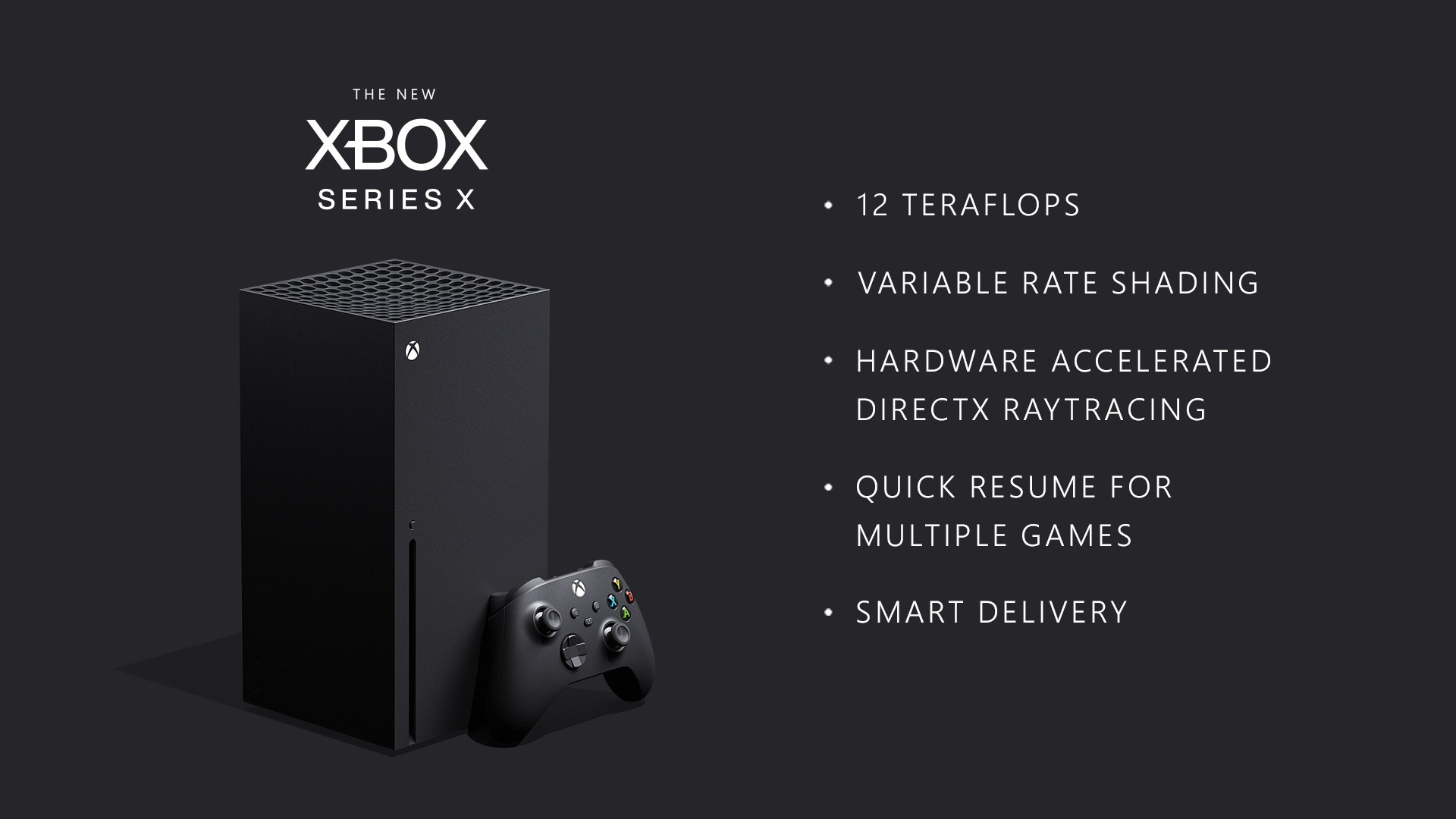
Quick Resume is basically what it sounds like, letting players pick up on multiple games, exactly where they left off. Dynamic Latency Input aims to bring more responsive feed back from controllers, by reducing latency. 120fps video will be supported by the console, along with HDMI 2.1, which automatically switches to the lowest latency mode to reduce game play lag.

As noted above, backward compatibility is central, now that Microsoft has a few generations of consoles under its belt. Game Pass is increasingly important in the company’s play moving forward, as it ramps up focus on cloud gaming.

More information is promised in “coming months.” Once again, Microsoft will have a stiff competition on its hands, with the PlayStation 5 currently slated for “holiday 2020.” 


from TechCrunch https://ift.tt/32oK0NG
via IFTTT

Comments

Popular posts from this blog

The Silent Revolution of On-Device AI: Why the Cloud Is No Longer King

Introduction For years, artificial intelligence has meant one thing: the cloud. Whether you’re asking ChatGPT a question, editing a photo with AI tools, or getting recommendations on Netflix — those decisions happen on distant servers, not your device. But that’s changing. Thanks to major advances in silicon, model compression, and memory architecture, AI is quietly migrating from giant data centres to the palm of your hand. Your phone, your laptop, your smartwatch — all are becoming AI engines in their own right. It’s a shift that redefines not just how AI works, but who controls it, how private it is, and what it can do for you. This article explores the rise of on-device AI — how it works, why it matters, and why the cloud’s days as the centre of the AI universe might be numbered. What Is On-Device AI? On-device AI refers to machine learning models that run locally on your smartphone, tablet, laptop, or edge device — without needing constant access to the cloud. In practi...

Apple’s AI Push: Everything We Know About Apple Intelligence So Far

Apple’s WWDC 2025 confirmed what many suspected: Apple is finally making a serious leap into artificial intelligence. Dubbed “Apple Intelligence,” the suite of AI-powered tools, enhancements, and integrations marks the company’s biggest software evolution in a decade. But unlike competitors racing to plug AI into everything, Apple is taking a slower, more deliberate approach — one rooted in privacy, on-device processing, and ecosystem synergy. If you’re wondering what Apple Intelligence actually is, how it works, and what it means for your iPhone, iPad, or Mac, you’re in the right place. This article breaks it all down.   What Is Apple Intelligence? Let’s get the terminology clear first. Apple Intelligence isn’t a product — it’s a platform. It’s not just a chatbot. It’s a system-wide integration of generative AI, machine learning, and personal context awareness, embedded across Apple’s OS platforms. Think of it as a foundational AI layer stitched into iOS 18, iPadOS 18, and m...

Max Q: Anomalous

Hello and welcome back to Max Q! Last week wasn’t the most successful for spaceflight missions. We’ll get into that a bit more below. In this issue: First up, a botched launch from Virgin Orbit… …followed by one from ABL Space Systems News from Rocket Lab, World View and more Virgin Orbit’s botched launch highlights shaky financial future After Virgin Orbit’s launch failure last Monday, during which the mission experienced an  “anomaly” that prevented the rocket from reaching orbit, I went back over the company’s financials — and things aren’t looking good. For Virgin Orbit, this year has likely been completely turned on its head. The company was aiming for three launches this year, but everything will remain grounded until the cause of the anomaly has been identified and resolved. It’s unclear how long that will take, but likely at least three months. Add this delay to Virgin’s dwindling cash reserves and you have a foundation that’s suddenly much shakier than before. ...