
Ethyca raises $4.2M to simplify GDPR compliance

GDPR, the European data privacy regulations, have been in effect for over a year, but it’s still a challenge for companies to comply. Ethyca, a New York City startup, has created a solution from the ground up to help customers adhere to the regulations, and today it announced a $4.2 million investment led by IA Ventures and Founder Collective.

Table Management, Sinai Ventures, Cheddar founder Jon Steinberg and Moat co-founder Jonah Goodhart also participated.

At its heart Ethyca is a data platform that helps companies discover sensitive data, then provides a mechanism for customers to see, edit or delete their data from the system. Finally, the solution enables companies to define who can see particular types of data across the organization to control access. All of these components are designed to help companies comply with GDPR regulations.
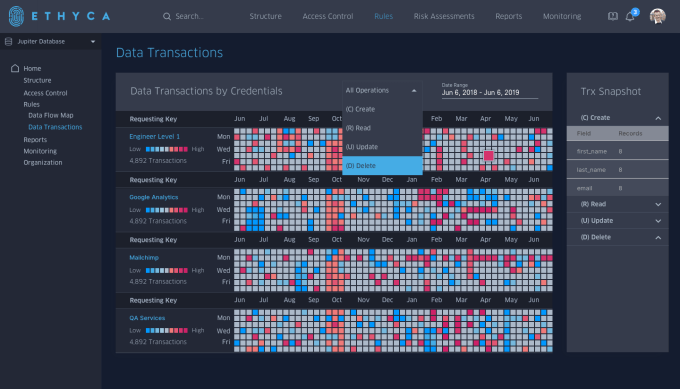
ethyca enterprise transaction log

Ethyca enterprise transaction log. Screenshot: Ethyca

Company co-founder Cillian Kieran says that the automation component is key and should greatly reduce the complexity and cost associated with complying with GDPR rules. From his perspective, current solutions which involve either expensive consultants or solutions that require some manual intervention, don’t get companies all the way there.

“These solutions don’t actually solve the issue from an infrastructure point of view. I think that’s the distinction. You can go and use the consultants, or you can use a control panel that tells you what you need to do. But ultimately, at some point you’re either going to have to build or deploy code that fixes some issues, or indeed manually manage or remediate those [issues]. Ethyca is designed for that and takes away those risks because it is managing privacy by design at the infrastructure level,” Kieran explained.

If you’re worried about the privacy of providing information like this to a third-party vendor, Kieran says that his company never actually sees the raw data. “We are a suite of tools that sits between business processes. We don’t capture raw data, We don’t see personal information. We find information based on unique identifiers,” he said.

The company has been around for over a year, but has been spending its first year, developing the solution. He sees this investment as validation of the problem his startup is trying to solve. “I think the investment represents the growing awareness fundamentally from both with the investor community, and also in the tech world, that data privacy as a regulatory constraint is real and will compound itself,” he said.

He also points out, GDPR is really just the tip of the privacy regulation iceberg with laws in Australia, Brazil, Japan, as well as California and other states in the US due to come online next year. He says his solution has been designed to deal with a variety of privacy frameworks beyond GDPR. If that’s so, his company could be in a good position moving forward.


from TechCrunch https://ift.tt/2Gq0ETl
via IFTTT

Comments

Popular posts from this blog

The Silent Revolution of On-Device AI: Why the Cloud Is No Longer King

Introduction For years, artificial intelligence has meant one thing: the cloud. Whether you’re asking ChatGPT a question, editing a photo with AI tools, or getting recommendations on Netflix — those decisions happen on distant servers, not your device. But that’s changing. Thanks to major advances in silicon, model compression, and memory architecture, AI is quietly migrating from giant data centres to the palm of your hand. Your phone, your laptop, your smartwatch — all are becoming AI engines in their own right. It’s a shift that redefines not just how AI works, but who controls it, how private it is, and what it can do for you. This article explores the rise of on-device AI — how it works, why it matters, and why the cloud’s days as the centre of the AI universe might be numbered. What Is On-Device AI? On-device AI refers to machine learning models that run locally on your smartphone, tablet, laptop, or edge device — without needing constant access to the cloud. In practi...

Apple’s AI Push: Everything We Know About Apple Intelligence So Far

Apple’s WWDC 2025 confirmed what many suspected: Apple is finally making a serious leap into artificial intelligence. Dubbed “Apple Intelligence,” the suite of AI-powered tools, enhancements, and integrations marks the company’s biggest software evolution in a decade. But unlike competitors racing to plug AI into everything, Apple is taking a slower, more deliberate approach — one rooted in privacy, on-device processing, and ecosystem synergy. If you’re wondering what Apple Intelligence actually is, how it works, and what it means for your iPhone, iPad, or Mac, you’re in the right place. This article breaks it all down.   What Is Apple Intelligence? Let’s get the terminology clear first. Apple Intelligence isn’t a product — it’s a platform. It’s not just a chatbot. It’s a system-wide integration of generative AI, machine learning, and personal context awareness, embedded across Apple’s OS platforms. Think of it as a foundational AI layer stitched into iOS 18, iPadOS 18, and m...

Billionaire clothing dynasty heiress launches Everybody & Everyone to make fashion sustainable

Veronica Chou’s family has made its fortune at the forefront of the fast fashion business through investments in companies like Michael Kors and Tommy Hilfiger . But now, the heiress to an estimated $2.1 billion fortune is launching her own company, Everybody & Everyone , to prove that the fashion industry can be both environmentally sustainable and profitable. There’s no argument about the negative impacts of the fashion industry on the environment. The textiles industry primarily uses non-renewable resources — on the order of 98 million tons per year. That includes the oil to make synthetic fibers, fertilizers to grow cotton, and toxic chemicals to dye, treat, and produce the textiles used to make clothes. The greenhouse gas footprint from textiles production was roughly 1.2 billion tons of CO2 equivalent in 2015 — more than all international flights and maritime shipments combined (and a lot of those maritime shipments and international flights were hauling clothes). The lit...