India’s largest bank has secured an unprotected server that allowed anyone to access financial information on millions of its customers, like bank balances and recent transactions.
The server, hosted in a regional Mumbai-based datacenter, stored two months of data from SBI Quick, a text message and call-based system used to request basic information about their bank accounts by customers of of the government-owned State Bank of India (SBI), the largest bank in the country and a highly ranked company in the Fortune 500.
But the bank had not protected the server with a password, allowing anyone who knew where to look to access the data on millions of customers’ information.
It’s not known for how long the server was open, but long enough for it to be discovered by a security researcher, who told TechCrunch of the leak, but did not want to be named for the story.
SBI Quick allows SBI’s banking customers to text the bank, or make a missed call, to retrieve information back by text message about their finances and accounts. It’s ideal for millions of the banking giant’s customers who don’t use smartphones or have limited data service. By using predefined keywords, like “BAL” for a customer’s current balance, the service recognizes the customer’s registered phone number and will send back current amount in that customer’s bank account. The system can also be used to send back the last five transactions, block an ATM card, and make inquiries about home or car loans.
It was the back-end text message system that was exposed, TechCrunch can confirm, storing millions of text messages each day.
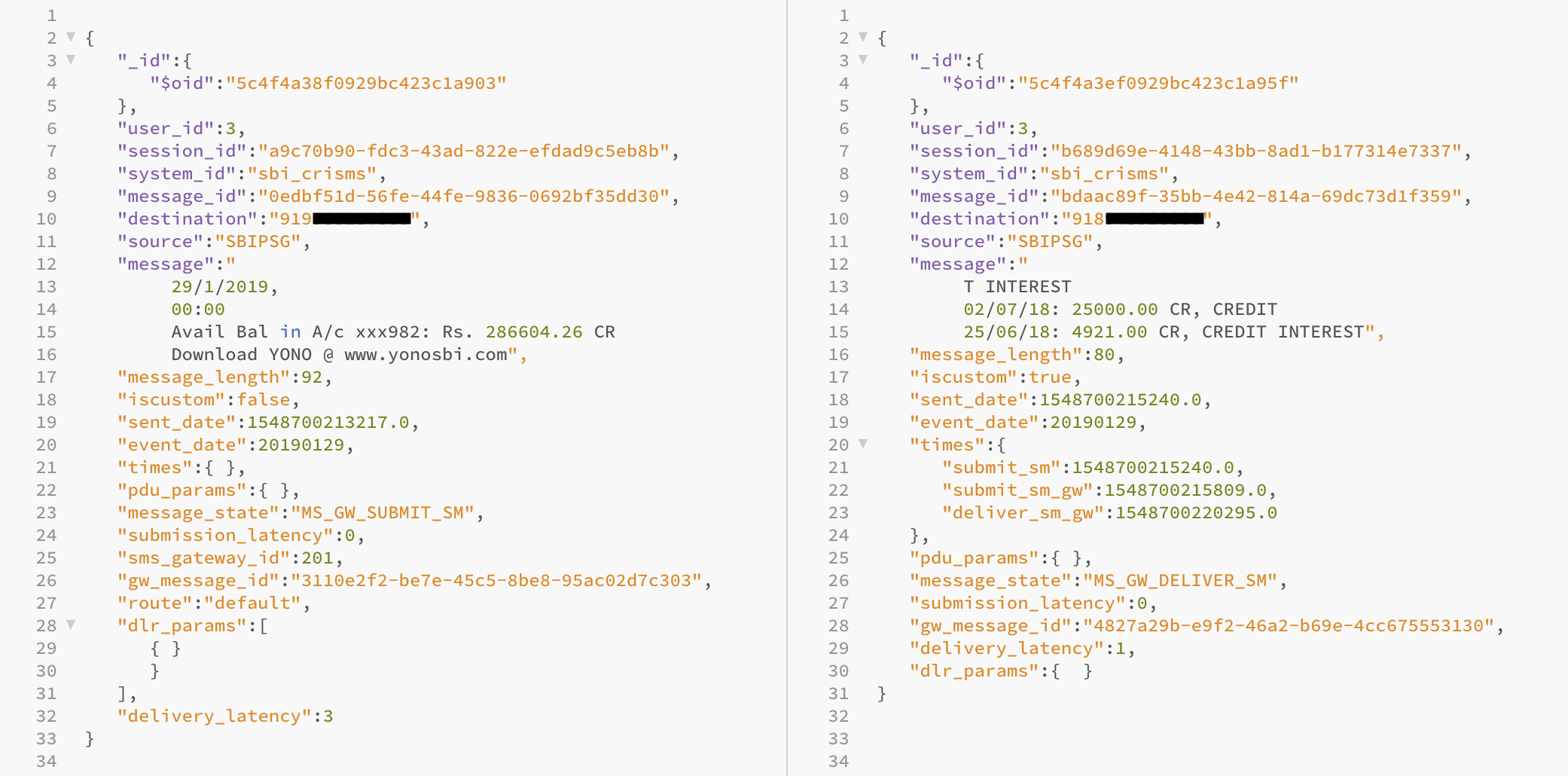
A redacted example of some of the banking and credit information found in the database. (Image: TechCrunch)
The passwordless database allowed us to see all of the text messages going to customers in real-time, including their phone numbers, bank balances, and recent transactions. The database also contained the customer’s partial bank account number. Some would say when a check had been cashed, and many of the bank’s sent messages included a link to download SBI’s YONO app for internet banking.
The bank sent out close to three million text messages on Monday alone.
The database also had daily archives of millions of text messages each, going back to December, allowing anyone with access a detailed view into millions of customers’ finances.
We verified the data by asking India-based security researcher Karan Saini to send a text message to the system. Within seconds, we found his phone number in the database, including the text message that he received back.
“The data available could potentially be used to profile and target individuals that are known to have high account balances,” said Saini in a message to TechCrunch. Saini previously found a data leak in India’s Aadhaar, the country’s national identity database, and a two-factor bypass bug in Uber’s ride-sharing app.
Saini said that knowing a phone number “could be used to aid social engineering attacks — which is one the most common attack vector here with regard to financial fraud,” he said.
SBI claims more than 500 million customers across the globe with 740 million accounts.
Just days earlier, SBI accused Aadhaar’s authority, UIDAI, of mishandling citizen data that allowed fake Aadhaar identity cards to be created, despite numerous security lapses and misuse of the system. UIDAI denied the report, saying there was “no security breach” of its system. (UIDAI often uses the term “fake news” to describe coverage it doesn’t like.)
TechCrunch reached out to SBI and India’s National Critical Information Infrastructure Protection Centre, which receives vulnerability reports for the banking sector. The database was secured overnight.
Despite several emails, SBI did not comment prior to publication.


from TechCrunch https://tcrn.ch/2WD9dRw
via IFTTT
Comments
Post a Comment