
SpaceX wants to land Starship on the Moon before 2022, then do cargo runs for 2024 human landing

Speaking at a quick series of interviews with commercial space company’s at this year’s annual International Astronautical Congress, SpaceX President and COO Gwynne Shotwell shed a little more light on her company’s current thinking with regards to the mission timelines for its forthcoming Starship spacefaring vehicle. Starship, currently in parallel development at SpaceX’s South Texas and Florida facilities, is intended to be an all-purpose successor to, and replacement for, both Falcon 9 and Falcon Heavy, with a higher payload capacity and the ability to reach the Moon and eventually Mars.

“Aspirationally, we want to get Starship to orbit within a year,” Shotwell said. “We definitely want to land it on the Moon before 2022. We want to […] stage cargo there to make sure that there are resources for the folks that ultimately land on the moon by 2024, if things go well, so that’s the aspirational timeframe.”

That’s an ambitious timeline, and as Shotwell herself repeatedly stated, these are “aspirational” timelines. In the space industry, as well as in tech, it’s not uncommon for leadership to set aggressive schedules in order to drive the teams working on projects to work at the limits of what’s actually possible. SpaceX CEO Elon Musk is also known for working to timelines that often don’t match up with reality, and Shotwell alluded to Musk’s ambitious goal setting as a virtue in another part of her on-stage interview at IAC.
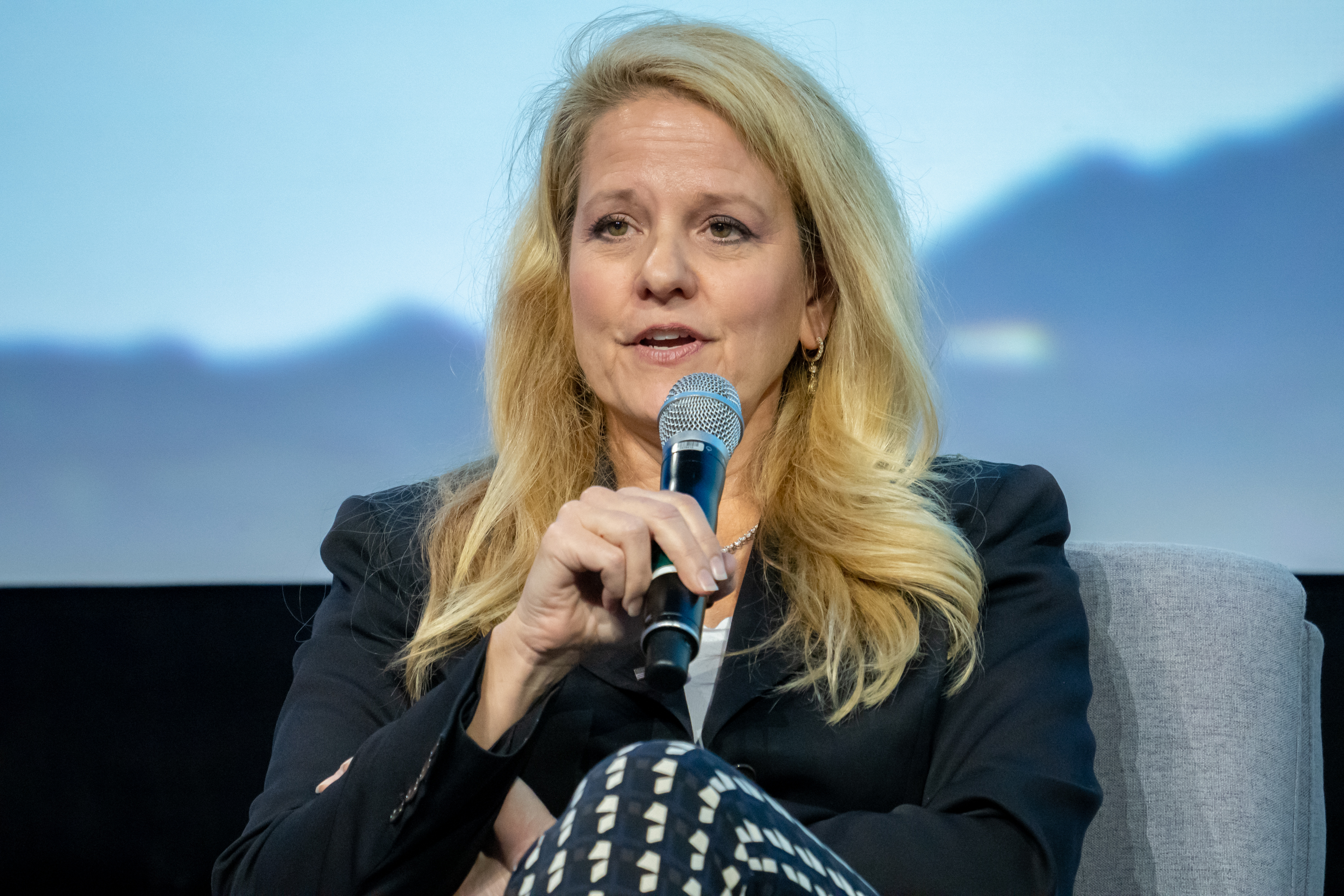
SpaceX President and COO Gwynne Shotwell at IAC 2019

SpaceX President and COO Gwynne Shotwell at IAC 2019 in Washington, D.C.

“Elon puts out these incredibly audacious goals and people say ‘You’re not going to do it, you’ll never get to orbit, you’ll never get a real rocket to orbit, […] you’ll never get Heavy to orbit, you’ll never get Dragon to the station, you’ll never get Dragon back, and you’ll never land a rocket,'” she said. “So, frankly, I love when people say we can’t do it, because it motivates my fantastic 6,500 employees to go do that thing.”

SpaceX has previously discussed its goal of starting its first orbital test flights of Starship within as little as a year. So far, the company has built and tested a so-called ‘Starhopper’ demonstration vehicle, which consisted of just the base of the vehicle and one of the Raptor engines it will use for its new Starship launch system and Super Heavy booster. After completing successful low-altitude flights with that vehicle, SpaceX moved on to assembling its Mk1 and Mk2 Starship test vehicles, which represent the full scale of the ultimate orbital spacecraft, and which are being built by teams in Boca Chica and Cape Canaveral, respectively. These will perform high-altitude testing, before SpaceX builds additional prototypes for orbital, and ultimately human test flights.

SpaceX already has already been contracted by Intuitive Machines and ispace, both companies working with NASA to delivery payloads to the Moon ahead of its 2024 Artemis program human Moon landing, but these payload missions all specify using Falcon 9 to deliver their payloads.


from TechCrunch https://ift.tt/2WcVf93
via IFTTT

Comments

Popular posts from this blog

The Silent Revolution of On-Device AI: Why the Cloud Is No Longer King

Introduction For years, artificial intelligence has meant one thing: the cloud. Whether you’re asking ChatGPT a question, editing a photo with AI tools, or getting recommendations on Netflix — those decisions happen on distant servers, not your device. But that’s changing. Thanks to major advances in silicon, model compression, and memory architecture, AI is quietly migrating from giant data centres to the palm of your hand. Your phone, your laptop, your smartwatch — all are becoming AI engines in their own right. It’s a shift that redefines not just how AI works, but who controls it, how private it is, and what it can do for you. This article explores the rise of on-device AI — how it works, why it matters, and why the cloud’s days as the centre of the AI universe might be numbered. What Is On-Device AI? On-device AI refers to machine learning models that run locally on your smartphone, tablet, laptop, or edge device — without needing constant access to the cloud. In practi...

Apple’s AI Push: Everything We Know About Apple Intelligence So Far

Apple’s WWDC 2025 confirmed what many suspected: Apple is finally making a serious leap into artificial intelligence. Dubbed “Apple Intelligence,” the suite of AI-powered tools, enhancements, and integrations marks the company’s biggest software evolution in a decade. But unlike competitors racing to plug AI into everything, Apple is taking a slower, more deliberate approach — one rooted in privacy, on-device processing, and ecosystem synergy. If you’re wondering what Apple Intelligence actually is, how it works, and what it means for your iPhone, iPad, or Mac, you’re in the right place. This article breaks it all down.   What Is Apple Intelligence? Let’s get the terminology clear first. Apple Intelligence isn’t a product — it’s a platform. It’s not just a chatbot. It’s a system-wide integration of generative AI, machine learning, and personal context awareness, embedded across Apple’s OS platforms. Think of it as a foundational AI layer stitched into iOS 18, iPadOS 18, and m...

Max Q: Anomalous

Hello and welcome back to Max Q! Last week wasn’t the most successful for spaceflight missions. We’ll get into that a bit more below. In this issue: First up, a botched launch from Virgin Orbit… …followed by one from ABL Space Systems News from Rocket Lab, World View and more Virgin Orbit’s botched launch highlights shaky financial future After Virgin Orbit’s launch failure last Monday, during which the mission experienced an  “anomaly” that prevented the rocket from reaching orbit, I went back over the company’s financials — and things aren’t looking good. For Virgin Orbit, this year has likely been completely turned on its head. The company was aiming for three launches this year, but everything will remain grounded until the cause of the anomaly has been identified and resolved. It’s unclear how long that will take, but likely at least three months. Add this delay to Virgin’s dwindling cash reserves and you have a foundation that’s suddenly much shakier than before. ...