Facebook’s news section, which was previously reported to be imminent, is here: The company is rolling out Facebook News in a limited test in the U.S. as a home screen tab and bookmark in the main Facebook app.
In a blog post, Facebook’s Campbell Brown (vice president of global news partnerships) and Mona Sarantakos (product manager, news) said that news articles will continue to appear in the main News Feed. However, they said that creating a specific tab focused on journalism “gives people more control over the stories they see, and the ability to explore a wider range of their news interests, directly within the Facebook app.”
Brown and Sarantakos added that the News tab was developed in consultation with publishers, and also based on feedback from a survey of more than 100,000 Facebook users in the United States earlier this year.
It sounds like Facebook News will use both human editors and algorithms to determine which stories you see — an unusual move for a company that’s been hesitant to police the content posted by users and advertisers. Specifically, there will be a section called Today’s Stories, curated by a team of journalists to highlight the biggest national news stories of the day.

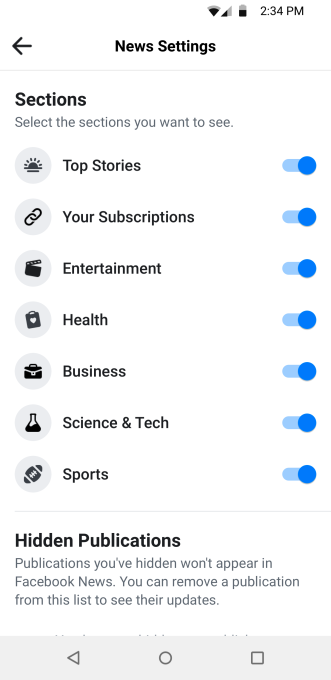
At the same time, Facebook will also provide algorithmic story suggestions based on your interests and activity. You’ll be able to hide articles, topics and publishers that you don’t want to see, and to browse sections devoted to business, entertainment, health, science and technology, and sports — topics where Facebook users apparently felt underserved.
“Regarding personalization, publishers worry that machine learning has limits and they’re right,” Brown and Sarantakos wrote. “We have progress to make before we can rely on technology alone to provide a quality news destination.”
Nonetheless, they suggested that algorithms will be “driving the majority of Facebook News,” and that they’ll be working to ensure that those algorithms are also surfacing “new forms of journalism in the digital age, including individual, independent journalism.”
Also included: a section where users who have linked their news subscriptions to their Facebook accounts can browse content from those subscriptions.
Which publishers will be included? Brown and Sarantakos said they must be part of Facebook’s News Page Index, and also by abide by the company’s Publisher Guidelines, which includes prohibitions against misinformation (as flagged by third-party fact checkers) and hate speech.
Facebook did not provide a list of participating publishers, but screenshots of the News section include stories from The Wall Street Journal, Time, The Washington Post, BuzzFeed News, Bloomberg, Fox Business, Business Insider, NPR and others; spokespeople for The Post, BuzzFeed and the LA Times confirmed their participation.
So even if publishers have been burned by relying too much on the social network in the past, it sounds like they’re not going to give up on working with Facebook.
It probably helps that the company is paying some of these publishers millions of dollars a year, according to Recode. (A Facebook spokesperson told me, “To ensure we’re including a range of topic areas, we’ll start by paying a subset of publishers who can provide a steady volume of fact-based and original content.”)
BuzzFeed News Editor-in-Chief Ben Smith told me via email that BuzzFeed is “glad to participate” and that “Facebook is taking the lead in recognizing the value news provides to these platforms in a tangible way.”
And Hillary Manning, The Los Angeles Times’ vice president of communications, said (also via email), “We anticipate that we’ll reach new readers through Facebook News and, as we reach more readers, we expect to see more growth in our digital subscriber base.”
Facebook says News will be available to a limited group of users in the U.S., starting today.
from TechCrunch https://ift.tt/365xggv
via IFTTT
Comments
Post a Comment