
YC-backed Observant uses the iPhone’s infrared depth sensors to analyze user emotions

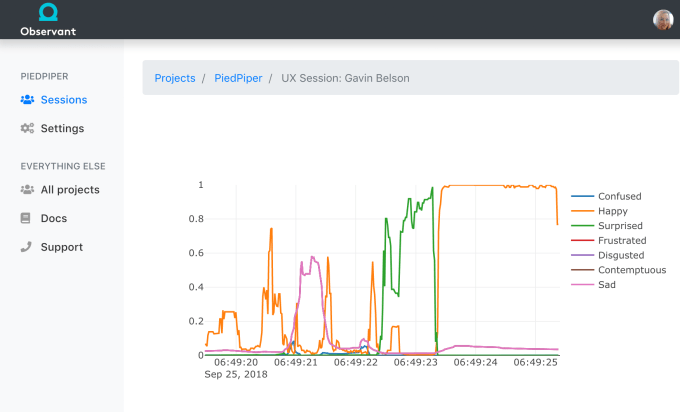
Observant has found a new way to use the fancy infrared depth sensors included on the iPhone X, XS and XR: analyzing people’s facial expression in order to understand how they’re responding to a product or a piece of content.

Observant was part of the winter batch of startups at accelerator Y Combinator, but was still in stealth mode on Demo Day. It was created by the same company behind bug-reporting product Buglife, and CEO Dave Schukin said his team created it because they wanted to find better ways to capture user reactions.

We’ve written about other startups that try to do something similar using webcams and eye tracking, but Schukin (who co-founded the company with CTO Daniel DeCovnick) argued that those approaches are less accurate than Observant’s — in particular, he argued that they don’t capture subtler “microexpressions,” and they don’t do as well in low-light settings.

In contrast, he said the infrared depth sensors can map your face in high levels of detail regardless of lighting, and Observant has also created deep learning technology to translate the facial data into emotions in real time.

Observant has created an SDK that can be installed in any iOS app, and it can provide either a full, real-time stream of emotional analysis, or individual snapshots of user responses tied to specific in-app events. The product is currently invite-only, but Schukin said it’s already live in some retail and e-commerce apps, and it’s also being used in focus group testing.
Observant

Of course, the idea of your iPhone capturing all your facial expressions might sound a little creepy, so he emphasized that as Observant brings on new customers, it’s working with them to ensure that when the data is collected, “users are crystal clear how it’s being used.” Plus, all the analysis actually happens on the users’ device, so no facial footage or biometric data gets uploaded.

Eventually, Schukin suggested that the technology could be applied more broadly, whether that’s by helping companies provide better recommendations, introduce more “emotional intelligence” to their chatbots or even detect sleepy driving.

As for whether Observant can achieve those goals when it’s only working on three phones, Schukin said, “When we started working on this almost a year go, the iPhone X was the only iPhone [with these depth sensors]. Our thinking at the time was, we know how Apple works, we know how this technology propagates over time, so we’re going to place a bet that eventually these depth sensors will be on every iPhone and every iPad, and they’ll be emulated and replicated on Android.”

So while it’s too early to say whether Observant’s bet will pay off, Schukin pointed to the fact that these sensors have expanded from one to three iPhone models as a sign that things are moving in the right direction.


from TechCrunch https://ift.tt/2PritHA
via IFTTT

Comments

Popular posts from this blog

The Silent Revolution of On-Device AI: Why the Cloud Is No Longer King

Introduction For years, artificial intelligence has meant one thing: the cloud. Whether you’re asking ChatGPT a question, editing a photo with AI tools, or getting recommendations on Netflix — those decisions happen on distant servers, not your device. But that’s changing. Thanks to major advances in silicon, model compression, and memory architecture, AI is quietly migrating from giant data centres to the palm of your hand. Your phone, your laptop, your smartwatch — all are becoming AI engines in their own right. It’s a shift that redefines not just how AI works, but who controls it, how private it is, and what it can do for you. This article explores the rise of on-device AI — how it works, why it matters, and why the cloud’s days as the centre of the AI universe might be numbered. What Is On-Device AI? On-device AI refers to machine learning models that run locally on your smartphone, tablet, laptop, or edge device — without needing constant access to the cloud. In practi...

Apple’s AI Push: Everything We Know About Apple Intelligence So Far

Apple’s WWDC 2025 confirmed what many suspected: Apple is finally making a serious leap into artificial intelligence. Dubbed “Apple Intelligence,” the suite of AI-powered tools, enhancements, and integrations marks the company’s biggest software evolution in a decade. But unlike competitors racing to plug AI into everything, Apple is taking a slower, more deliberate approach — one rooted in privacy, on-device processing, and ecosystem synergy. If you’re wondering what Apple Intelligence actually is, how it works, and what it means for your iPhone, iPad, or Mac, you’re in the right place. This article breaks it all down.   What Is Apple Intelligence? Let’s get the terminology clear first. Apple Intelligence isn’t a product — it’s a platform. It’s not just a chatbot. It’s a system-wide integration of generative AI, machine learning, and personal context awareness, embedded across Apple’s OS platforms. Think of it as a foundational AI layer stitched into iOS 18, iPadOS 18, and m...

Max Q: Anomalous

Hello and welcome back to Max Q! Last week wasn’t the most successful for spaceflight missions. We’ll get into that a bit more below. In this issue: First up, a botched launch from Virgin Orbit… …followed by one from ABL Space Systems News from Rocket Lab, World View and more Virgin Orbit’s botched launch highlights shaky financial future After Virgin Orbit’s launch failure last Monday, during which the mission experienced an  “anomaly” that prevented the rocket from reaching orbit, I went back over the company’s financials — and things aren’t looking good. For Virgin Orbit, this year has likely been completely turned on its head. The company was aiming for three launches this year, but everything will remain grounded until the cause of the anomaly has been identified and resolved. It’s unclear how long that will take, but likely at least three months. Add this delay to Virgin’s dwindling cash reserves and you have a foundation that’s suddenly much shakier than before. ...