
Google looks to AI interactions and cats to power its latest AR feature

Of all the features and hardware that dropped at Google’s event earlier this month, one that felt particularly glossed over was Playground, the new augmented reality mode that’s arrived on the Pixel 3 camera. For a company that has been investing in phone-based AR for quite a while, it launched rather quietly and in a fairly hidden spot amongst other photo modes in the Pixel 3 camera app.

I got to venture over to the company’s offices to take a closer look at the cute little stickers and 3D character “Playmojis” and hear how Google is aiming to ensure that the AR world has a deeper understanding of your environment than just its geometry.

Google has long flirted with letting users capture moments that bring virtual characters into their daily life. Since the days of Project Tango, Google has been working to create characters that can live in the virtual space at appropriate scale, responding to boundaries of the room and different lighting conditions. With this release, the company challenged themselves on interactivity, trying to get the 3D characters to not only react to what was happening with other Playground objects in the space, but with elements of the real world, as well, so when you smile, the virtual character posed behind you can toss up a grin as well.
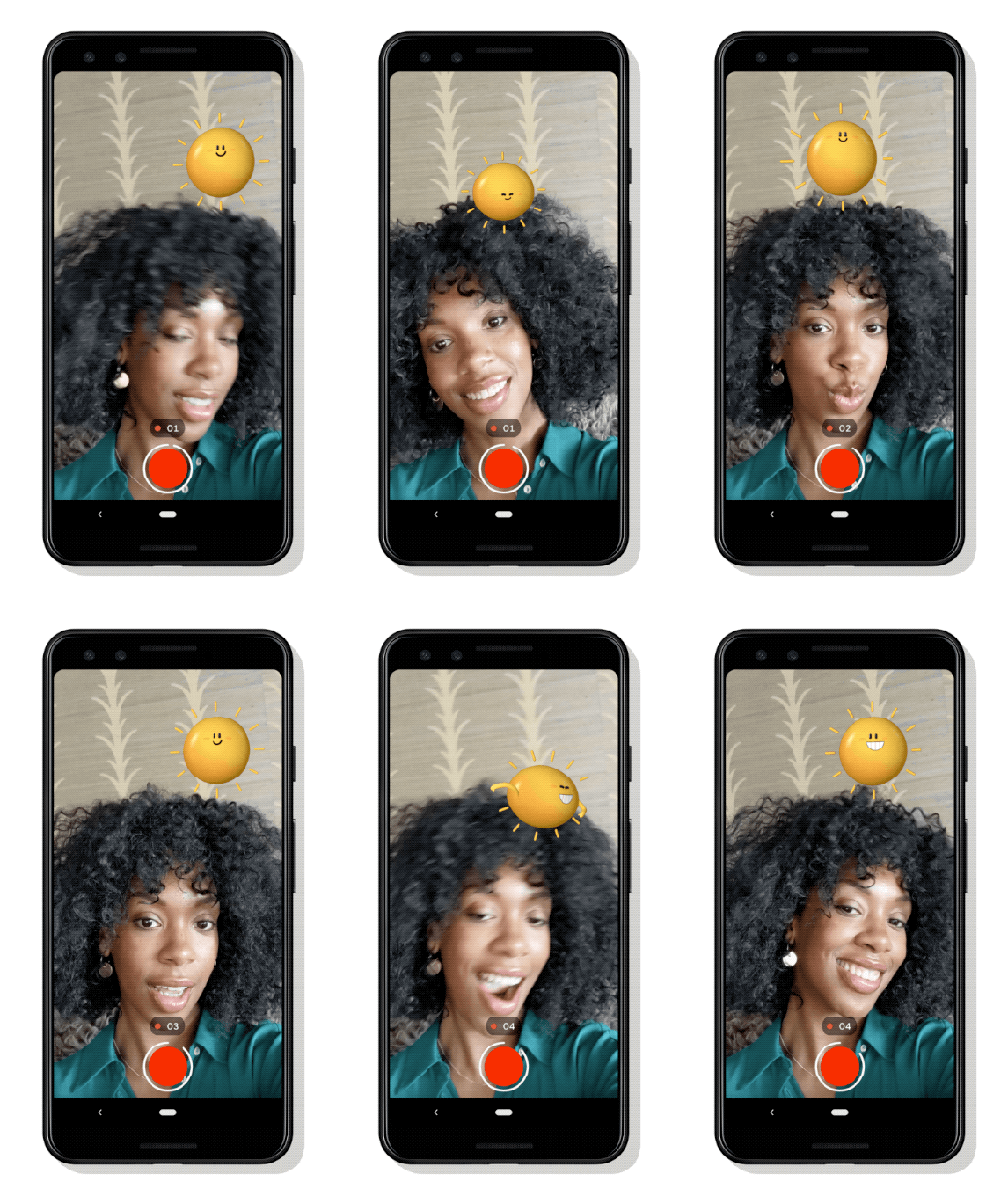
“We thought, let’s think deeper into it and start making these stickers smarter and see if we can actually use AR and machine learning to help users be more creative,” Joe Bose, a product manager at Google working on AR, told TechCrunch.

Interactivity is ultimately what makes Playground different from the one-off AR sticker packs Google has dropped with past partnerships with Star Wars or Stranger Things. Playground also showcases a wider swath of Google’s AR efforts than just placing objects into environments. There’s some clear work being done by the live image recognition engine that powers Google Lens, bringing about a cool feature that suggests stickers and playmojis for you to drop into the world. If your camera is focused on a sunny meadow, Playground suggests some more nature-centric AR stickers; when a dog jumped into view while I was demoing, some pooch recommendations popped up.

For now there’s a hefty amount of stickers and some Marvel superheroes and dogs. As part of National Cat Day today, Google is bringing some AR kitties into the action, I’m told, which by all accounts should more than ensure the feature’s success — or at least boost sharability — among lovers of cats real and virtual.

For now Playground is just available on the Pixel 3, but the team is looking to bring the feature to past Pixel phones in the near future.

In the end, Playground is a hilarious amount of sophisticated tech just to add some added pizzazz to your photos, but that’s augmented reality tech in a snapshot. The bullish folks may say it represents a new computing platform, but in 2018 it’s ensuring that your cat has a virtual pal in your photos and videos.


from TechCrunch https://ift.tt/2ET2yxD
via IFTTT

Comments

Popular posts from this blog

The Silent Revolution of On-Device AI: Why the Cloud Is No Longer King

Introduction For years, artificial intelligence has meant one thing: the cloud. Whether you’re asking ChatGPT a question, editing a photo with AI tools, or getting recommendations on Netflix — those decisions happen on distant servers, not your device. But that’s changing. Thanks to major advances in silicon, model compression, and memory architecture, AI is quietly migrating from giant data centres to the palm of your hand. Your phone, your laptop, your smartwatch — all are becoming AI engines in their own right. It’s a shift that redefines not just how AI works, but who controls it, how private it is, and what it can do for you. This article explores the rise of on-device AI — how it works, why it matters, and why the cloud’s days as the centre of the AI universe might be numbered. What Is On-Device AI? On-device AI refers to machine learning models that run locally on your smartphone, tablet, laptop, or edge device — without needing constant access to the cloud. In practi...

Apple’s AI Push: Everything We Know About Apple Intelligence So Far

Apple’s WWDC 2025 confirmed what many suspected: Apple is finally making a serious leap into artificial intelligence. Dubbed “Apple Intelligence,” the suite of AI-powered tools, enhancements, and integrations marks the company’s biggest software evolution in a decade. But unlike competitors racing to plug AI into everything, Apple is taking a slower, more deliberate approach — one rooted in privacy, on-device processing, and ecosystem synergy. If you’re wondering what Apple Intelligence actually is, how it works, and what it means for your iPhone, iPad, or Mac, you’re in the right place. This article breaks it all down.   What Is Apple Intelligence? Let’s get the terminology clear first. Apple Intelligence isn’t a product — it’s a platform. It’s not just a chatbot. It’s a system-wide integration of generative AI, machine learning, and personal context awareness, embedded across Apple’s OS platforms. Think of it as a foundational AI layer stitched into iOS 18, iPadOS 18, and m...

Max Q: Anomalous

Hello and welcome back to Max Q! Last week wasn’t the most successful for spaceflight missions. We’ll get into that a bit more below. In this issue: First up, a botched launch from Virgin Orbit… …followed by one from ABL Space Systems News from Rocket Lab, World View and more Virgin Orbit’s botched launch highlights shaky financial future After Virgin Orbit’s launch failure last Monday, during which the mission experienced an  “anomaly” that prevented the rocket from reaching orbit, I went back over the company’s financials — and things aren’t looking good. For Virgin Orbit, this year has likely been completely turned on its head. The company was aiming for three launches this year, but everything will remain grounded until the cause of the anomaly has been identified and resolved. It’s unclear how long that will take, but likely at least three months. Add this delay to Virgin’s dwindling cash reserves and you have a foundation that’s suddenly much shakier than before. ...