
Pandora introduces capabilities for shorter, more personalized ads

Pandora announced three new capabilities for advertisers today — the ability to dynamically assemble different audio ads for different listeners, the ability to sequentially target ads so that they fit together into a larger strategy and shorter ad formats that range from four to 10 seconds in length.

Claire Fanning, Pandora’s vice president of ad strategy, told me via email that the company is announcing these capabilities at the same time because “they work together in really powerful ways.”

For example, she also sent along campaign mock-ups that showed how ads could be tailored to include both the day of the week and a call-to-action tied to the listener’s location, and how the ads could be also specifically sequenced so that listeners start with the longer message, then hear shorter and shorter spots.

“We believe that an advertiser’s personalized audio strategy will not only be unique to that advertiser, but also unique to each campaign,” Fanning said. “In some cases, leveraging one capability may be best (short form, dynamic, sequential) — and in other cases, leveraging 2 or 3 may be most powerful. It’s really dependent on the advertiser’s creative strategy and which solution, or solutions, will support that strategy best.”
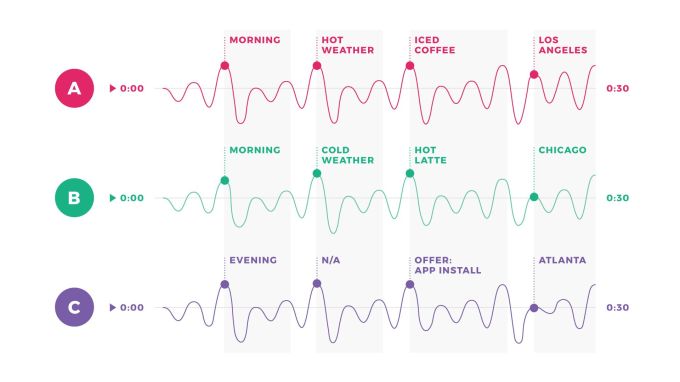
Pandora dynamic audio

While Pandora launched its own on-demand music service last year, advertising remains the main way the company monetizes its 72.3 million active listeners. It says it’s the first company to make these features available in a large-scale way, and it’s already been testing them with 20 advertisers, enlisting Veritonic to measure the results. For one thing, it says that Lay’s found short-form audio had a 56 percent higher return on ad spend.

As the company looks to deliver more personalized advertising, it may face more questions about privacy, but Fanning said Pandora doesn’t collect any personally identifiable information about users except for their email addresses.

“We use industry-standard security practices to protect our data and have developed internal tools and processes to ensure compliance with our privacy commitment,” Fanning added. “We’ll continue to fortify this by tightening certain contractual language, auditing existing 3rd-party data partners, and evaluating future partnerships with enhanced rigor.”


from TechCrunch https://ift.tt/2oijTov
via IFTTT

Comments

Popular posts from this blog

The Silent Revolution of On-Device AI: Why the Cloud Is No Longer King

Introduction For years, artificial intelligence has meant one thing: the cloud. Whether you’re asking ChatGPT a question, editing a photo with AI tools, or getting recommendations on Netflix — those decisions happen on distant servers, not your device. But that’s changing. Thanks to major advances in silicon, model compression, and memory architecture, AI is quietly migrating from giant data centres to the palm of your hand. Your phone, your laptop, your smartwatch — all are becoming AI engines in their own right. It’s a shift that redefines not just how AI works, but who controls it, how private it is, and what it can do for you. This article explores the rise of on-device AI — how it works, why it matters, and why the cloud’s days as the centre of the AI universe might be numbered. What Is On-Device AI? On-device AI refers to machine learning models that run locally on your smartphone, tablet, laptop, or edge device — without needing constant access to the cloud. In practi...

Apple’s AI Push: Everything We Know About Apple Intelligence So Far

Apple’s WWDC 2025 confirmed what many suspected: Apple is finally making a serious leap into artificial intelligence. Dubbed “Apple Intelligence,” the suite of AI-powered tools, enhancements, and integrations marks the company’s biggest software evolution in a decade. But unlike competitors racing to plug AI into everything, Apple is taking a slower, more deliberate approach — one rooted in privacy, on-device processing, and ecosystem synergy. If you’re wondering what Apple Intelligence actually is, how it works, and what it means for your iPhone, iPad, or Mac, you’re in the right place. This article breaks it all down.   What Is Apple Intelligence? Let’s get the terminology clear first. Apple Intelligence isn’t a product — it’s a platform. It’s not just a chatbot. It’s a system-wide integration of generative AI, machine learning, and personal context awareness, embedded across Apple’s OS platforms. Think of it as a foundational AI layer stitched into iOS 18, iPadOS 18, and m...

Max Q: Anomalous

Hello and welcome back to Max Q! Last week wasn’t the most successful for spaceflight missions. We’ll get into that a bit more below. In this issue: First up, a botched launch from Virgin Orbit… …followed by one from ABL Space Systems News from Rocket Lab, World View and more Virgin Orbit’s botched launch highlights shaky financial future After Virgin Orbit’s launch failure last Monday, during which the mission experienced an  “anomaly” that prevented the rocket from reaching orbit, I went back over the company’s financials — and things aren’t looking good. For Virgin Orbit, this year has likely been completely turned on its head. The company was aiming for three launches this year, but everything will remain grounded until the cause of the anomaly has been identified and resolved. It’s unclear how long that will take, but likely at least three months. Add this delay to Virgin’s dwindling cash reserves and you have a foundation that’s suddenly much shakier than before. ...