An Indian upstart, co-founded by a group of journalists, that seeks to disrupt how people follow news and what they consume has raised capital as it prepares to accelerate its growth and broaden its offering.
The Signal is aiming to serve a need for the modern pace of life where everybody is busy, said Dinesh Narayanan, its co-founder and editor in an interview. “People still want to keep up with what’s happening in the world. They can read newspapers or multiple news outlets, but obviously they don’t have time to do it,” he said.
The Noida-headquartered startup has been attempting to solve this with an eponymous newsletter and podcast where it curates, produces and discusses what they argue are the most important developments from the world of business, technology, economy and policy.
The newsletter, which goes out six times a week, features nearly a dozen stories in each edition and deep dives into two to three major stories, offering additional context and commentary from a team of journalists who have previously worked at newsrooms including The Economic Times, The Quint, YourStory, The Morning Context and Reuters.
Signal says it is aiming to serve savvy audiences in India and beyond. It has amassed over 38,000 subscribers, a base that includes several unicorn founders, lawmakers and policy executives. Its newsletter goes out at 8 AM and requires just five to seven minutes of reader time, said Narayanan.
The startup, which plans to expand its coverage into more areas including sports and launch newer products, isn’t currently charging its readers and listeners. Instead, most newsletters are currently backed by big name sponsors. Narayanan argued that a sponsor-backed model is the more sustainable way to monetize a news product in the country.
“Everybody talks about this total addressable market, right? Nobody really knows what exactly it is today because you have a population of probably about 150-200 million people who can afford to pay. There are so many avenues available to people which is giving them free news. It is a very small sliver of the audience which would actually pay,” he said.
“So some of them would be paying because it’s good journalism, some of them would be paying because they give exactly the amount of news which they want, some of them would be paying for the depth of content. I think the existing players are already competing for this rather small pie.”
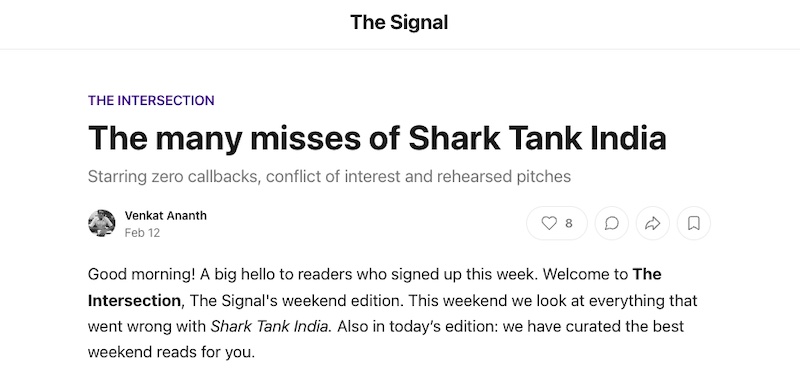
Each Saturday, Signal publishes original stories in a newsletter called The Intersection.
The Signal, whose most other founding members including Venkat Ananth and Patanjali Pahwa are also journalists, is the latest independent media venture in the South Asian nation, which is the one of the world’s largest news markets. The founding team also includes ex-Google India public policy official Rajneil Kamath and Chinmay Bhogle, formerly of Times Internet, Star Sports and Tata Motors.
Several journalists in the country have left their influential jobs at top media houses in recent years to build something of their own as they grow frustrated at attempting to bring systemic changes to the way legacy outlets work – or take inspiration from a similar flow in the U.S., where journalists have traditionally shown more entrepreneurial instincts.
But unlike the U.S. and the UK, where several media venture founders have made successful exits, India is yet to demonstrate any.
At the end of the day, the future of the Signal depends on the purchasing power per capita of the nation, Narayanan said. As the “purchasing power increases and the consumption patterns change, purely on that basis … exits and the size of exits are a function of that. It’s a business. Yeah, so it is definitely tied to the fortunes of the country as a whole,” he added.
For now, that’s not something The Signal needs to worry about.
The startup said Monday it has raised a new funding round, but did not disclose the size. The Signal’s angel investors include CRED’s Miten Sampat, Zomato co-founder Deepinder Goyal, Unacademy co-founder Gaurav Munjal, Haptik co-founder Aakrit Vaish, media entrepreneur Parry Ravindranathan, Vue.ai founder Ashwini Asokan and DealStreetAsia founder and CEO Joji Philip Thomas. Investment fund LetsVenture led the round, while venture capital fund Capital A also participated in it, Narayanan said. Fintech-focused fund Rainmatter also invested in the round, according to a regulatory filing. (Narayanan and Rainmatter didn’t comment on the fund’s participation.)
“Venkat, Patanjali, Dinesh & Roshni P Nair have authored some of the most important stories in India tech over the past 5 years, and I am very excited to see them build The Signal as a way to enable readers make sense of it all,” said Sampat. “India, and eventually the world, needs an outlet that goes beyond newsflashes and gets deep into nuanced reportage through a mix of curation, original writing and new formats of sense-making.”
from TechCrunch https://ift.tt/NCIfV7B
via IFTTT
Comments
Post a Comment