 |
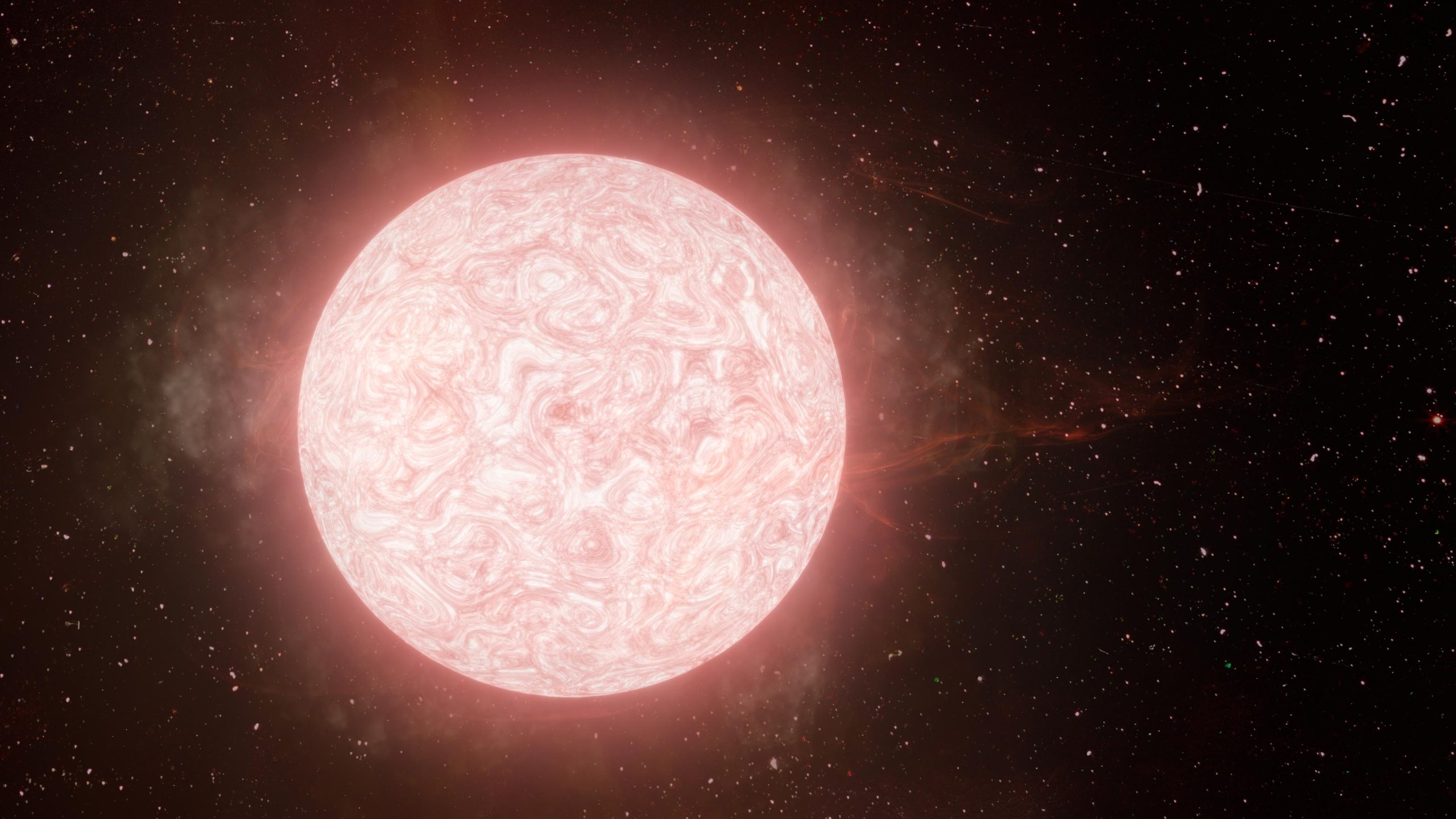
| An artist’s impression of a red supergiant star in the final year of its life emitting a tumultuous cloud of gas. This suggests at least some of these stars undergo significant internal changes before going supernova. Credit: W.M. Keck Observatory/Adam Makarenko |
Ground-based telescopes provided the first real-time look at the death throes of a red supergiant star.
While these aren't the the brightest or most massive stars, they are the largest by volume. A popular red supergiant, which has attracted interest due to its irregular eclipsing, is Betelgeuse.
This star is located in the galaxy NGC 5731, about 120 million light years from Earth distant it was ten times as massive as the sun. Before they go out in splendor, some stars experience violent eruptions or release bright layers of hot gas.
Until astronomers witnessed this event, they believed that red supergiants were relatively calm. before they explode in a supernova or collapse into a dense neutron star.
Instead, scientists watched the star self-destruct in dramatic fashion before collapsing in a type II supernova. This star death is the rapid collapse and violent explosion of a massive star after it has burned through the hydrogen, helium and other elements in its core.
All that remains is the star's iron, but iron can't fuse so the star will run out of energy. When that happens, the iron collapses and causes the supernova. A study detailing these findings published Thursday in The Astrophysical Journal.
"This is a breakthrough in our understanding of what massive stars do moments before they die," said lead study author Wynn Jacobson-Galán, a National Science Foundation Graduate Research Fellow at University of California, Berkeley, in a statement.
"Direct detection of pre-supernova activity in a red supergiant star has never been observed before in an ordinary type II supernova. For the first time, we watched a red supergiant star explode."
Astronomers were first alerted to the star's unusual activity 130 days before it went supernova. Bright radiation was detected in the summer of 2020 by the University of Hawaiʻi Institute for Astronomy Pan-STARRS telescope on Maui's Haleakalā.
Then, in the fall of that year, the researchers witnessed a supernova in the same spot.
They observed it using the W.M. Keck Observatory's Low Resolution Imaging Spectrometer on Maunakea, Hawai'i, and named the supernova 2020tlf. Their observations revealed that there was material around the star when it exploded -- the bright gas that the star violently kicked away from itself over the summer.
"It's like watching a ticking time bomb," said senior study author Raffaella Margutti, an associate professor of astronomy and astrophysics at UC Berkeley, in a statement. "We've never confirmed such violent activity in a dying red supergiant star where we see it produce such a luminous emission, then collapse and combust, until now."
Some of these massive stars likely experience consequential internal changes that cause the tumultuous release of gas before they die, the finding has shown.
The work was conducted while Jacobson-Galán and Margutti were still at Northwestern University. They had remote access to the Keck Observatory's telescopes in Hawai'i, which was "instrumental in providing direct evidence of a massive star transitioning into a supernova explosion," Margutti said.
"I am most excited by all of the new 'unknowns' that have been unlocked by this discovery," Jacobson-Galán said. "Detecting more events like SN 2020tlf will dramatically impact how we define the final months of stellar evolution, uniting observers and theorists in the quest to solve the mystery on how massive stars spend the final moments of their lives."
Source: CNN
source https://techncruncher.blogspot.com/2022/01/astronomers-capture-red-supergiant-star.html
Comments
Post a Comment