
Netflix launches ‘Downloads for You,’ a new feature that automatically downloads content you’ll like

Netflix today is launching a new feature that aims to bring more offline content to users who opt in automatic downloads. With “Downloads for You” enabled, the Netflix app will download recommended TV shows and movies to your mobile device based on your tastes, as determined by your Netflix watch history.

After turning on the feature for the first time, you’ll be able to select the amount of storage space you want to dedicate to saving these recommended downloads on your device: either 1GB, 3GB, or 5GB. The downloads will then take place when you’re connected to a Wi-Fi network, and will contain a mix of recommendations that Netflix believes you’ll like. Typically, the app will download the first few episodes of a TV show — enough to get you started.

You can also cast the downloaded content to a nearby TV, where it will stream directly from your phone.

After you’ve watched the episodes or movies, you can delete them from the device to free up more storage space for the next time you’re connected to WiFi.

Netflix notes its full catalog is available for download, not just its own original content. However, there will be some titles with download limitations due to licensing restrictions.
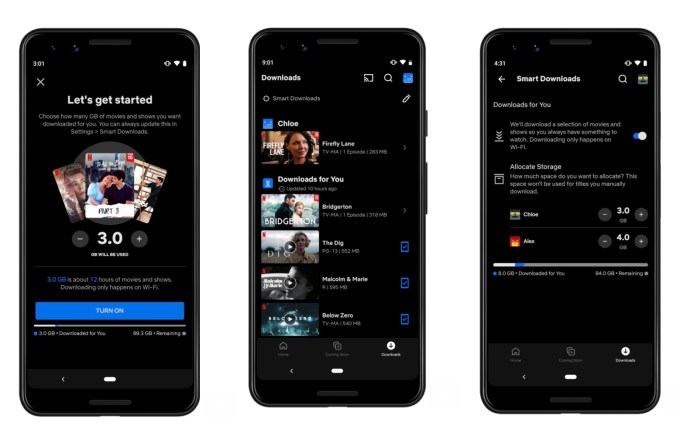
The feature is an addition, not a replacement for Netflix’s existing offline access feature known as Smart Downloads. First launched in 2018 before becoming globally available, Smart Downloads allows users to pick which shows or movies they want to save for offline viewing.

Netflix says it began testing Downloads for You in late 2020, but is today making the feature available to all users worldwide, initially on Android. A version for iOS is in the works and will arrive later this year.

Offline downloads can make sense for those who are traveling — for example, by plane or underground train, where internet access is not a given. But it also makes sense for users in emerging markets, where access to a reliable cellular connection or bandwidth can be a concern.

During tests, Netflix notes it saw high usage of the feature in the U.S. But it considers the emerging market use case — where Android devices are more heavily used and connections are often unreliable — to be of particular importance. This especially true for countries like India and Brazil, and elsewhere in the Asia-Pacific region.

“We’re excited to introduce Downloads for You. People who choose this new feature will have shows or movies automatically downloaded to their devices, with recommendations based on their tastes,” said Patrick Flemming, Netflix’s Director of Product Innovation, in a statement. “We want to make discovering your next new favorite series or film even easier, whether you’re connected or not.”


from TechCrunch https://ift.tt/3sigjtu
via IFTTT

Comments

Popular posts from this blog

The Silent Revolution of On-Device AI: Why the Cloud Is No Longer King

Introduction For years, artificial intelligence has meant one thing: the cloud. Whether you’re asking ChatGPT a question, editing a photo with AI tools, or getting recommendations on Netflix — those decisions happen on distant servers, not your device. But that’s changing. Thanks to major advances in silicon, model compression, and memory architecture, AI is quietly migrating from giant data centres to the palm of your hand. Your phone, your laptop, your smartwatch — all are becoming AI engines in their own right. It’s a shift that redefines not just how AI works, but who controls it, how private it is, and what it can do for you. This article explores the rise of on-device AI — how it works, why it matters, and why the cloud’s days as the centre of the AI universe might be numbered. What Is On-Device AI? On-device AI refers to machine learning models that run locally on your smartphone, tablet, laptop, or edge device — without needing constant access to the cloud. In practi...

Apple’s AI Push: Everything We Know About Apple Intelligence So Far

Apple’s WWDC 2025 confirmed what many suspected: Apple is finally making a serious leap into artificial intelligence. Dubbed “Apple Intelligence,” the suite of AI-powered tools, enhancements, and integrations marks the company’s biggest software evolution in a decade. But unlike competitors racing to plug AI into everything, Apple is taking a slower, more deliberate approach — one rooted in privacy, on-device processing, and ecosystem synergy. If you’re wondering what Apple Intelligence actually is, how it works, and what it means for your iPhone, iPad, or Mac, you’re in the right place. This article breaks it all down.   What Is Apple Intelligence? Let’s get the terminology clear first. Apple Intelligence isn’t a product — it’s a platform. It’s not just a chatbot. It’s a system-wide integration of generative AI, machine learning, and personal context awareness, embedded across Apple’s OS platforms. Think of it as a foundational AI layer stitched into iOS 18, iPadOS 18, and m...

Max Q: Anomalous

Hello and welcome back to Max Q! Last week wasn’t the most successful for spaceflight missions. We’ll get into that a bit more below. In this issue: First up, a botched launch from Virgin Orbit… …followed by one from ABL Space Systems News from Rocket Lab, World View and more Virgin Orbit’s botched launch highlights shaky financial future After Virgin Orbit’s launch failure last Monday, during which the mission experienced an  “anomaly” that prevented the rocket from reaching orbit, I went back over the company’s financials — and things aren’t looking good. For Virgin Orbit, this year has likely been completely turned on its head. The company was aiming for three launches this year, but everything will remain grounded until the cause of the anomaly has been identified and resolved. It’s unclear how long that will take, but likely at least three months. Add this delay to Virgin’s dwindling cash reserves and you have a foundation that’s suddenly much shakier than before. ...