
Yayzy app automatically calculates the environmental impact of your spending

Ahead of the turning of the New Year, many people are wishing they could do something about the environment. Now, a UK startup hopes to make our environmental impact more personal.

Yayzy has now launched an iOS app (but Android is coming) which literally links to your bank account to work out the environmental impact of what you buy. It uses payment data via Open Banking standards to automatically calculate the carbon footprint of each purchase a user makes, giving them a picture of their total monthly carbon emissions. This makes the carbon footprint calculated more accurate and bespoke to the individual, allowing them to immediately connect their spending to its impact on the planet.

Yayzy has secured £900,000 in backing from Antler Venture Capital, Seedrs (a crowdfunding round) and the CoreAngels Impact Fund. As the user sees what the carbon footprint is of their purchase, they can choose to offset it right then and there on the app via the carbon offsetter Ecosphere Plus. In the app, users can also find tips to reduce their carbon footprint, eco-friendly retailers near them or insights into lifestyle choices that have the highest environmental impact.

Their competitors are people like CoGo, a real-time Carbon Footprint tracker, and and Doconomy and the soon to launch Tred.

But Yayzy is taking a different approach. It brings together all of a user’s spending and shows them item by item as they spend, what the carbon footprint of that spend is. So far – it claims – its competitors don’t do that.
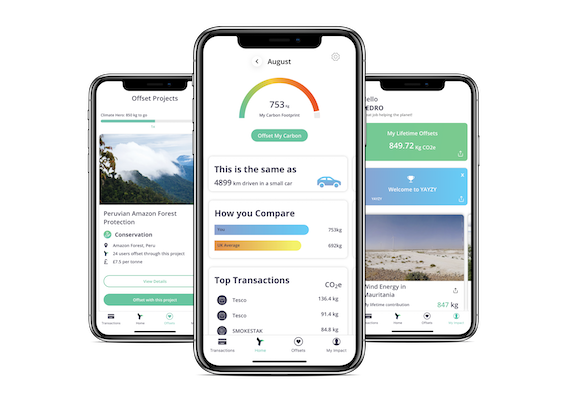
Yaysy app

This can be done ad hoc, item by item, or by signing up to a monthly subscription to either carbon offsetting projects or the user’s own unique climate portfolio. This portfolio would bundle multiple projects together for a more ‘holistic’ impact. Yayzy says all of these projects have been carefully selected based on strict criteria, and also advance the UN Sustainable development goals.

For its underlying carbon data, Yayzy is using Vital Metrics https://ift.tt/38nP8Fe
as used by Google, Microsoft and both the UK and US governments, among others.

Mankaran Ahluwalia, cofounder and CEO of Yayzy said in a statement: “While emissions have gradually risen as lockdown eases, YAYZY wants to put us all in the driver’s seat to control our own environmental impact… It is clear from a plethora of surveys that the majority of people want to address climate change before it is too late, but that a huge intention/action gap blocks much of it. Our solution with Yayzy is to make environmental impact ‘up close and personal’ and the action to tackle it super easy, all via your phone.”

Ahluwalia, was as a technology analyst with Infosys and built a lending platform for alternate credit. Cofounder Cristian Dan, CTO, previously built a discounts platform and cofounder Pedro Cabrero, CFO was in equity sales and trading for UBS and Citigroup, and co-founded the a leading online pharmacy in Mexico.


from TechCrunch https://ift.tt/2LX8Wrv
via IFTTT

Comments

Popular posts from this blog

The Silent Revolution of On-Device AI: Why the Cloud Is No Longer King

Introduction For years, artificial intelligence has meant one thing: the cloud. Whether you’re asking ChatGPT a question, editing a photo with AI tools, or getting recommendations on Netflix — those decisions happen on distant servers, not your device. But that’s changing. Thanks to major advances in silicon, model compression, and memory architecture, AI is quietly migrating from giant data centres to the palm of your hand. Your phone, your laptop, your smartwatch — all are becoming AI engines in their own right. It’s a shift that redefines not just how AI works, but who controls it, how private it is, and what it can do for you. This article explores the rise of on-device AI — how it works, why it matters, and why the cloud’s days as the centre of the AI universe might be numbered. What Is On-Device AI? On-device AI refers to machine learning models that run locally on your smartphone, tablet, laptop, or edge device — without needing constant access to the cloud. In practi...

Apple’s AI Push: Everything We Know About Apple Intelligence So Far

Apple’s WWDC 2025 confirmed what many suspected: Apple is finally making a serious leap into artificial intelligence. Dubbed “Apple Intelligence,” the suite of AI-powered tools, enhancements, and integrations marks the company’s biggest software evolution in a decade. But unlike competitors racing to plug AI into everything, Apple is taking a slower, more deliberate approach — one rooted in privacy, on-device processing, and ecosystem synergy. If you’re wondering what Apple Intelligence actually is, how it works, and what it means for your iPhone, iPad, or Mac, you’re in the right place. This article breaks it all down.   What Is Apple Intelligence? Let’s get the terminology clear first. Apple Intelligence isn’t a product — it’s a platform. It’s not just a chatbot. It’s a system-wide integration of generative AI, machine learning, and personal context awareness, embedded across Apple’s OS platforms. Think of it as a foundational AI layer stitched into iOS 18, iPadOS 18, and m...

Billionaire clothing dynasty heiress launches Everybody & Everyone to make fashion sustainable

Veronica Chou’s family has made its fortune at the forefront of the fast fashion business through investments in companies like Michael Kors and Tommy Hilfiger . But now, the heiress to an estimated $2.1 billion fortune is launching her own company, Everybody & Everyone , to prove that the fashion industry can be both environmentally sustainable and profitable. There’s no argument about the negative impacts of the fashion industry on the environment. The textiles industry primarily uses non-renewable resources — on the order of 98 million tons per year. That includes the oil to make synthetic fibers, fertilizers to grow cotton, and toxic chemicals to dye, treat, and produce the textiles used to make clothes. The greenhouse gas footprint from textiles production was roughly 1.2 billion tons of CO2 equivalent in 2015 — more than all international flights and maritime shipments combined (and a lot of those maritime shipments and international flights were hauling clothes). The lit...