Spotify this morning announced a series of new initiatives to address the COVID-19 health crisis across its platform. The company is launching a financial relief effort for those in the creative community who have been heavily impacted by the virus, which includes the addition of a public donations feature on its website. The company is also working to add a new feature that will allow artists to fundraise directly from their fans via their Spotify artist profile pages. Meanwhile, for listeners, Spotify is adding a COVID-19 news and information hub in its app to help keep users informed.
The new Spotify COVID-19 Music Relief Project will recommend verified organizations that are offering financial relief to those in the music community who are in need, worldwide. At launch, Spotify is partnering with MusiCares, PRS Foundation, and Help Musicians, and says it’s planning to add more partners in time.
The company says it will also match dollar-for-dollar the public donations made through the Spotify COVID-19 Music Relief page up to a total contribution of $10 million. Industry professionals in need of financial assistance will go to the partners’ sites for information to apply for relief funds.
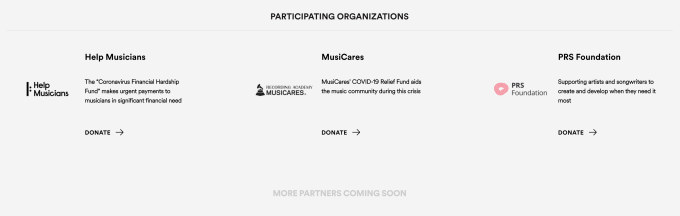
“While streaming still gives artists a way to connect with their fans, so many other sources of revenue have been put on hold by this crisis,” notes the company on the Relief project’s page. “To play our part, we’re working with a growing list of organizations offering financial relief to creators around the world to find ways to support our community,” it says.
And though not yet launched, Spotify says it’s working to add a new fundraising feature for artists that will allow them to drive their fans to a fundraising destination of their own choice. This would allow artists to directly fundraise for other artists in need or another separate initiative of their own choosing. This feature will be optional for the artists to use and no changes to their profile pages will occur unless the artist wants to participate. And unlike the fundraising efforts on other sites, Spotify says it won’t take a cut of the funds.
Of course, offering personal fundraisers in a time of crisis can also be problematic, as there are a number of scammers now trying to capitalize on crisis with fake fundraisers. Artists, like anyone else, could fall for these scams and then rally their fans towards the cause — potentially redirecting money away from true relief organizations at a time when it’s critical.
This is worsened by the fact that personal fundraisers generally need vetting to ensure they in and of themselves aren’t scams or engaging in some kind of fraud. Even Facebook, operating at the scale it does, is warning users that it currently has fewer people on staff to review personal fundraisers due to the coronavirus (COVID-19) outbreak. It says fundraisers may not even be able to be reviewed at all and if they are, they’ll take longer than usual. And yet Spotify is readily the rollout of fundraisers at this time when staffing reductions are in place? That’s concerning.

In addition, Spotify is adding a new feature to connect listeners with news and information about COVID-19. Through a new in-app hub, the company is pointing users to news and podcasts from the media, including ABC News, BBC World Service, CNN, Foreign Policy, and NPR.
And, like most companies, Spotify is also offering advertising space to governments and nonprofits for health information and PSAs.
The new COVID-19 Music Relief Project and COVID-19 hub are live today. Artists fundraisers are in the works.


from TechCrunch https://ift.tt/2y9rBJV
via IFTTT
Comments
Post a Comment