
Vine reboot Byte officially launches

Two years after Vine’s co-founder Dom Hofmann announced he was building a successor to the short-form video app, today Byte makes its debut on iOS and Android. Byte lets you shoot or upload and then share six-second videos. It comes equipped with standard social features like a feed, Explore page, notifications, and profiles. For now, though Byte lacks the remixability, augmented reality filters, transition effects, and other bonus features you’ll find in apps like TikTok.
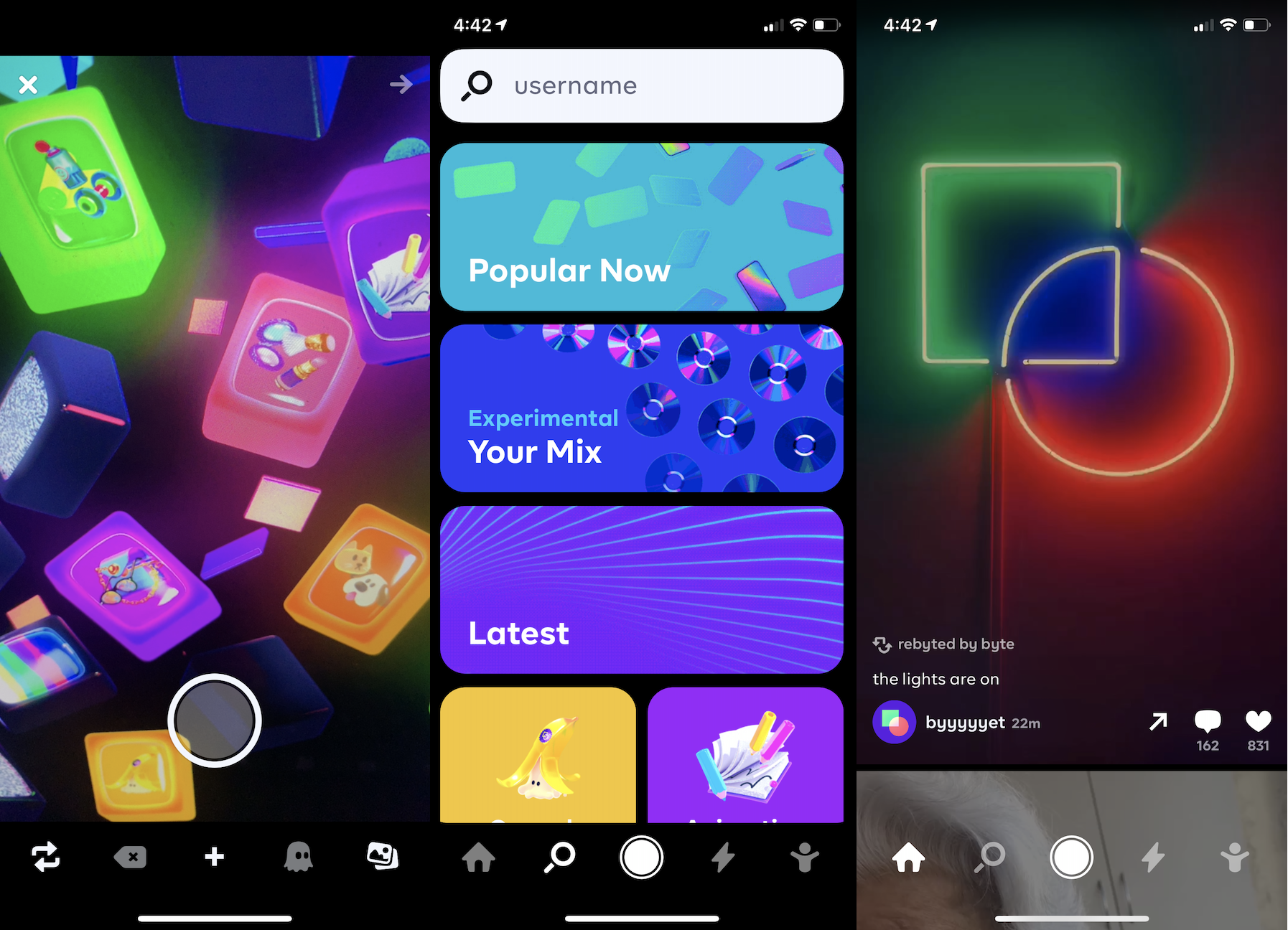
What Hofmann hopes will differentiate Byte is an early focus on helping content creators make money — something TikTok, and other micro-entertainment apps largely don’t offer. The app plans to soon launch a pilot of its partner program for offering monetization options to people proving popular on Byte. When asked if Byte would offer ad revenue sharing, tipping, or other options to partners, Hofmann told me that “We’re looking at all of those, but we’ll be starting with a revenue share + supplementing with our own funds. We’ll have more details about exactly how the pilot program will work soon.”

Staying connected with Byte’s most loyal users is another way Hofmann hopes to set his app apart. He’s been actively running a beta tester forum since the initial Byte announcement in early 2018, and sees it as a way to find out what features to build next. “It’s always a bummer when the people behind online services and the people that actually use them are disconnected from one another, so we’re trying out these forums to see if we can do a better job at that” Hofmann writes.

Byte is a long time coming. To rewind all the way, Hofmann co-founded Vine in June 2012 with Colin Kroll and Rus Yusupov, but it was acquired by Twitter before its launch in January 2013. By that fall, Hofmann had left the company. But 2014 and 2015 saw Vine’s popularity grow thanks to rapid-fire comedy skits and the creativity unlocked by its looping effect. Vine reached over 200 million active users. Then the unthinkable happened. Desperate to cut costs, Twitter shut down Vine’s sharing feed in late 2016 so it wouldn’t have to host any more video content. The creative web mourned.

By then, Hofmann had already built the first version of Byte, which offered more free-form creation. You could pull together photos, GIFs, drawings and more into little shareable creations. But this prototype never gained steam. Hofmann gave Vine fans hope when he announced plans to build a successor called V2 in early 2018, but cancelled it a few months later. Hofmann got more serious about the project by then end of 2018, announcing the name Byte and then beginning beta testing in April 2019.

Now the big question will be whether Byte can take off despite its late start. Between TikTok, Snapchat, Instagram, and more, do people need another short-form video app?


from TechCrunch https://ift.tt/2sV024J
via IFTTT

Comments

Popular posts from this blog

The Silent Revolution of On-Device AI: Why the Cloud Is No Longer King

Introduction For years, artificial intelligence has meant one thing: the cloud. Whether you’re asking ChatGPT a question, editing a photo with AI tools, or getting recommendations on Netflix — those decisions happen on distant servers, not your device. But that’s changing. Thanks to major advances in silicon, model compression, and memory architecture, AI is quietly migrating from giant data centres to the palm of your hand. Your phone, your laptop, your smartwatch — all are becoming AI engines in their own right. It’s a shift that redefines not just how AI works, but who controls it, how private it is, and what it can do for you. This article explores the rise of on-device AI — how it works, why it matters, and why the cloud’s days as the centre of the AI universe might be numbered. What Is On-Device AI? On-device AI refers to machine learning models that run locally on your smartphone, tablet, laptop, or edge device — without needing constant access to the cloud. In practi...

Apple’s AI Push: Everything We Know About Apple Intelligence So Far

Apple’s WWDC 2025 confirmed what many suspected: Apple is finally making a serious leap into artificial intelligence. Dubbed “Apple Intelligence,” the suite of AI-powered tools, enhancements, and integrations marks the company’s biggest software evolution in a decade. But unlike competitors racing to plug AI into everything, Apple is taking a slower, more deliberate approach — one rooted in privacy, on-device processing, and ecosystem synergy. If you’re wondering what Apple Intelligence actually is, how it works, and what it means for your iPhone, iPad, or Mac, you’re in the right place. This article breaks it all down.   What Is Apple Intelligence? Let’s get the terminology clear first. Apple Intelligence isn’t a product — it’s a platform. It’s not just a chatbot. It’s a system-wide integration of generative AI, machine learning, and personal context awareness, embedded across Apple’s OS platforms. Think of it as a foundational AI layer stitched into iOS 18, iPadOS 18, and m...

Max Q: Anomalous

Hello and welcome back to Max Q! Last week wasn’t the most successful for spaceflight missions. We’ll get into that a bit more below. In this issue: First up, a botched launch from Virgin Orbit… …followed by one from ABL Space Systems News from Rocket Lab, World View and more Virgin Orbit’s botched launch highlights shaky financial future After Virgin Orbit’s launch failure last Monday, during which the mission experienced an  “anomaly” that prevented the rocket from reaching orbit, I went back over the company’s financials — and things aren’t looking good. For Virgin Orbit, this year has likely been completely turned on its head. The company was aiming for three launches this year, but everything will remain grounded until the cause of the anomaly has been identified and resolved. It’s unclear how long that will take, but likely at least three months. Add this delay to Virgin’s dwindling cash reserves and you have a foundation that’s suddenly much shakier than before. ...