
Facebook Viewpoints pays users for well-being surveys & tasks

Facebook is launching a new market research, task, and product testing program that lets users earn money. Starting today, people in the US who are over 18 can download Viewpoints and participate in a well-being survey so Facebook can learn to “limit the negative impacts of social media and enhance the benefits.” Other opportunities include completing online chores on behalf of Facebook, or trying out new apps or devices ahead of launch so Facebook can refine them.

The well-being survey will take about 15 minutes score users 1000 points, which translates into a $5 reward that’s paid over PayPal. People interested in signing up can join Viewpoints here. The company claims it will only use the data collected internally and won’t sell it. Facebook Viewpoints is available on iOS and Android, and the company plans to open the app to more countries next year.
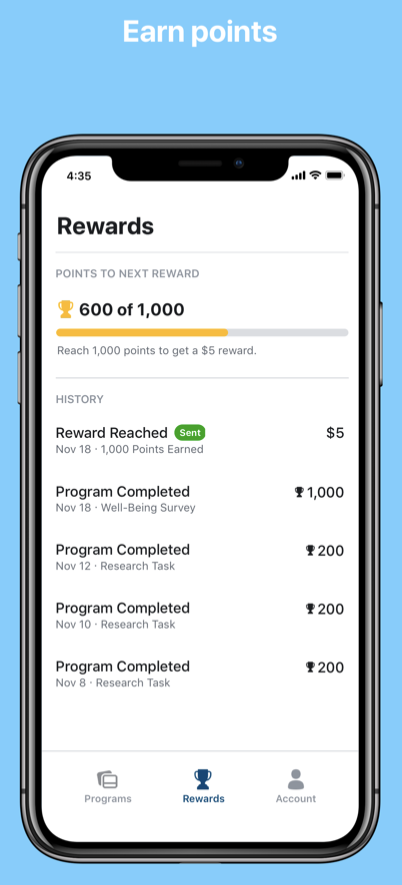
The question is whether users will be comfortable giving up even more data Facebook. Many are already creeped out by Facebook, but the monetary incentive might override their morals.

Meanwhile, Facebook will have to work to prevent the app from beinh abused. Most importantly, it needs to figure out how to make sure underage minors aren’t slipping into the app. They might be more vulnerable to coercion by cash, and less aware of the consequences of sharing their data.

I tried using Viewpoints but wasn’t invited to the well-being study or any other opportunities, so I couldn’t earn any money or try it out further as som studies are open only to people in certain locations or demographics. For now you have to log in with a Facebook account but it showed greyed out options for Google, phone, and email login that Facebook says are coming soon. Payments can take up to 10 days to process and your points expire after 5 years. Facebook won’t post or publicly share any info you provide through the app.

The launch of Viewpoints comes after Facebook shut down its paid market surveillance program Research and its free VPN that collected users’ data Onavo in the wake of a TechCrunch investigation that found the company was paying teenagers for their data while breaking Apple’s rules about distributing employee-only apps outside of a company.

The social network relaunched its market research efforts under the name Study From Facebook in June with a commitment to not allowing kids access. But in the meantime, leaked court documents have shown that Facebook purposefully used market research collected from Onavo to find potential rivals to cut off from its data. Facebook is now under anti-trust investigations surrounding concerns that disadvantaging its competitors hurt consumer choice in social apps.


from TechCrunch https://ift.tt/2Drw6ix
via IFTTT

Comments

Popular posts from this blog

The Silent Revolution of On-Device AI: Why the Cloud Is No Longer King

Introduction For years, artificial intelligence has meant one thing: the cloud. Whether you’re asking ChatGPT a question, editing a photo with AI tools, or getting recommendations on Netflix — those decisions happen on distant servers, not your device. But that’s changing. Thanks to major advances in silicon, model compression, and memory architecture, AI is quietly migrating from giant data centres to the palm of your hand. Your phone, your laptop, your smartwatch — all are becoming AI engines in their own right. It’s a shift that redefines not just how AI works, but who controls it, how private it is, and what it can do for you. This article explores the rise of on-device AI — how it works, why it matters, and why the cloud’s days as the centre of the AI universe might be numbered. What Is On-Device AI? On-device AI refers to machine learning models that run locally on your smartphone, tablet, laptop, or edge device — without needing constant access to the cloud. In practi...

Apple’s AI Push: Everything We Know About Apple Intelligence So Far

Apple’s WWDC 2025 confirmed what many suspected: Apple is finally making a serious leap into artificial intelligence. Dubbed “Apple Intelligence,” the suite of AI-powered tools, enhancements, and integrations marks the company’s biggest software evolution in a decade. But unlike competitors racing to plug AI into everything, Apple is taking a slower, more deliberate approach — one rooted in privacy, on-device processing, and ecosystem synergy. If you’re wondering what Apple Intelligence actually is, how it works, and what it means for your iPhone, iPad, or Mac, you’re in the right place. This article breaks it all down.   What Is Apple Intelligence? Let’s get the terminology clear first. Apple Intelligence isn’t a product — it’s a platform. It’s not just a chatbot. It’s a system-wide integration of generative AI, machine learning, and personal context awareness, embedded across Apple’s OS platforms. Think of it as a foundational AI layer stitched into iOS 18, iPadOS 18, and m...

Billionaire clothing dynasty heiress launches Everybody & Everyone to make fashion sustainable

Veronica Chou’s family has made its fortune at the forefront of the fast fashion business through investments in companies like Michael Kors and Tommy Hilfiger . But now, the heiress to an estimated $2.1 billion fortune is launching her own company, Everybody & Everyone , to prove that the fashion industry can be both environmentally sustainable and profitable. There’s no argument about the negative impacts of the fashion industry on the environment. The textiles industry primarily uses non-renewable resources — on the order of 98 million tons per year. That includes the oil to make synthetic fibers, fertilizers to grow cotton, and toxic chemicals to dye, treat, and produce the textiles used to make clothes. The greenhouse gas footprint from textiles production was roughly 1.2 billion tons of CO2 equivalent in 2015 — more than all international flights and maritime shipments combined (and a lot of those maritime shipments and international flights were hauling clothes). The lit...