
Here is where CEOs of heavily funded startups went to school

CEOs of funded startups tend to be a well-educated bunch, at least when it comes to university degrees.

Yes, it’s true college dropouts like Mark Zuckerberg and Bill Gates can still do well. But Crunchbase data shows that most startup chief executives have an advanced degree, commonly from a well-known and prestigious university.

Earlier this month, Crunchbase News looked at U.S. universities with strong track records for graduating future CEOs of funded companies. This unearthed some findings that, while interesting, were not especially surprising. Stanford and Harvard topped the list, and graduates of top-ranked business schools were particularly well-represented.

In this next installment of our CEO series, we narrowed the data set. Specifically, we looked at CEOs of U.S. companies funded in the past three years that have raised at least $100 million in total venture financing. Our intent was to see whether educational backgrounds of unicorn and near-unicorn leaders differ markedly from the broad startup CEO population.

Sort of, but not really

Here’s the broad takeaway of our analysis: Most CEOs of well-funded startups do have degrees from prestigious universities, and there are a lot of Harvard and Stanford grads. However, chief executives of the companies in our current data set are, educationally speaking, a pretty diverse bunch with degrees from multiple continents and all regions of the U.S.

In total, our data set includes 193 private U.S. companies that raised $100 million or more and closed a VC round in the past three years. In the chart below, we look at the universities most commonly attended by their CEOs:1
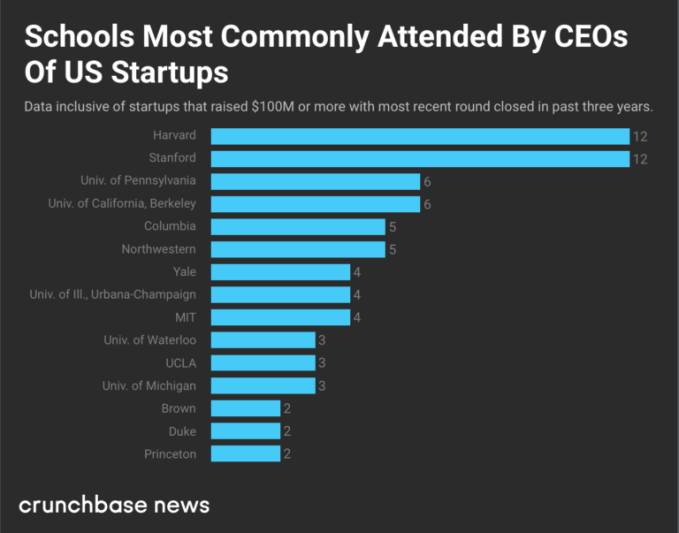
The rankings aren’t hugely different from the broader population of funded U.S. startups. In that data set, we also found Harvard and Stanford vying for the top slots, followed mostly by Ivy League schools and major research universities.

For heavily funded startups, we also found a high proportion of business school degrees. All of the University of Pennsylvania alum on the list attended its Wharton School of Business. More than half of Harvard-affiliated grads attended its business school. MBAs were a popular credential among other schools on the list that offer the degree.

Where the most heavily funded startup CEOs studied

When it comes to the most heavily funded startups, the degree mix gets quirkier. That makes sense, given that we looked at just 20 companies.

In the chart below, we look at alumni affiliations for CEOs of these companies, all of which have raised hundreds of millions or billions in venture and growth financing:
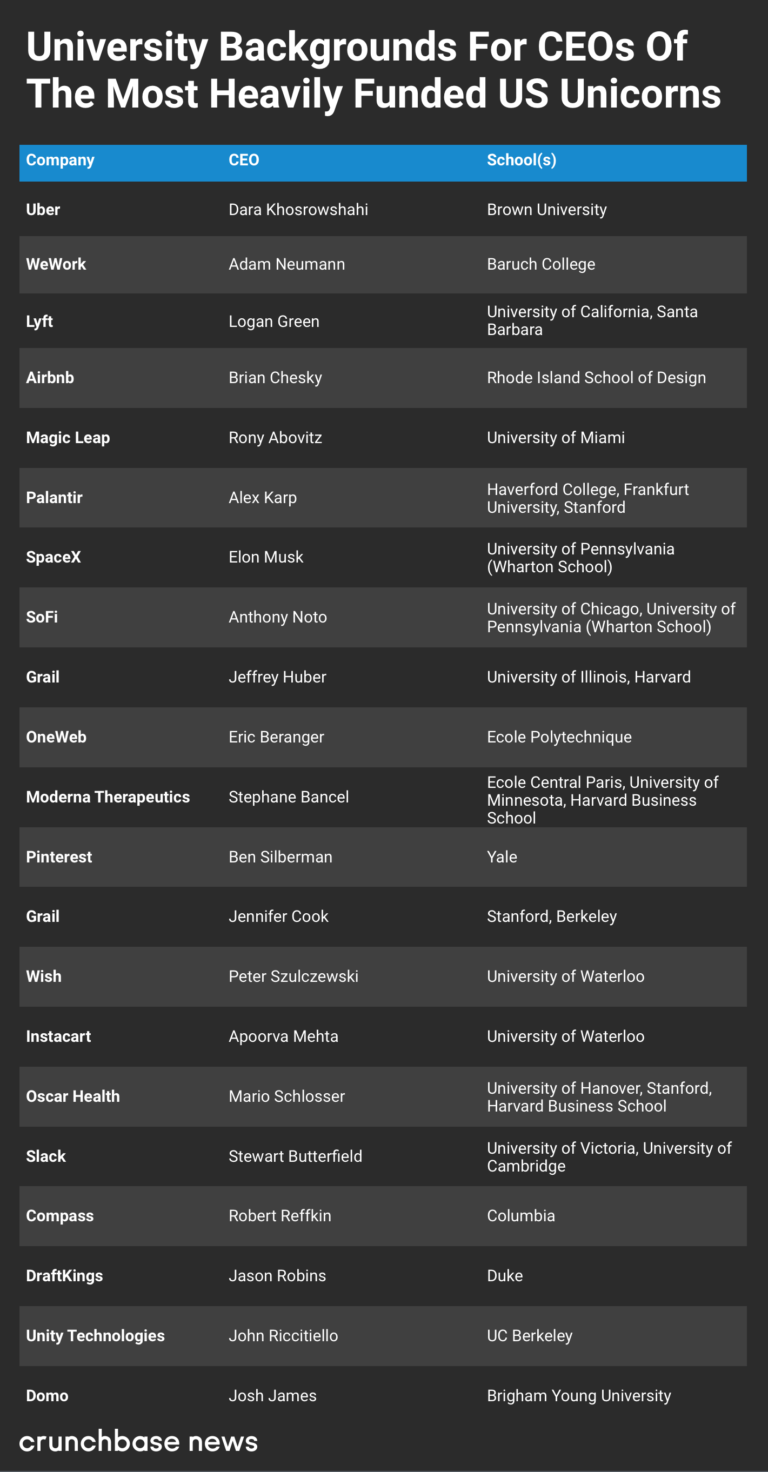
One surprise finding from the U.S. startup data set was the prevalence of Canadian university grads. Three CEOs on the list are alums of the University of Waterloo. Others attended multiple well-known universities. The list also offers fresh proof that it’s not necessary to graduate from college to raise billions. WeWork CEO Adam Neumann just finished his degree last year, 15 years after he started. That didn’t stop the co-working giant from securing more than $7 billion in venture and growth financing.

  1. Several CEOs attended more than one university on the list.


from TechCrunch https://ift.tt/2s5rnxB
via IFTTT

Comments

Popular posts from this blog

The Silent Revolution of On-Device AI: Why the Cloud Is No Longer King

Introduction For years, artificial intelligence has meant one thing: the cloud. Whether you’re asking ChatGPT a question, editing a photo with AI tools, or getting recommendations on Netflix — those decisions happen on distant servers, not your device. But that’s changing. Thanks to major advances in silicon, model compression, and memory architecture, AI is quietly migrating from giant data centres to the palm of your hand. Your phone, your laptop, your smartwatch — all are becoming AI engines in their own right. It’s a shift that redefines not just how AI works, but who controls it, how private it is, and what it can do for you. This article explores the rise of on-device AI — how it works, why it matters, and why the cloud’s days as the centre of the AI universe might be numbered. What Is On-Device AI? On-device AI refers to machine learning models that run locally on your smartphone, tablet, laptop, or edge device — without needing constant access to the cloud. In practi...

Apple’s AI Push: Everything We Know About Apple Intelligence So Far

Apple’s WWDC 2025 confirmed what many suspected: Apple is finally making a serious leap into artificial intelligence. Dubbed “Apple Intelligence,” the suite of AI-powered tools, enhancements, and integrations marks the company’s biggest software evolution in a decade. But unlike competitors racing to plug AI into everything, Apple is taking a slower, more deliberate approach — one rooted in privacy, on-device processing, and ecosystem synergy. If you’re wondering what Apple Intelligence actually is, how it works, and what it means for your iPhone, iPad, or Mac, you’re in the right place. This article breaks it all down.   What Is Apple Intelligence? Let’s get the terminology clear first. Apple Intelligence isn’t a product — it’s a platform. It’s not just a chatbot. It’s a system-wide integration of generative AI, machine learning, and personal context awareness, embedded across Apple’s OS platforms. Think of it as a foundational AI layer stitched into iOS 18, iPadOS 18, and m...

Billionaire clothing dynasty heiress launches Everybody & Everyone to make fashion sustainable

Veronica Chou’s family has made its fortune at the forefront of the fast fashion business through investments in companies like Michael Kors and Tommy Hilfiger . But now, the heiress to an estimated $2.1 billion fortune is launching her own company, Everybody & Everyone , to prove that the fashion industry can be both environmentally sustainable and profitable. There’s no argument about the negative impacts of the fashion industry on the environment. The textiles industry primarily uses non-renewable resources — on the order of 98 million tons per year. That includes the oil to make synthetic fibers, fertilizers to grow cotton, and toxic chemicals to dye, treat, and produce the textiles used to make clothes. The greenhouse gas footprint from textiles production was roughly 1.2 billion tons of CO2 equivalent in 2015 — more than all international flights and maritime shipments combined (and a lot of those maritime shipments and international flights were hauling clothes). The lit...