
Amazon gets into the blockchain with Quantum Ledger Database & Managed Blockchain

Amazon last year dismissed the idea of getting into the blockchain with AWS, but today that’s changed. The company announced a new service called Amazon Quantum Ledger Database or QLDB, which is a fully managed ledger database with a central trusted authority. The service, which is launching into preview today, offers an append-only, immutable journal that tracks the history of all changes, Amazon said.

And all the changes are cryptographically chained and verifiable.

The company announced the product on stage today at AWS:ReInvent, noting QLDB’s other features – including its transparent nature, ability to automatically scale up or down as needed, ease of use, and speed. The database can execute two to three times more transactions, Amazon claimed, compared with existing products.

It also announced a managed blockchain service.
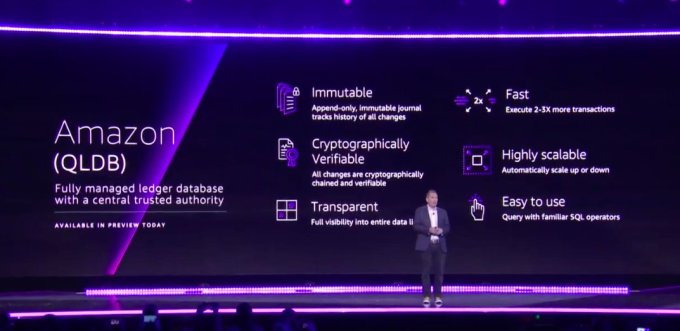
“It will be really scalable, you’ll have a much more flexible and robust set of APIs for you to make any kind of changes or adjustments to the ledger database,” said Andy Jassy, AWS CEO, in describing the new QLDB offering.

On the QLDB website, Amazon explains the new database in more depth:

Amazon QLDB is a new class of database that eliminates the need to engage in the complex development effort of building your own ledger-like applications. With QLDB, your data’s change history is immutable – it cannot be altered or deleted – and using cryptography, you can easily verify that there have been no unintended modifications to your application’s data. QLDB uses an immutable transactional log, known as a journal, that tracks each application data change and maintains a complete and verifiable history of changes over time. QLDB is easy to use because it provides developers with a familiar SQL-like API, a flexible document data model, and full support for transactions. QLDB is also serverless, so it automatically scales to support the demands of your application. There are no servers to manage and no read or write limits to configure. With QLDB, you only pay for what you use.

QLDB was one of AWS’ blockchain-related announcements today. The company also debuted AWS Managed Blockchain, which can work with QLDB. (More on that here).

“Amazon Managed Blockchain is a fully managed service that allows you to set up and manage a scalable blockchain network with just a few clicks,” Amazon said in an announcement. The product eliminates the overhead required to create the network and automatically scales to meet the demands of thousands of applications running millions of transactions, it said.

It also manages your certificates, lets you easily invite new members to join the network, and tracks operational metrics such as usage of compute, memory, and storage resources.

Managed Blockchain is able to replicate an immutable copy of your blockchain network activity into Amazon Quantum Ledger Database (QLDB), which lets you analyze the network activity outside the network and gain insights into trends.

Interested customers can sign up for Amazon Managed Blockchain preview here.

And those with applications that need an immutable and verifiable ledger database can try out Amazon QLDB here.

more AWS re:Invent 2018 coverage


from TechCrunch https://ift.tt/2P23gIN
via IFTTT

Comments

Popular posts from this blog

The Silent Revolution of On-Device AI: Why the Cloud Is No Longer King

Introduction For years, artificial intelligence has meant one thing: the cloud. Whether you’re asking ChatGPT a question, editing a photo with AI tools, or getting recommendations on Netflix — those decisions happen on distant servers, not your device. But that’s changing. Thanks to major advances in silicon, model compression, and memory architecture, AI is quietly migrating from giant data centres to the palm of your hand. Your phone, your laptop, your smartwatch — all are becoming AI engines in their own right. It’s a shift that redefines not just how AI works, but who controls it, how private it is, and what it can do for you. This article explores the rise of on-device AI — how it works, why it matters, and why the cloud’s days as the centre of the AI universe might be numbered. What Is On-Device AI? On-device AI refers to machine learning models that run locally on your smartphone, tablet, laptop, or edge device — without needing constant access to the cloud. In practi...

Apple’s AI Push: Everything We Know About Apple Intelligence So Far

Apple’s WWDC 2025 confirmed what many suspected: Apple is finally making a serious leap into artificial intelligence. Dubbed “Apple Intelligence,” the suite of AI-powered tools, enhancements, and integrations marks the company’s biggest software evolution in a decade. But unlike competitors racing to plug AI into everything, Apple is taking a slower, more deliberate approach — one rooted in privacy, on-device processing, and ecosystem synergy. If you’re wondering what Apple Intelligence actually is, how it works, and what it means for your iPhone, iPad, or Mac, you’re in the right place. This article breaks it all down.   What Is Apple Intelligence? Let’s get the terminology clear first. Apple Intelligence isn’t a product — it’s a platform. It’s not just a chatbot. It’s a system-wide integration of generative AI, machine learning, and personal context awareness, embedded across Apple’s OS platforms. Think of it as a foundational AI layer stitched into iOS 18, iPadOS 18, and m...

Max Q: Anomalous

Hello and welcome back to Max Q! Last week wasn’t the most successful for spaceflight missions. We’ll get into that a bit more below. In this issue: First up, a botched launch from Virgin Orbit… …followed by one from ABL Space Systems News from Rocket Lab, World View and more Virgin Orbit’s botched launch highlights shaky financial future After Virgin Orbit’s launch failure last Monday, during which the mission experienced an  “anomaly” that prevented the rocket from reaching orbit, I went back over the company’s financials — and things aren’t looking good. For Virgin Orbit, this year has likely been completely turned on its head. The company was aiming for three launches this year, but everything will remain grounded until the cause of the anomaly has been identified and resolved. It’s unclear how long that will take, but likely at least three months. Add this delay to Virgin’s dwindling cash reserves and you have a foundation that’s suddenly much shakier than before. ...