At least a hundred U.S. counties, towns, and cities have bought China-made surveillance systems that the U.S. government has linked to human rights abuses, according to contract data seen by TechCrunch.
Some municipalities have spent tens of thousands of dollars or more to buy surveillance equipment made by two Chinese technology companies, Hikvision and Dahua, after the companies were added to the U.S. government’s economic backlist in 2019 after the companies were linked to China’s ongoing efforts to suppress ethnic minorities in Xinjiang, where most Uighur Muslims live. Congress also banned U.S. federal agencies from buying new Hikvision and Dahua technology or renewing contracts over fears that it could help the Chinese government to conduct espionage.
But those federal actions broadly do not apply at the state and city level, allowing local governments to buy these China-made surveillance systems — including video cameras and thermal imaging scanners — largely uninhibited, so long as federal funds are not used to buy the equipment.
Details of the contracts were provided by GovSpend, which tracks federal and state government spending, to TechCrunch via IPVM, a leading news publication on video surveillance, which has followed the Hikvision and Dahua bans closely.
The biggest spender, according to the data and as previously reported by IPVM, showed that the Board of Education in Fayette County, Georgia spent $490,000 in August 2020 on dozens of Hikvision thermal cameras, used for temperature checks at its public schools.
A statement provided by Fayette County Public Schools spokesperson Melinda Berry-Dreisbach said the cameras were purchased from its longtime security vendor, authorized dealer for Hikvision. The statement did not address whether the Board of Education was aware of Hikvision’s links to human rights abuses. Berry-Dreisbach did not respond to our follow-up questions.
IPVM research found many thermal scanners, including Hikvision and Dahua models, produced inaccurate readings, prompting the U.S. Food and Drug Administration to issue a public health alert warning that misreported readings could present “potentially serious public health risks.”
Nash County in North Carolina, which has a population of 95,000 residents, spent more than $45,000 between September and December 2020 to buy Dahua thermal cameras. County Manager Zee Lamb forwarded emails that confirmed the purchases and that the gear was deployed at the county’s public schools, but did not comment.
The data also shows that the Parish of Jefferson in Louisiana, which includes part of the city of New Orleans, spent $35,000 on Hikvision surveillance cameras and video storage between October 2019 and September 2020. A parish spokesperson did not comment.
Only one municipality we contacted addressed the links between the technology they bought and human rights abuses. Kern County in California spent more than $15,000 on Hikvision surveillance cameras and video recording equipment in June 2020 for its probation department offices. The contract data showed a local vendor, Tel Tec Security, supplied the Hikvision technology to the county.
Ryan Alsop, chief administrative officer for Kern County, said he was “not familiar at all with the issues you’re referencing with regard to Hikvision,” when asked about Hikvision’s links to human rights abuses.
“Again, we didn’t contract with Hikvision, we contracted with Tel Tec Security,” said Alsop.
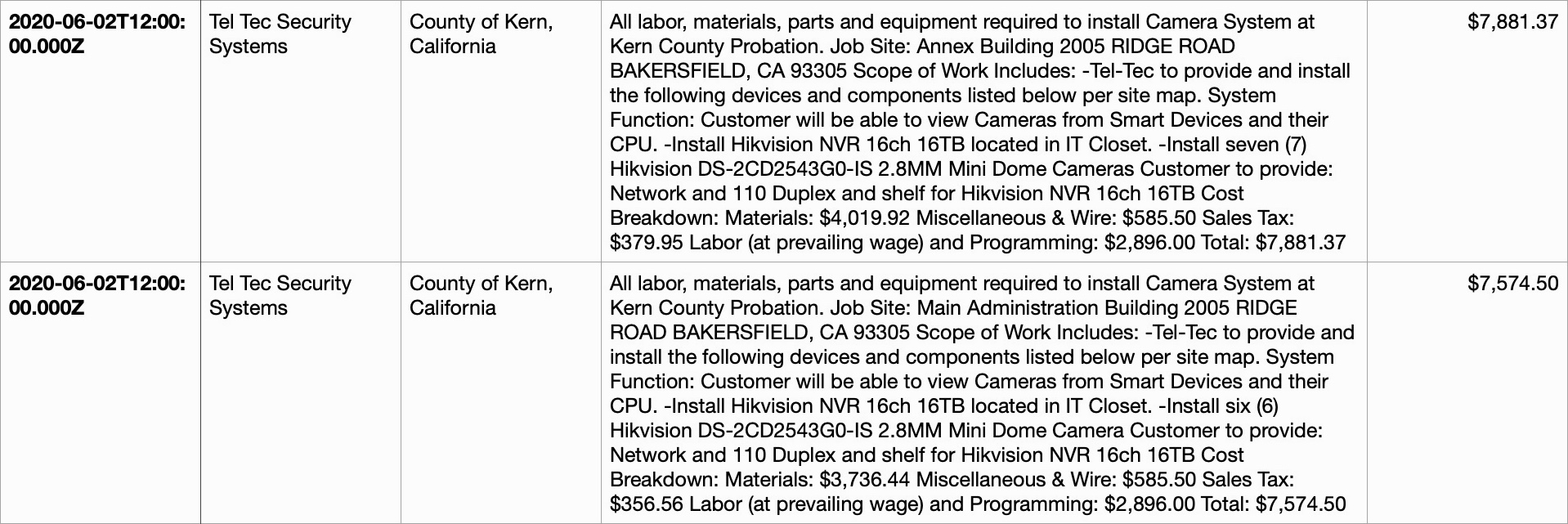
Kern County spent more than $15,000 on Hikvision equipment at its county probation service offices. (Data: GovSpend/supplied)
A spokesperson for the City of Hollywood in Florida, which spent close to $30,000 on Hikvision thermal cameras, said the Chinese technology maker “was the only major manufacturer with a viable solution that was ready for delivery; would serve the defined project scope; and was within the project budget.” The cameras were used to take employees’ body temperatures to curb the spread of COVID-19. The spokesperson did not address the links to human rights abuses but noted that the federal ban did not apply to the city.
Maya Wang, a senior researcher at Human Rights Watch, said a lack of privacy regulations at the local level contributed to municipalities buying this technology.
“One of the problems is that these kinds of cameras, regardless of the country of origin and regardless of whether or not they’re even linked to human rights abuses, have been introduced to various parts of the country — especially at state and city levels — without any kind of regulation to ensure that they comply with privacy standards,” said Wang in a call. “There is, again, no kind of regulatory framework to vet the companies based on their track record, whether or not they have abused human rights in their practices, such that we can evaluate or choose better companies, and encourage the ones with better privacy protections to win, essentially.”
Chief among the U.S. government’s allegations are that Beijing has relied heavily on Hikvision, Dahua, and others to supply the surveillance technology it uses to monitor the Uighur population as part of the government’s ongoing efforts to suppress the ethnic group, which it has repeatedly denied.
United Nations watchdogs say Beijing has detained more than a million Uighurs in internment camps in recent years as part of these efforts, which led to the U.S. blacklisting of the two surveillance technology makers.
In adding the companies to the government’s economic blacklist, the Commerce Department said Hikvision and Dahua “have been implicated in human rights violations and abuses in the implementation of China’s campaign of repression, mass arbitrary detention, and high-technology surveillance against Uighurs, Kazakhs, and other members of Muslim minority groups.” The Biden administration called the human rights abuses a “genocide.”
IPVM has also reported extensively on how the companies’ surveillance technology has been used to suppress the Uighurs. Dahua was found to have race detection in its code for providing “real-time Uighur warnings” to police.
Earlier this year, the Thomson Reuters Foundation found half of London’s councils and the largest 20 U.K. cities were using the technology linked to Uighur abuses. The Guardian also found that Hikvision surveillance technology was used in U.K. schools.
When reached, Dahua pointed to a blog post with a statement, and claimed that “contrary to some reporting in the media, our company has never developed any technology or solution that seeks to target a specific ethnic group.” The statement added: “Claims to the contrary are simply false and we are aware of no evidence that has ever been put forward to support such claims.”
Hikvision did not respond to a request for comment.
Send tips securely over Signal and WhatsApp to +1 646-755-8849. You can also send files or documents using our SecureDrop. Learn more.
from TechCrunch https://ift.tt/3bOzSnF
via IFTTT
Comments
Post a Comment