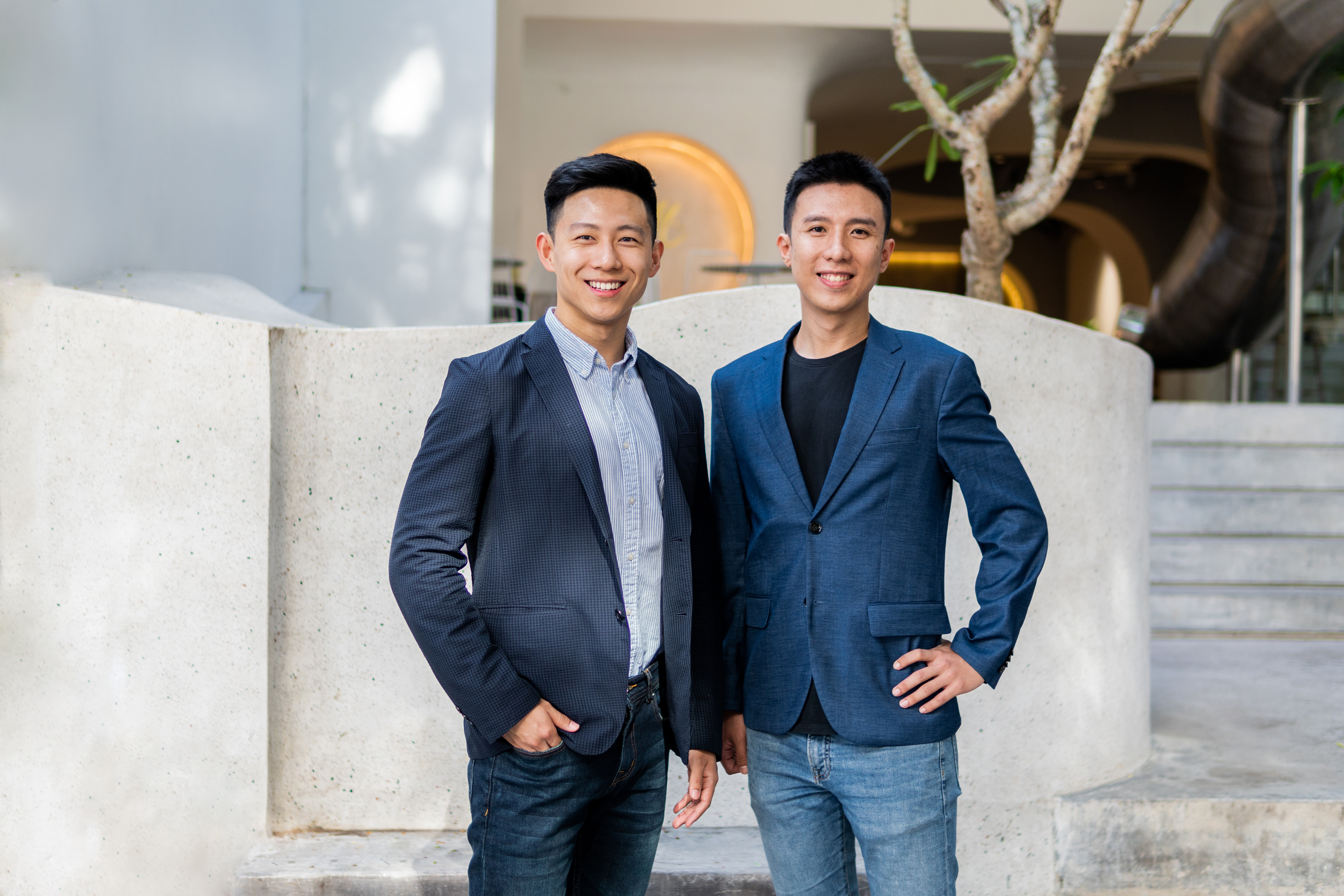
Homebase co-founders Phillip An and Junyuan Tan
The home ownership rate in Vietnam is about 90%, but many millennials are struggling to join that number. Rising property prices in cities, coupled with a lack of financing options, mean more people have to delay buying their first homes unless they have family support.
Part of Y Combinator’s latest batch, Homebase was founded in 2019 to give prospective buyers in Vietnam an alternative to traditional financing. Homebase acts as a co-investor, buying a share of property with customers, who then have the option of purchasing equity from Homebase until they take full ownership, or selling the property for their portion of the proceeds. In the meantime, buyers pay rent to Homebase that corresponds to the company’s stake, and have full usage rights to the home, so they can live in or rent it.
Co-founders Junyuan Tan and Phillip An originally started Homebase in Singapore, but decided to focus on Vietnam because Tan had lived there while working on his previous startups, RePrice Technologies and Atlantis Lab. Tan wanted to buy a home, but found bank mortgages charged high interest rates even on short-term loans.
“If you look at the whole of Southeast Asia, compared to Europe or the U.S., there are really no other solutions, like government schemes or rent-to-own financing solutions,” Homebase chief operating officer Phillip An told TechCrunch.
Its model is similar to Divvy Homes and ZeroDown in the United States and, in fact, leaders from both startups have invested in Homebase (Divvy Homes co-founder Brian Ma and ZeroDown’s former COO Troy Steckenrider). Homebase’s other backers include VinaCapital Ventures, Class 5 Global, Pegasus Technology Ventures, 1982 Ventures, Antler and Darius Cheung, the founder and CEO of 99.co.
Most of Homebase’s transactions are currently in Ho Chi Minh City and Saigon, and it plans to expand into Hanoi and Danang by the end of this year. Ultimately, Homebase’s goal is to enter other Southeast Asian markets where home owners also face a dearth of financing options, like Singapore, Thailand and Indonesia.
In Vietnam, about 70% of adults are “unbanked,” meaning they don’t have a bank account, which makes it difficult to apply for mortgages. An said some of Homebase’s customers use the service because they are unbanked. Other customers have financial accounts, but see Homebase as a faster, more flexible option to bank loans.
Its contracts range from one to 10 years, and at the end, customers have the option of buying all the equity in the property or selling it with Homebase to get back their investment. The amount of equity customers buy at the start also varies. For example, home buyers who are using Homebase as an alternative to mortgages typically take an initial 20% to 30% stake in the property, while real estate investors often start with a 50% stake.
Homebase finances its stake in properties in part by working with third-party financial institutions, including private high-net worth individuals and family offices who see it as an opportunity to diversify their holdings into a new asset class. An said the company is also talking to different types of funds, including equity, hedge, real estate debt and emerging market debt, from Europe, the United States and Singapore.
To screen applicants, Homebase has an internal checklist and onboarding process, and it also works with real estate agents, developers and other partners in Vietnam.
For those third parties, Homebase serves as a value-add tool that helps them close more deals by providing a way for customers to get financing. Homebase also performs due diligence on potential properties, including examining documentation and permits, and has built an asset valuation model based on existing property data, transaction data and information from developers.
An said this valuation service, which Homebase is expanding, is a key part of the business because it provides assurance to buyers that the company’s incentives are aligned with theirs.
“We stand to risk our investment, too,” he said. “Many customers are also first-time buyers and they want more help to find a good property.”
from TechCrunch https://ift.tt/2NSWcn9
via IFTTT
Comments
Post a Comment