
A new Android bug, Strandhogg 2.0, lets malware pose as real apps and steal user data

Security researchers have found a major vulnerability in almost every version of Android, which lets malware imitate legitimate apps to steal app passwords and other sensitive data.

The vulnerability, dubbed Strandhogg 2.0 (named after the Norse term for a hostile takeover) affects all devices running Android 9.0 and earlier. It’s the “evil twin” to an earlier bug of the same name, according to Norwegian security firm Promon, which discovered both vulnerabilities six months apart. Strandhogg 2.0 works by tricking a victim into thinking they’re entering their passwords on a legitimate app while instead interacting with a malicious overlay. Strandhogg 2.0 can also hijack other app permissions to siphon off sensitive user data, like contacts, photos, and track a victim’s real-time location.

The bug is said to be more dangerous than its predecessor because it’s “nearly undetectable,” Tom Lysemose Hansen, founder and chief technology officer at Promon, told TechCrunch.

The good news is that Promon said it has no evidence that hackers have used the bug in active hacking campaigns. The caveat is that there are “no good ways” to detect an attack. Fearing the bug could still be abused by hackers, Promon delayed releasing details of the bug until Google could fix the “critical”-rated vulnerability.

A spokesperson for Google told TechCrunch that the company also saw no evidence of active exploitation. “We appreciate the work of the researchers, and have released a fix for the issue they identified.” The spokesperson said Google Play Protect, an app screening service built-in to Android devices, blocks apps that exploit the Strandhogg 2.0 vulnerability.

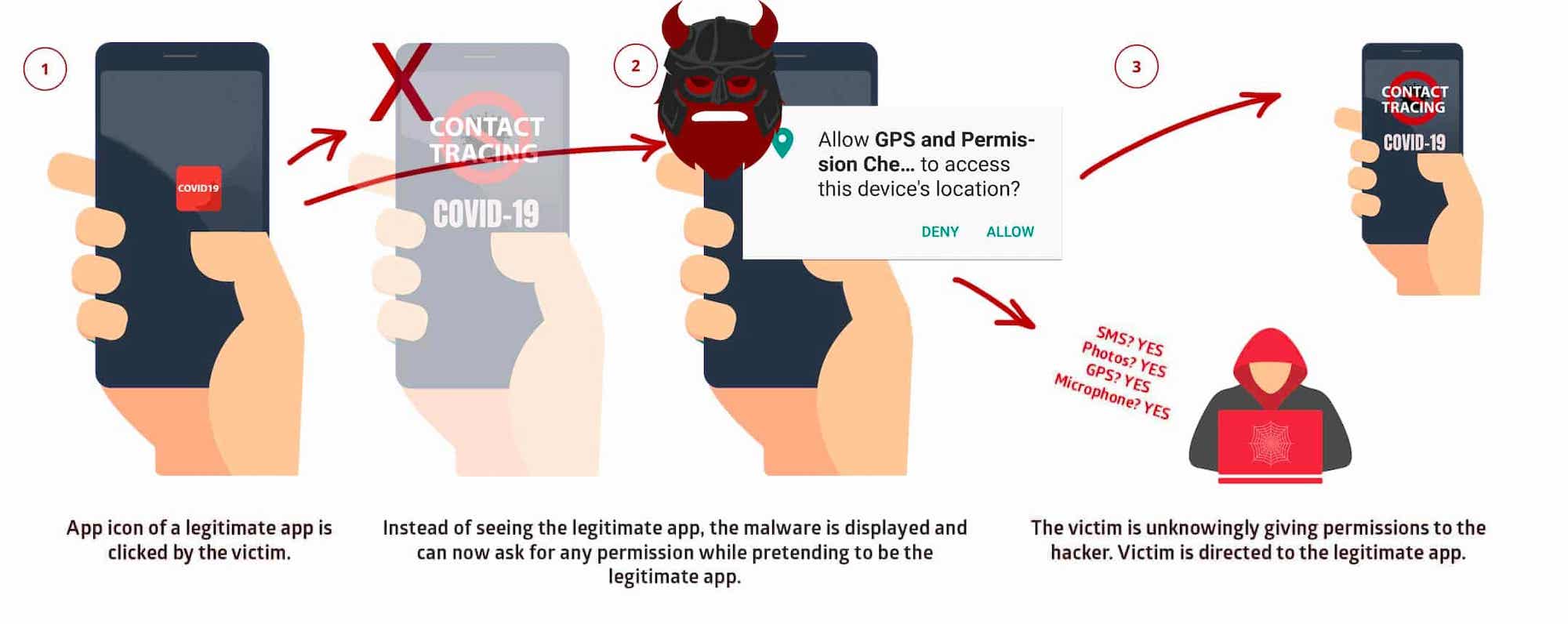
Standhogg 2.0 works by abusing Android’s multitasking system, which keeps tabs on every recently opened app so that the user can quickly switch back and forth. A victim would have to download a malicious app — disguised as a normal app — that can exploit the Strandhogg 2.0 vulnerability. Once installed and when a victim opens a legitimate app, the malicious app quickly hijacks the app and injects malicious content in its place, such as a fake login window.

When a victim enters their password on the fake overlay, their passwords are siphoned off to the hacker’s servers. The real app then appears as though the login was real.

Strandhogg 2.0 doesn’t need any Android permissions to run, but it can also hijack the permissions of other apps that have access to a victim’s contacts, photos, and messages by triggering a permissions request.

“If the permission is granted, then the malware now has this dangerous permission,” said Hansen.

Once that permission is granted, the malicious app can upload data from a user’s phone. The malware can upload entire text message conversations, said Hansen, allowing the hackers to defeat two-factor authentication protections.

The risk to users is likely low, but not zero. Promon said updating Android devices with the latest security updates — out now — will fix the vulnerability. Users are advised to update their Android devices as soon as possible.


from TechCrunch https://ift.tt/2X3jWa8
via IFTTT

Comments

Popular posts from this blog

The Silent Revolution of On-Device AI: Why the Cloud Is No Longer King

Introduction For years, artificial intelligence has meant one thing: the cloud. Whether you’re asking ChatGPT a question, editing a photo with AI tools, or getting recommendations on Netflix — those decisions happen on distant servers, not your device. But that’s changing. Thanks to major advances in silicon, model compression, and memory architecture, AI is quietly migrating from giant data centres to the palm of your hand. Your phone, your laptop, your smartwatch — all are becoming AI engines in their own right. It’s a shift that redefines not just how AI works, but who controls it, how private it is, and what it can do for you. This article explores the rise of on-device AI — how it works, why it matters, and why the cloud’s days as the centre of the AI universe might be numbered. What Is On-Device AI? On-device AI refers to machine learning models that run locally on your smartphone, tablet, laptop, or edge device — without needing constant access to the cloud. In practi...

Apple’s AI Push: Everything We Know About Apple Intelligence So Far

Apple’s WWDC 2025 confirmed what many suspected: Apple is finally making a serious leap into artificial intelligence. Dubbed “Apple Intelligence,” the suite of AI-powered tools, enhancements, and integrations marks the company’s biggest software evolution in a decade. But unlike competitors racing to plug AI into everything, Apple is taking a slower, more deliberate approach — one rooted in privacy, on-device processing, and ecosystem synergy. If you’re wondering what Apple Intelligence actually is, how it works, and what it means for your iPhone, iPad, or Mac, you’re in the right place. This article breaks it all down.   What Is Apple Intelligence? Let’s get the terminology clear first. Apple Intelligence isn’t a product — it’s a platform. It’s not just a chatbot. It’s a system-wide integration of generative AI, machine learning, and personal context awareness, embedded across Apple’s OS platforms. Think of it as a foundational AI layer stitched into iOS 18, iPadOS 18, and m...

Max Q: Anomalous

Hello and welcome back to Max Q! Last week wasn’t the most successful for spaceflight missions. We’ll get into that a bit more below. In this issue: First up, a botched launch from Virgin Orbit… …followed by one from ABL Space Systems News from Rocket Lab, World View and more Virgin Orbit’s botched launch highlights shaky financial future After Virgin Orbit’s launch failure last Monday, during which the mission experienced an  “anomaly” that prevented the rocket from reaching orbit, I went back over the company’s financials — and things aren’t looking good. For Virgin Orbit, this year has likely been completely turned on its head. The company was aiming for three launches this year, but everything will remain grounded until the cause of the anomaly has been identified and resolved. It’s unclear how long that will take, but likely at least three months. Add this delay to Virgin’s dwindling cash reserves and you have a foundation that’s suddenly much shakier than before. ...