
Memo Bank unveils its business bank, credit license and $22.5 million in new funding

Memo Bank wasn’t always called Memo Bank. It originally started as Margo Bank and it has been flying under the radar for a few years. The French startup is now about to launch publicly and shared more details about what it is building.

As the name suggests, Memo Bank is a bank. It plans to server business customers exclusively and it targets small and medium companies that generate over €2 million in annual turnover and have more than 10 employees.

Jean-Daniel Guyot, the co-founder and CEO of Memo Bank, previously founded Capitaine Train, which later became Captain Train, which later was acquired by Trainline. Capitaine Train disrupted online train ticket sales in France as the national railway company basically had a monopoly.

When you’re creating a bank, you’re also entering a highly regulated market. And Memo Bank’s team is aware of that and wants to create a barrier to entry with its competitors while providing a different service compared to legacy players.

Memo Bank is a credit institution and has obtained the proper licenses from the French regulator (ACPR) and the European Central Bank. “It’s a unique event in France, it hasn’t happened since 1970,” Guyot said in a press conference.

“You don’t build a bank in a garage with a few thousand euros,” he added in order to set his startup apart from other fintech startups.

The startup has raised a $22.5 million (€20 million) funding round from BlackFin Capital Partners, existing investor Daphni and Bpifrance. Founders Future and a ton of business angels are also joining the round — Alexis Bonillo, Antoine Martin, Marc Simoncini, Nicolas Steegmann, Oleg Tscheltzoff, Paulin Dementhon, Pierre Valade, Rachel Delacour, Sarah Meyohas, Thibaud Elzière, Xavier Niel…

The former CEO of Arkéa Ronan Le Moal is also taking a seat at the table as chairman of the board. Memo Bank had previously raised $7.6 million (€6.7 million) in 2018.
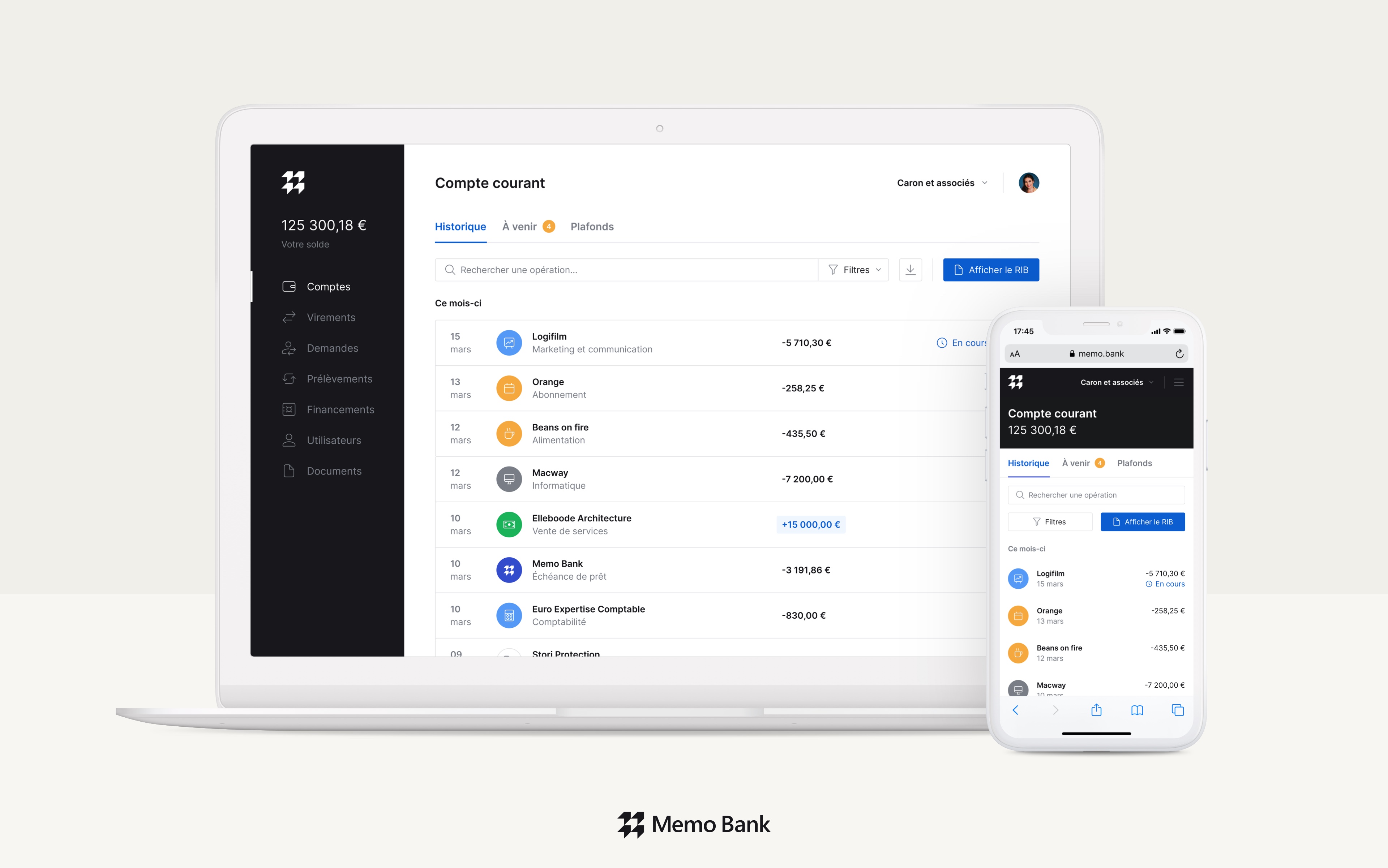
So what is Memo Bank exactly? You’ll have to wait a few months if you want to become a client. The company has developed its own core banking infrastructure and wants to offer everything you’d expect from a business bank.

It starts with a bank account that doesn’t suck. “It seems obvious but believe me it’s not,” Guyot said. Many business banks don’t let you add team members without sending a letter. Or you can’t browse transactions that are older than three months in the web interface.

But the real product is credit. Memo Bank wants to offer credit lines in just a few days without any cumbersome paperwork. Memo Bank’s biggest competitor isn’t neobanks. The startup is competing directly with online lending platforms, such as October.

At first, Memo Bank is going to accept clients in the Paris area. While the company won’t have any physical branch, it wants to be able to come and talk to you directly. It’ll expand to Lyon and then other French cities in the next years. Eventually, Memo Bank hopes it can attract 4,000 clients within four years.


from TechCrunch https://ift.tt/3fMjxzc
via IFTTT

Comments

Popular posts from this blog

The Silent Revolution of On-Device AI: Why the Cloud Is No Longer King

Introduction For years, artificial intelligence has meant one thing: the cloud. Whether you’re asking ChatGPT a question, editing a photo with AI tools, or getting recommendations on Netflix — those decisions happen on distant servers, not your device. But that’s changing. Thanks to major advances in silicon, model compression, and memory architecture, AI is quietly migrating from giant data centres to the palm of your hand. Your phone, your laptop, your smartwatch — all are becoming AI engines in their own right. It’s a shift that redefines not just how AI works, but who controls it, how private it is, and what it can do for you. This article explores the rise of on-device AI — how it works, why it matters, and why the cloud’s days as the centre of the AI universe might be numbered. What Is On-Device AI? On-device AI refers to machine learning models that run locally on your smartphone, tablet, laptop, or edge device — without needing constant access to the cloud. In practi...

Apple’s AI Push: Everything We Know About Apple Intelligence So Far

Apple’s WWDC 2025 confirmed what many suspected: Apple is finally making a serious leap into artificial intelligence. Dubbed “Apple Intelligence,” the suite of AI-powered tools, enhancements, and integrations marks the company’s biggest software evolution in a decade. But unlike competitors racing to plug AI into everything, Apple is taking a slower, more deliberate approach — one rooted in privacy, on-device processing, and ecosystem synergy. If you’re wondering what Apple Intelligence actually is, how it works, and what it means for your iPhone, iPad, or Mac, you’re in the right place. This article breaks it all down.   What Is Apple Intelligence? Let’s get the terminology clear first. Apple Intelligence isn’t a product — it’s a platform. It’s not just a chatbot. It’s a system-wide integration of generative AI, machine learning, and personal context awareness, embedded across Apple’s OS platforms. Think of it as a foundational AI layer stitched into iOS 18, iPadOS 18, and m...

Max Q: Anomalous

Hello and welcome back to Max Q! Last week wasn’t the most successful for spaceflight missions. We’ll get into that a bit more below. In this issue: First up, a botched launch from Virgin Orbit… …followed by one from ABL Space Systems News from Rocket Lab, World View and more Virgin Orbit’s botched launch highlights shaky financial future After Virgin Orbit’s launch failure last Monday, during which the mission experienced an  “anomaly” that prevented the rocket from reaching orbit, I went back over the company’s financials — and things aren’t looking good. For Virgin Orbit, this year has likely been completely turned on its head. The company was aiming for three launches this year, but everything will remain grounded until the cause of the anomaly has been identified and resolved. It’s unclear how long that will take, but likely at least three months. Add this delay to Virgin’s dwindling cash reserves and you have a foundation that’s suddenly much shakier than before. ...